

Your guide to getting started with ZoomMate
Everything you need to start using ZoomMate: notes, search, workflows, and AI tools — all inside Zoom Workplace.
Hosted VoIP is a cloud phone system managed by a third-party provider. Learn how it works, key benefits, features to look for, and how Zoom Phone can help.
 7 min read
Published on June 28, 2024



Tired of managing a phone system that demands costly hardware, vendor maintenance contracts, and a dedicated IT staff? You're not alone — and there's a better way. Enter: hosted VoIP.
Hosted voice over internet protocol (VoIP) is a cloud-based phone service managed entirely by a third-party provider. It can help cut the cost and complexity of traditional phone infrastructure while giving your team access to enterprise-grade calling, messaging, and collaboration features across supported devices.
The global VoIP services market was valued at $151.21 billion in 2024 and is projected to reach $264.27 billion by 2029, according to Research and Markets — a clear sign that businesses of all sizes are making the shift.
If you're looking for a modern, cost-efficient way to streamline business communications, hosted VoIP may be exactly what you need. This guide covers how it works, what benefits it delivers, which features often matter most, and how to choose the right service for your business.
A VoIP phone system is a piece of telephony tech that lets businesses communicate using a broadband internet connection instead of a traditional phone line.
How exactly does this work?
VoIP phone systems convert voice into digital data packets and send them over the internet. This is a much more flexible way to make calls and means you don’t need to have a physical phone line.
Hosted VoIP is a cloud-based communication technology that transmits voice calls over the internet, eliminating the need for traditional phone lines. In a hosted VoIP system, the hardware and software that support the service are managed by a third-party provider via the cloud. This means businesses don't need to invest in or maintain their own telecommunications infrastructure.
Since the service is cloud-based, you can easily add or remove users and access advanced features like conference calling, voicemail to email, and automated attendants. Hosted VoIP eliminates the need for expensive on-premise hardware and maintenance contracts, making it a cost-effective choice for businesses of all sizes. It's also ideal for flexible and remote work, as users can connect from any location with an internet connection.
Hosted VoIP helps you cut costs and more. It provides advanced features that allow you to focus on what really matters: connecting with your customers and growing your business.
Hosted VoIP works by turning your voice into digital signals and sending them over the internet.
When you make a call using hosted VoIP, your voice gets converted into packets of data, which are then sent across the internet to the recipient. Along the way, they find the best route to their destination, much like GPS guiding you through traffic. The process is fast, so you don't notice any delays or glitches. At the other end, the data is converted back into sound, and voila! You've made a call.
Since everything happens over the internet, you can use various devices to make and receive calls. It could be a traditional desk phone, a smartphone, or even a computer with a headset.
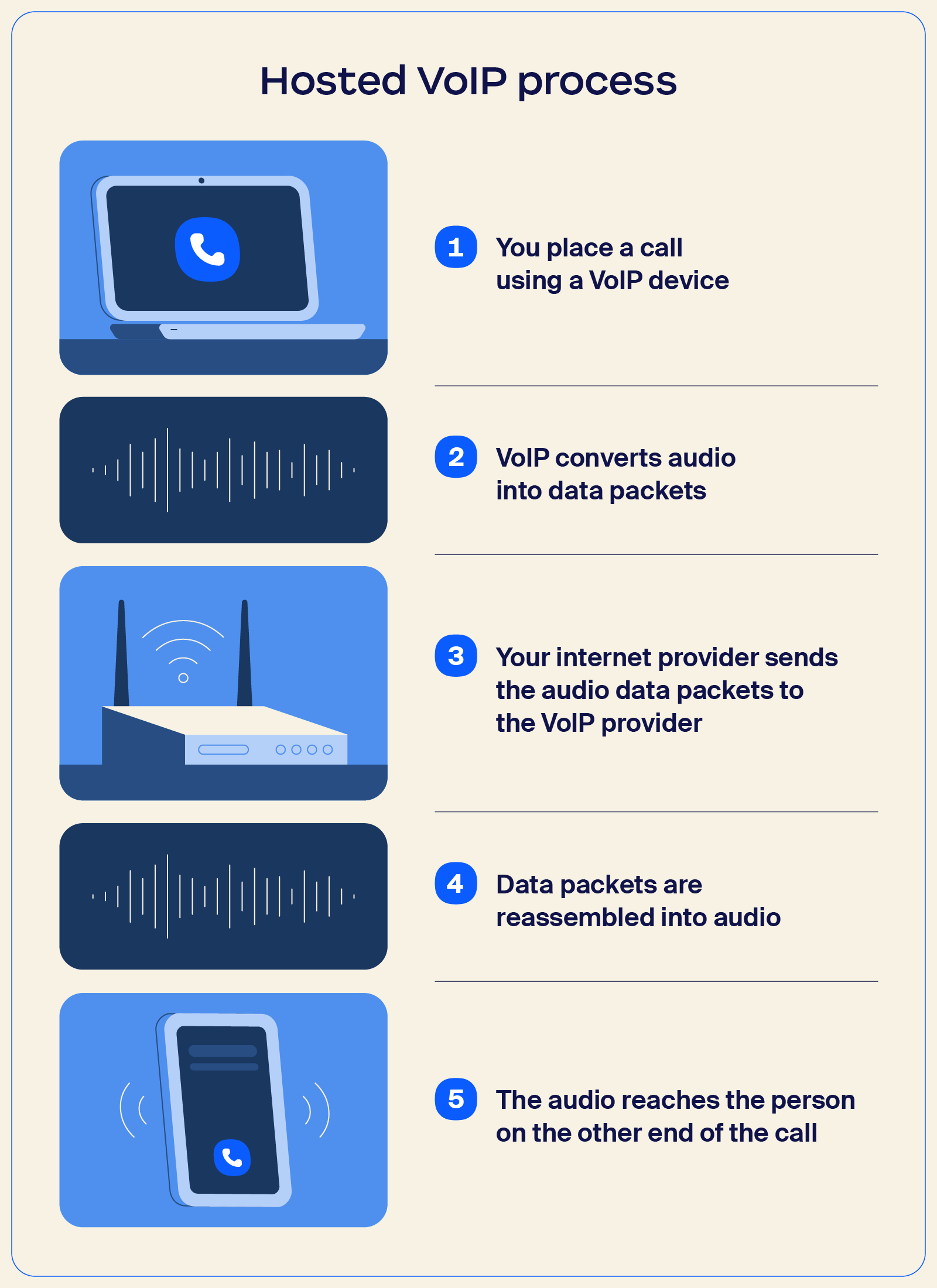
Most hosted VoIP calls require roughly 100 Kbps of upload and download bandwidth per concurrent call. A standard business broadband connection — typically 25 Mbps or higher — handles VoIP comfortably alongside other everyday tasks. For teams making many simultaneous calls, a quality of service (QoS) setting on your router helps prioritize voice traffic and maintain call quality.
Hosted VoIP offers a wealth of benefits that go far beyond upgrading your phone system to a newer technology. Let's explore how it can transform your business communication.
Hosted VoIP can reduce your monthly phone bill by offering consistent pricing and eliminating surprise long-distance charges. Plus, hosted VoIP scales easily—you only pay for what you use, making it a budget-friendly solution for businesses of all sizes.
Ditch the complex PBX systems and say goodbye to maintenance headaches. Your service provider manages the hosted VoIP system, freeing up your IT team to focus on core tasks. Automatic software updates and bug fixes keep your system always running smoothly and securely.
Boost teamwork as you easily work with other communication channels such as video conferencing and instant messaging, all seamlessly integrated within your phone system. Streamline workflows with voicemail to text, auto attendants that route calls efficiently, and call forwarding for on-the-go accessibility.
Work from anywhere with your business phone number — an internet connection lets you stay connected and productive. Choose from traditional desk phones, softphones on your computer, or mobile apps to suit your needs and preferences. This flexibility allows your team to communicate using the most convenient method for them.
Hosted VoIP means you get access to additional customer support features like voicemail, call routing, call queues, and interactive voice response (IVR) systems for free. It’s also easier to integrate with contact centers, so you can provide 24/7 support for your customers.
Hosted telephony providers prioritize your privacy with various data protection and encryption protocols. You can have confidence that call and customer information remains private with end-to-end encryption and secure data storage.
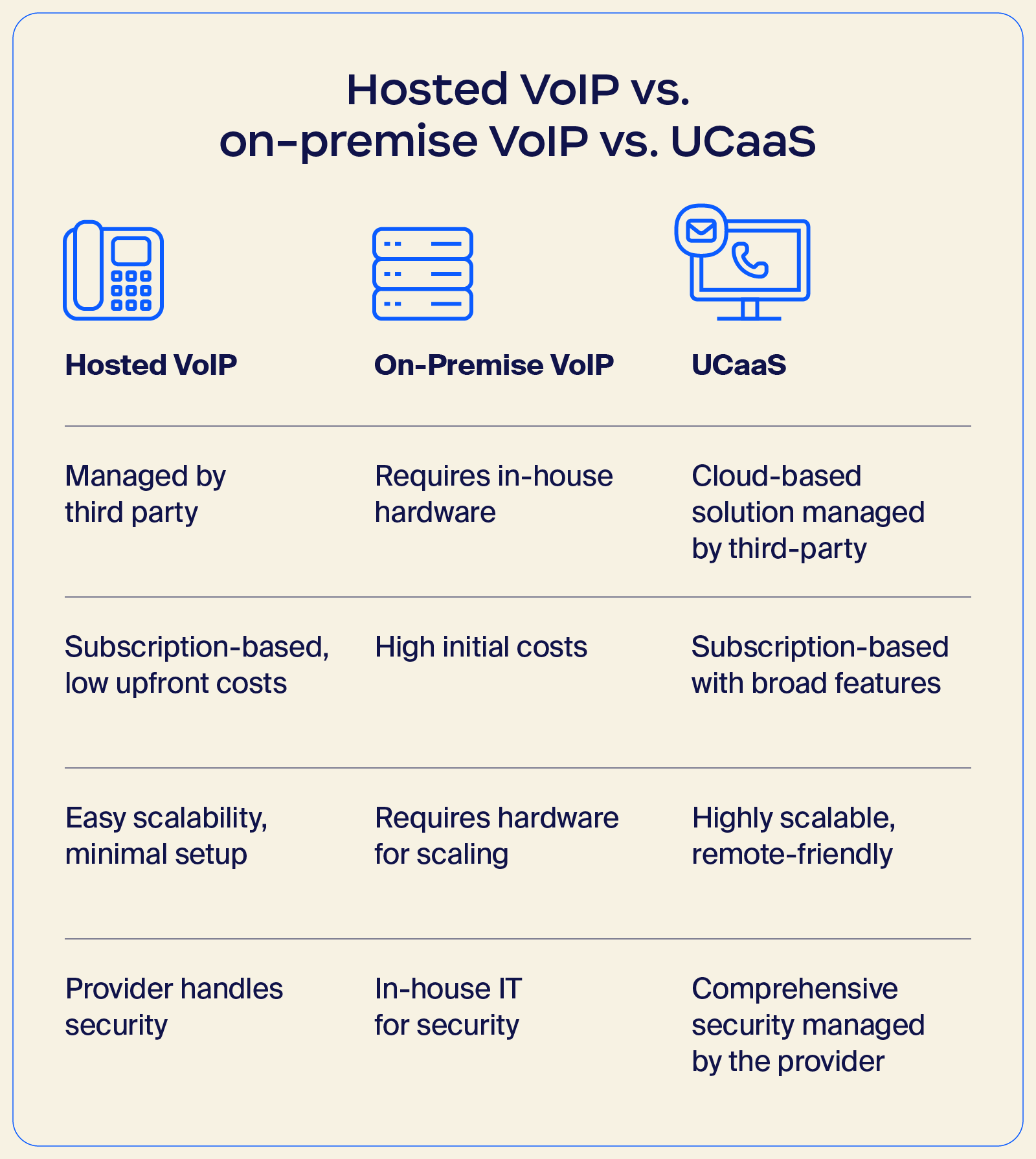
When selecting a business communication solution, the choice between hosted VoIP, on-premise VoIP, and unified communications as a service (UCaaS) comes down to where you want infrastructure to live and how much control you need. Here's a side-by-side breakdown to help you decide.
As the name suggests, on-premise VoIP involves setting up all the necessary hardware and software for your VoIP system on your business’s premises. This solution typically requires dedicated IT staff to maintain and manage the infrastructure, including servers, network equipment, and VoIP phones.
On-premise VoIP gives you greater control over your phone system but comes with higher upfront costs and ongoing maintenance requirements.
As a service-based approach to business phone systems, hosted VoIP doesn't require any physical hardware on your premises. A third-party provider handles all aspects of the system, including hosting and management, in their secure cloud infrastructure.
This eliminates the need for extensive IT staff and maintenance, allowing you to focus on business operations without worrying about maintaining a complex phone system.
Imagine running your business with a single app for all your communication needs — no more switching between video conferencing, chat platforms, and separate phone systems. That's the power of UCaaS (unified communications as a service).
Zoom excels as a UCaaS provider, offering features like crystal-clear video calls, secure messaging, and phone integration — all accessible from a single app. This simplifies communication workflows, boosts collaboration, and helps you save time for your team to focus on what matters most.
Hosted VoIP goes beyond simply making and receiving calls. It's a communication powerhouse packed with features designed to streamline your business operations and enhance collaboration. Let's delve into some of the key benefits you can expect.
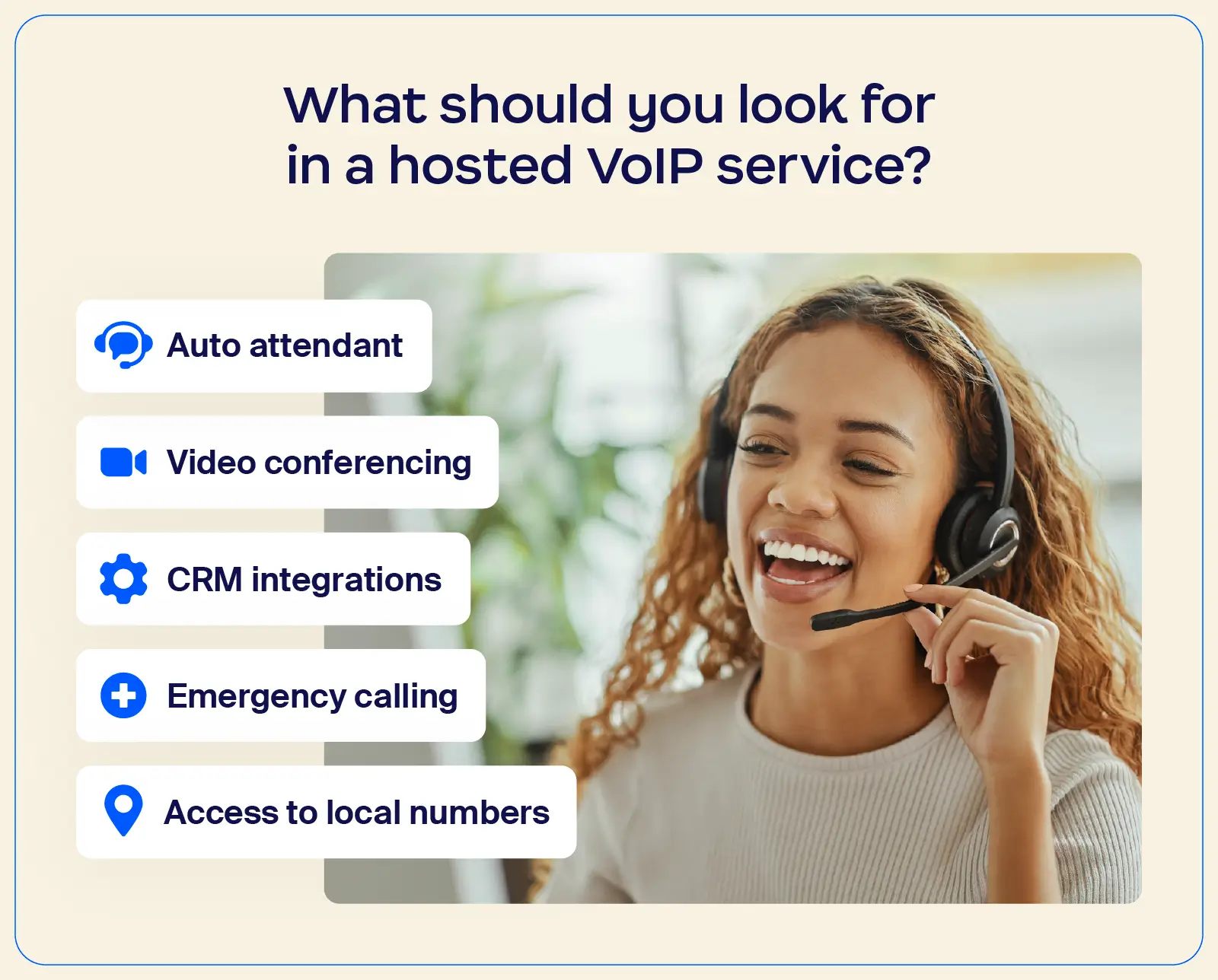
Hosted VoIP goes beyond simply making and receiving calls. It's a communication powerhouse packed with features designed to streamline your business operations and enhance collaboration. Let's delve into some of the key features you can expect.
Imagine a tireless virtual receptionist working around the clock. An auto attendant greets callers professionally, routes them to the appropriate department, and even handles after-hours messages. This helps ensure you never miss a lead or an important message while freeing up your team's time for more strategic tasks.
Keep remote workers and clients seamlessly connected with quality collaboration tools like voice and video conferencing. No matter the location, device, or time, you can keep the conversation going.
Hosted VoIP can seamlessly integrate with your existing CRM software. This means call logs, voicemail transcripts, and caller information automatically populate in your CRM, giving you a complete picture of your customer interactions and allowing you to personalize your approach.
The scalability and user-friendly management features of hosted VoIP solutions allow organizations to quickly update contact information and emergency protocols, adapting to evolving needs with minimal downtime.
Because internet access is available almost everywhere, using internet-based phone services is a dependable way to quickly and reliably contact emergency services.
Hosted VoIP allows you to acquire local phone numbers for different regions, maintaining a professional presence and making it easier for potential clients to connect with you. This is particularly valuable for businesses with a geographically dispersed customer base.
Access real-time call analytics to make more informed business decisions about how to handle customer interactions. This is a must-have feature if you’re fielding a lot of calls.
Call recording is a business essential. Recordings can be used to keep detailed records of customer interactions, train new hires and different teams, and gather general insights. Most VoIP providers charge extra for call recording, so review the fine print carefully.
Security is a top consideration when moving your business phone system to the cloud. Reputable hosted VoIP providers build protection directly into the platform. Here's what to look for:
When evaluating providers, ask specifically about their security controls, third-party attestations, and features designed to support your compliance efforts — the right provider should help your team meet the requirements relevant to your industry.
Zoom Phone is a modern, AI-first hosted VoIP solution built for businesses that want enterprise-grade reliability with less complexity.
With Zoom Phone, your team gets built-in AI features that are designed to make every call more productive: call summaries capture key points after each conversation, voicemail prioritization surfaces the messages that need attention first, and voicemail tasks pull out action items automatically so nothing important falls through the cracks. These AI features are available with eligible paid plans.
What sets Zoom Phone apart from other hosted VoIP providers:
Whether you're switching from a legacy PBX or looking for your first business phone system, Zoom Phone can offer a lower total cost of ownership and potential for faster return on investment compared to traditional phone systems. Explore Zoom Phone to see how it fits your business.
Considering a switch to hosted VoIP? Here are answers to some of the most common questions businesses ask before making the move.
Think of a PBX (private branch exchange) as the brain of your office phone system. A hosted PBX system lives in the cloud and is managed by your service provider. This eliminates the need for on-site hardware and simplifies maintenance.
While hosted VoIP is typically a component of a hosted PBX, the latter provides a more comprehensive telephony solution, often with additional business-oriented features like auto attendants and call forwarding.
While VoIP offers many benefits, it’s important to consider potential drawbacks. One is dependence on a reliable internet connection. Call quality can suffer if your internet goes down or you experience jitter. Some security concerns — such as unauthorized access to phone lines — also exist, so it’s important to choose a reputable provider with strong security measures (like Zoom).
While you can host your own VoIP system, it’s a complex undertaking. It requires technical expertise, purchasing and maintaining hardware, and ongoing software updates. For most businesses, the simplicity and cost-effectiveness of a hosted VoIP solution outweigh the challenges of self-hosting.
There are two types of VoIP: hosted VoIP and on-premise VoIP. The two differ depending on where the system lives: in the cloud or on-prem.
Cloud-hosted VoIP doesn’t require significant physical hardware. Your service provider handles everything — updates, maintenance, and system admin. Many small businesses love this hassle-free option.
On-premise VoIP requires a hardwired system located at your business, usually in a server room. You’ll need IT staff with telecom and network experience to set up, configure, and maintain this system, so it’s usually the less popular option for smaller businesses. Enterprises, or organizations with stricter security or compliance requirements, prefer on-premise VoIP because it gives them better control over setup.
Hosted VoIP costs vary between $15 and $22.49 per user per month, depending on plan tier, features, provider, and number of users. Plans are typically billed annually. This doesn’t include additional costs like setup, installation, or migration fees.
Basic managed VoIP plans typically include features like:
More advanced plans typically include features like:
For many small businesses, yes. Hosted VoIP nearly eliminates the upfront hardware costs of a traditional phone system and replaces them with a predictable monthly subscription. You get features that used to require expensive enterprise equipment — call queues, auto attendants, analytics, and mobile apps — at a fraction of the cost. And since the provider handles all maintenance and updates, you don't need dedicated IT resources to keep things running.
Switching to hosted VoIP is simpler than most businesses expect. The process typically involves: choosing a provider, porting your existing business phone numbers (most providers offer free number porting), downloading the app or configuring your IP phones, and setting up call routing rules. Many providers — including Zoom Phone — offer onboarding support to walk you through each step.
Hosted VoIP is one of the most cost-effective upgrades a business can make to its communications stack. It can reduce the maintenance burden of legacy hardware, scale with your team, and unlock advanced calling features that help everyone stay connected and productive — wherever they work.