Virtual team building: Importance, tips, and 25 ideas
Learn the importance of virtual team building and best practices for implementing it, and explore 25 fun team-building ideas for remote and hybrid teams.
Good video meeting etiquette can go a long way, whether you're meeting with customers, leaders, or your team. Here are 16 tips for an effective Zoom meeting.
Published on November 27, 2019
Everyone knows good manners are important, especially in the workplace. Coworkers who are on time, friendly, and respectful are the ones you like working with, whether in person or virtually. That’s right: Professional etiquette still applies in virtual settings, especially with recent meeting statistics showing that employees spend an average of 392 hours per year in meetings.
And with a majority of organizations currently operating in a hybrid environment (69% of mid-sized companies and at least 60% of both small and large organizations), it’s more imperative than ever to strive for good video meeting etiquette.
Reliable, easy-to-use video conferencing platforms like Zoom have helped improve the productivity and effectiveness of virtual meetings. Still, there are additional ways to help everyone get the most out of the allotted time. Here are 16 video conferencing etiquette tips for a focused and effective virtual meeting for hosts and attendees alike.
For a successful meeting, it’s helpful to get things started early. Set your meeting off on the right foot with these video meeting etiquette tips to set the stage for strong business communication during the meeting.
Before your meeting, test your tech tools to make sure everything is in tip-top shape. Leveraging high-quality tools like Zoom Meetings is a great start, but even then, you’ll want to check on connectivity, sound, and video quality to see that everything is working as it should be. This helps you avoid delays caused by last-minute issues.
Not all meetings require formal attire, especially virtual meetings, but it’s still important to present yourself appropriately, whether you’re a host or an attendee. Know your audience and work culture, and dress accordingly. This might mean dressing up a bit to meet with a client, but feeling comfortable in regular clothes for a brainstorming session with your immediate team.
Don’t go into the meeting unprepared. If you’re hosting, take time beforehand to craft a meeting agenda that keeps the team informed of what’s to come and helps them stay on task. If you’re attending a meeting, spend a few minutes reviewing the agenda so you come prepared for the day’s topics.
Meeting hosts should strive to use the highest-quality software to host meetings. This can help avoid connectivity issues, confusion, and those moments when people keep asking, “Can you hear me now?” or “Can you see my screen?”
A great option is Zoom’s meeting and team collaboration tools. Known for providing high-quality video and audio, as well as a full suite of helpful collaboration features like whiteboards and chat, Zoom can set your remote or hybrid team up for a great meeting with minimal interruptions.
You want your attendees’ focus to be on the meeting content, not your messy office or your amazing art collection. By maintaining a clean setting with work-appropriate art and decorations, you reduce the risk of attendee distraction.
You should also attend the meeting from a quiet area that has minimal background noise and movement. Zoom’s virtual background feature is an easy way to eliminate background distractions when you have to meet in a messy or busy location.
Only invite the required attendees; inviting those who don’t truly need to participate can add noise to the meeting and take up unnecessary time in people’s days. If there are stakeholders who should remain informed but don’t need to be physically present, you can send them a summary of the meeting via Zoom Team Chat.
As an invitee, review any meeting invites you receive to determine whether you actually need to attend. If not, request a recording or a summary to get the info you need.
The meeting itself is where you’ll use most of your video etiquette, since it’s where you’ll be directly interacting with others. Once the meeting has started, stay attentive and engaged. Hosts should make sure the meeting is inclusive and on track, and attendees should actively listen and participate.
If you’re looking at yourself on the screen while you’re talking, it will seem like your attention is elsewhere. Direct eye contact with the camera while speaking gives attendees the impression that you are looking at them rather than off to the side, which creates an environment where everyone feels engaged and present in the conversation.
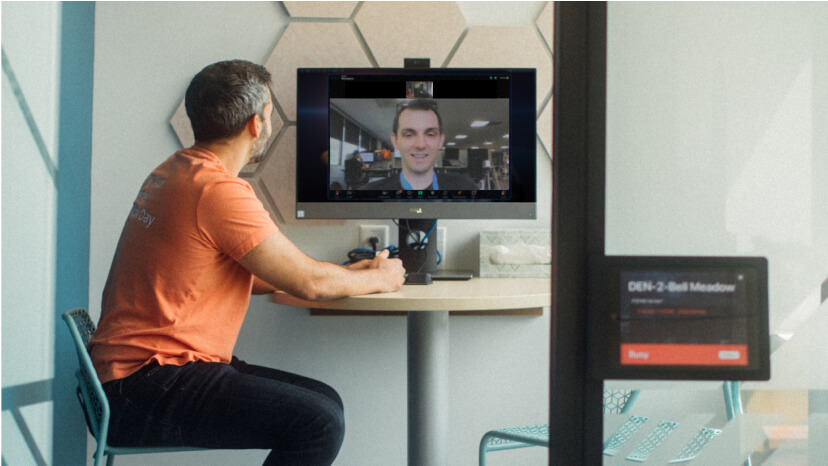
Be sure to position your webcam and monitor at eye level so you can look into the camera and simulate an eye-to-eye connection with other attendees.
No one wants to be distracted by extraneous background noise, but it’s easy to forget to keep things quiet. That’s why it’s a best practice for virtual conferences to keep your microphone muted throughout the meeting, only unmuting when it’s your turn to speak.
This will help everyone focus and keep participants from feeling embarrassed that everyone overheard them asking their pet, “Who’s a good boy?!”
Even if you’re paying close attention throughout the meeting, it can be hard to remember everything after the fact. Taking notes to reference later can help, but if you spend the meeting writing down everything, you may be less engaged overall.
Zoom’s AI features can be a big help here. Simply let My Notes capture meeting notes for you and send you a summary after the meeting, so you can stay engaged and benefit from detailed notes later.
Notifications from messaging applications, ringtones, and desktop applications can be distracting, which can make your attendees feel disrespected and undervalued. Mitigating these distractions helps keep the meeting focused and free from interruption.
The chat function can be a great benefit for large teams, allowing people to weigh in without having to fight for speaking time. However, it’s important to use it sparingly and intentionally so you don’t cause extra distractions.
As a host, consider leveraging the chat function at specific moments or for specific questions so that the team knows when and how to share. As an attendee, chat is a great place to ask questions without interrupting the speaker.
But try not to monopolize the chat or detract from the meeting’s content; instead, wait for relevant moments to share your thoughts.
Keep meetings accessible to everyone by leveraging AI features. For example, have AI create captions for the meeting so that those who are hard of hearing or have auditory processing concerns can easily follow along. You can even select specific fonts and font sizes so your attendees can easily read your caption.
In addition to simply captioning the meeting, AI can help you translate the captions to reach a global audience. This lets globally distributed teams understand the meeting in their own languages, so everyone can understand and participate as well as possible.
Ideally, meeting hosts should wait until everyone else has left the meeting before hanging up. This lets attendees leave at their own pace and get any final words in before disconnecting.
However, if the host must leave early, an alternative host should be assigned. It can help to discuss this ahead of time with a colleague who agrees to take over if you need to exit early.
Post-meeting, there are still a few best practices for effective online meetings to keep in mind. Wrap things up carefully and be sure everyone has access to the information they need to proceed with the next steps.
Use Zoom’s Meeting Summary feature to summarize the meeting and any crucial action items. Attendees no longer have to frantically take notes throughout the meeting, and everyone gets the same information about the tasks and the next steps.
Zoom’s AI features can also help you assign action items and follow-up tasks to the right people based on the key points from the meeting. Zoom Tasks can identify specific action items from the meeting, create a task list, and even help you complete them by specifying what you need to do and nudging you to do it.
Create and distribute meeting minutes as quickly as you can after the meeting, ideally within the first 24 hours. You can leverage meeting summaries and notes, as well as Zoom Templates, to make this as simple and lightweight as possible.
Good video meeting etiquette is critical to ensuring that your meetings are professional, efficient, and valuable. But effective virtual meetings require more than just good manners. You need the right tools to help the host and attendees get the most out of the meeting content and understand how to follow up afterwards.
Zoom Meetings gives you high-quality audio and video communication, plus extras like captions, translation*, and chat. Zoom’s AI helps you keep track of meeting notes, action items, and tasks, and can craft detailed meeting minutes to help keep everyone informed.
*Translated captions for meetings and webinars are included with Zoom Workplace Enterprise plans and as an add-on for paid Zoom Workplace plans.