
Your guide to getting started with ZoomMate
Everything you need to start using ZoomMate: notes, search, workflows, and AI tools — all inside Zoom Workplace.
 5 min read
Published on July 14, 2026
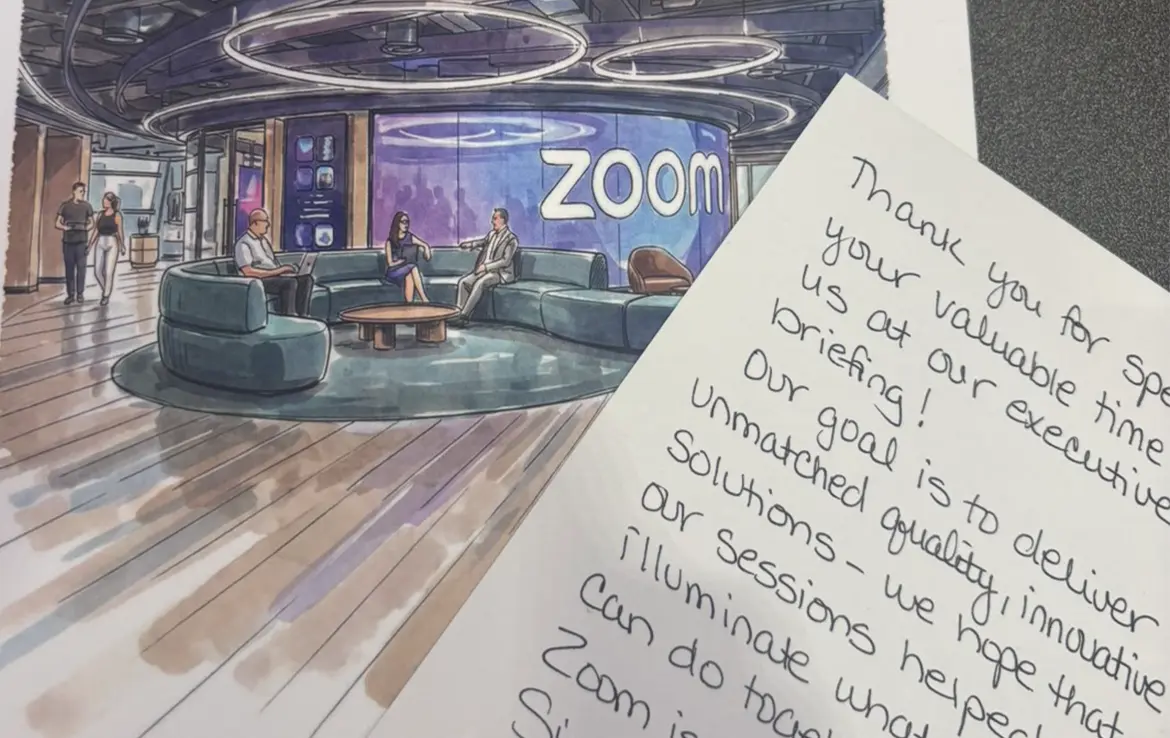



I hosted a roundtable recently at our London EBC. Senior marketing leaders, all of them running significant event programmes. Midway through, I asked a straightforward question: has anyone in this room actually solved getting meaningful feedback from events?
Nobody said yes.
Everyone collects feedback. Everyone has a post-event survey. Almost everyone admitted, once we got into it, that the data they gather rarely changes what they do next. All that feedback exists. It just doesn't connect to anything that matters.
I've come to think this is one of the most expensive blind spots in marketing. We keep trying to fix it with better survey design. The real issue is measurement architecture.
The standard post-event survey gives you a five-point rating scale, a handful of closed questions, and maybe a free-text box. Most people leave the free-text box blank. The ones who don't are disproportionately at the extremes: either thrilled or annoyed.
I think of this as the J-curve of survey responses. You hear from the edges. The middle, where most of your audience actually sits, stays quiet. So you end up with data that confirms what you already believed and misses the more interesting, more nuanced reality.
There's a politeness factor too, especially in professional settings. People are more honest in conversation than in writing. You can hear hesitation when someone speaks. You can catch the thing they almost said. A survey captures the polished, safe version.
Teams invest real hours building survey instruments and reporting dashboards. The output rarely changes what happens at the next event.
Even when teams do manage to collect useful qualitative data, there's a second problem waiting. It sits in isolation from everything else.
It doesn't connect to attribution. It doesn't feed into pipeline reporting. Nobody can tell you whether the people who loved your keynote were the same people who booked a meeting with sales three weeks later. Insights get presented at a debrief, acknowledged, filed. Then the machine moves on to the next event.
This mirrors a broader failure in marketing measurement. Research by IAB shows that up to 75% of marketing leaders consider their attribution models underperforming. Fewer than 10% of organizations say they understand their customers' journey behavior very well, according to Alterian and CX Network. Everything else is inference and assumption.
Events suffer from this more than most channels. A good event's value is relational. A conversation that shifts someone's thinking. An objection addressed in person. A prospect who arrives sceptical and leaves curious. Almost nothing about that shows up cleanly in a multi-touch attribution model. So events get undervalued, budgets get questioned, and the cycle repeats.
AI is useful here, but probably not in the way you'd expect from reading most marketing about it.
Its real contribution is making qualitative analysis possible at scale. Open-text survey responses, event transcripts, post-session conversations: these have long been rich sources of signal. They've also been too labour-intensive to process properly. AI changes that equation. Cluster analysis across hundreds of open-text responses can surface the objectives attendees actually care about, rather than the ones you assumed when you built the agenda.
Sentiment analysis is moving into event intelligence too. It's already widely used in many sales and contact centre environments. Applied to events, it lets you analyse tone and texture alongside content. Implicit feedback, not just explicit ratings.
But AI doesn't fix the structural disconnect. It won't automatically wire your event feedback into your CRM, your pipeline data, or your attribution model. That architecture has to be designed on purpose. Before the event, not after.
Twenty years in B2B demand generation taught me one thing early. If you can't connect an activity to pipeline, it will eventually lose its budget. Events are no exception.
Every event should have a defined business outcome before it launches. Qualified leads generated. Pipeline influenced. Accounts moved from one stage to the next. "Raise awareness" is not a KPI. The feedback mechanism should be designed to capture signal that connects to that outcome, rather than signal that's simply easy to collect.
The framework I keep returning to is the pre/during/post intelligence loop. Before the event: who's attending, what do they already know, what do they need to believe? During: what's landing, what isn't, in real time? After: what changed, for whom, and can you prove it? Each phase generates data. The value comes from connecting all three phases into a single picture.
At Zoom's EMEA marketing function, this was one of the first principles we put in place. No event without a defined outcome. No outcome without a measurement plan. It sounds obvious when you say it out loud. In practice, it's surprisingly uncommon.
The marketing leaders who'll get the most from their event programmes over the next few years won't necessarily be the ones running the biggest events. They'll be the ones who've built the infrastructure to understand what their events actually accomplish, and who've connected that understanding to the decisions that follow.
That's harder than building a better survey. It's also the right problem.
We're hosting a virtual follow-up session in the coming weeks, with a live demo of Zoom Events, to explore exactly this: how to build the full event intelligence loop from audience understanding through to pipeline attribution. If any of this resonates, I'd encourage you to join.