Meet Zoom AI Companion, your new AI assistant!
Boost productivity and team collaboration with Zoom AI Companion, available at no additional cost with eligible paid Zoom plans.
Call center shrinkage is the percentage of scheduled time agents are unavailable for customer interactions due to breaks, training, or other factors.
 7 min read
Updated on March 10, 2026
Published on March 10, 2026




Imagine a scenario where a team of 50 agents is scheduled to handle customer calls, but only 40 are available. The result? Longer wait times, frustrated customers, and increased pressure on the available agents. That’s the effect of call center shrinkage.
Call center shrinkage is a crucial metric that significantly impacts a call center’s efficiency. Shrinkage refers to the percentage of time agents are unavailable to handle customer interactions, even though they are scheduled to work.
Managing shrinkage in a call center effectively is vital for maintaining optimal performance, ensuring customer satisfaction, and keeping operational costs in check. In this post, we’ll learn various causes of call center shrinkage, how to calculate shrinkage, and what you can do to reduce it.
Call center shrinkage is the gap between the number of agents scheduled to work and those actually available to handle customer interactions. It’s caused by internal factors like breaks, training sessions, and meetings, as well as external factors such as unplanned absences.
This reduction in available agents can lead to inefficiencies, resulting in fewer calls being handled, longer wait times, and increased customer dissatisfaction. High shrinkage also strains agents, leading to burnout, and increases operational costs due to the need for overtime or additional staffing. Over time, unchecked shrinkage can damage a company’s reputation and erode customer trust.
Call center shrinkage is influenced by both internal and external factors that reduce available agent time. Internal causes stem from the everyday operations and management of the call center, while external causes are often beyond immediate control.

Internal factors of shrinkage are rooted in a call center’s daily activities and routines. These can include:
External factors contributing to call center shrinkage are often outside the organization’s direct control but still significantly impact performance. These factors include:
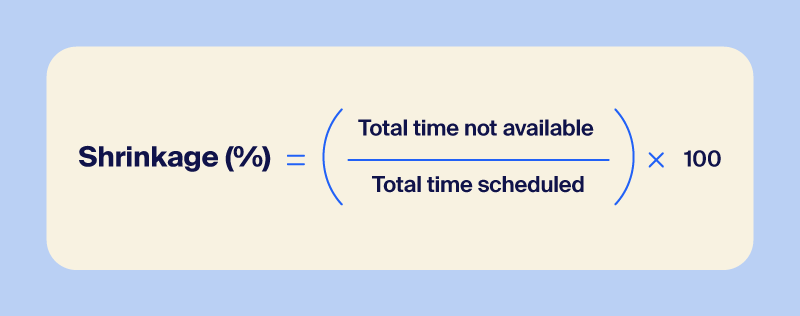
Understanding how to calculate call center shrinkage is essential for effective workforce management. The shrinkage formula is:
Shrinkage (%) = (Total time not available / Total time scheduled) × 100
This formula takes into account the total time agents are not available to handle calls divided by the total time they were scheduled to work. By multiplying this ratio by 100, you get the shrinkage percentage, which indicates how much of your scheduled workforce is not actively engaging with customers. The lower the shrinkage percentage, the more efficient your call center generally utilizes its workforce.
To illustrate how this works in practice, consider an agent with a standard schedule of 260 working days per year and 8 hours per day, totaling 2,080 scheduled hours annually.
The table below identifies how those 2,080 hours are allocated, distinguishing between weekly recurring events and annual day-based allowances.
| Category | Hours per week | Days per year | Hours per year | Shrinkage % |
| External shrinkage | ||||
| Annual leave | — | 15 | 120 | 5.8% |
| Public | — | 10 | 80 | 3.8% |
| holidays | ||||
| Sick leave | — | 6 | 48 | 2.3% |
| Personal time off | — | 3 | 24 | 1.2% |
| Internal shrinkage | ||||
| Training sessions | 2 | 13 | 104 | 5% |
| Team meetings | 1.5 | 7.8 | 78 | 3.8% |
| One-on-one coaching | 0.5 | 2.6 | 26 | 1.3% |
| Breaks (2 x 15 min/day) | 2.5 | 13 | 130 | 6.3% |
| Administrative tasks | 1 | 5.2 | 52 | 2.5% |
| System downtime | 0.5 | 2.6 | 26 | 1.3% |
| TOTAL: | 78.2 | 688 | 33.1% |
Industry benchmarks for a “good” call center shrinkage rate typically range from 30% to 35%, but your ideal target will depend on several factors.
Contact centers with heavy email or chat volume may experience lower shrinkage than those with heavy voice volume. The main reason is that asynchronous channels offer more flexibility in agent scheduling.
Similarly, centers with robust quality assurance programs and extensive coaching requirements will naturally see higher planned shrinkage due to the time invested in agent development. Your organization’s PTO policies, seasonal patterns, and technology infrastructure also play crucial roles in determining what’s realistic.
For example, a retail contact center likely experiences higher shrinkage during holiday seasons when PTO requests peak, and an organization with outdated systems may struggle with unplanned downtime, which can further drive shrinkage.
When setting realistic shrinkage reduction goals, consider:
Planned shrinkage includes all scheduled activities that take agents away from customer interactions. You’ll know about them in advance and should be able to factor them into workforce planning. Given its predictability, workforce managers can account for it when creating schedules to ensure adequate coverage during these periods.
Unplanned shrinkage, on the other hand, represents unexpected absences and disruptions that workforce planners cannot anticipate. While some unplanned shrinkage is inevitable, excessive rates may signal other issues, like low morale or ineffective absence policies.
| Planned shrinkage | Unplanned shrinkage |
| Scheduled PTO and vacation days | Sick leave and medical appointments |
| Recurring team meetings and huddles | Family emergencies and bereavement |
| Planned training programs and certifications | System crashes and technical failures |
| Regular coaching sessions and performance reviews | Unscheduled meetings or urgent escalations |
| Mandated breaks and lunch periods | Tardiness and early departures |
| Company holidays and observances | Impromptu coaching or disciplinary discussions |
Reducing call center shrinkage requires a proactive approach to managing both internal and external factors. When you leverage the right tools and strategies, your call center can improve both efficiency and overall service quality.
Workforce management software is a powerful tool that can enhance agent scheduling, so call centers have the right number of agents available at all times. Accurately forecasting call volumes and automating shift assignments allows the software to minimize coverage gaps and unnecessary downtime.
Real-time adherence monitoring within the software also allows managers to track agents’ activities against their schedules, identifying deviations and addressing them promptly. This way, agents stay on task, further reducing shrinkage and enhancing operational efficiency.
Consolidate training sessions and schedule them during low-demand periods so agents stay available when customer demand is highest. Additionally, automating routine administrative tasks, such as data entry or reporting, frees up agents’ time, allowing them to focus more on customer interactions.
Implementing microlearning sessions that fit into agents’ daily routines allows them to complete training in shorter, manageable increments without disrupting call flow.
Reducing call volume is a strategic way to minimize shrinkage by decreasing the demand on your agents. Implementing intelligent call routing directs customer calls to the most appropriate agent or department, reducing unnecessary transfers and handling times.
Additionally, enhancing self-service options, such as interactive voice response (IVR) systems and online FAQs, empowers customers to resolve common issues without speaking to an agent.
Health and wellness programs, such as stress management workshops or gym memberships, can help reduce absenteeism and improve overall agent well-being. Encouraging leadership to foster a culture of engagement and recognition also plays a key role in keeping agents motivated and committed.
Offer flexible work schedules to accommodate employees’ personal needs, enhancing work-life balance and reducing burnout.
Integrating AI into your contact center can help significantly reduce shrinkage by automating routine tasks and enhancing operational efficiency. AI-powered tools, such as chatbots and virtual assistants, can handle a large volume of customer inquiries, freeing up human agents to focus on more complex issues. This reduces the need for agents to be constantly available, lowering the overall shrinkage rate.
AI can also assist in predictive scheduling by analyzing patterns in call volumes and agent performance, helping managers improve workforce allocation and reduce idle time.
Real-time monitoring and analytics enable managers to quickly identify and address deviations, helping agents stay on task.
Call center shrinkage measures the portion of scheduled time agents are unavailable to take calls, such as during breaks or training. For example, if an agent is scheduled for an eight-hour shift but spends two hours in training, this two-hour period contributes to shrinkage, showing the time lost due to non-call activities.
Agent utilization, on the other hand, assesses how effectively agents use their available time to handle calls. For instance, if an agent is available for six hours after accounting for breaks and training but spends only four hours actively on calls, this indicates a two-hour gap in productive time.
A well-designed contact center is crucial for operational efficiency and minimizing shrinkage. Zoom CX offers robust workforce management and quality management solutions tailored to achieve these goals. Advanced scheduling capabilities improve agent allocation, while real-time adherence monitoring enables managers to track and adjust agent availability in real time.
The software also automates administrative tasks, reducing the time agents spend on non-customer activities. Plus, intelligent call routing directs calls to the right agents.
Request a demo for Zoom CX today to see how we can help you streamline operations and ultimately reduce call center shrinkage.
Here are answers to some of the most common questions about managing and optimizing call center shrinkage.
Most well-run contact centers operate with shrinkage rates of 30% to 35%, though acceptable levels vary by operation.
A voice-heavy center with extensive training might reasonably target 32%-35%, while a chat-focused operation could aim for 25%-30%. If your shrinkage consistently exceeds 40%, investigate potential issues like excessive absenteeism or inadequate technology.
Shrinkage benchmarks vary considerably across industries due to differences in operational complexity and regulatory requirements.
Popular industry benchmarks:
High shrinkage directly impacts revenue by increasing wait times and leading to higher call abandonment. These lost interactions represent immediate revenue loss, particularly in sales environments.
Excessive shrinkage also forces organizations to hire additional agents to maintain service levels, increasing labor costs while potentially damaging customer satisfaction and lifetime value.