


Your guide to getting started with ZoomMate
Everything you need to start using ZoomMate: notes, search, workflows, and AI tools — all inside Zoom Workplace.
 12 min read
Published on April 21, 2025




Great customer support can help improve customer relationships and support business growth. According to research Zoom commissioned with Morning Consult, 26% of consumers would leave a brand after just one poor interaction. The stakes are high, and many businesses struggle to deliver the seamless, consistent service customers are looking for.
With omnichannel customer service, customers get a unified, frictionless experience, whether they contact you via phone, email, chat, or social media. Without it, support teams face disjointed interactions, longer resolution times, and frustrated customers.
In this guide, we'll break down what omnichannel customer service is, its benefits, key challenges, and how to implement it effectively so you can deliver the kind of support that can help improve customer loyalty and long-term business performance.
Omnichannel customer service is a connected, integrated approach to customer support that integrates all communication channels — phone, email, chat, social media, and more — into a single, seamless experience.
So what does omnichannel mean in practice? It means a customer can start a conversation on one channel and continue it on another without losing context — and agents have full visibility into the interaction history regardless of where it began.
Omnichannel means that all communication channels are integrated into a single platform. Unlike multichannel support, where each channel operates independently, omnichannel supports smooth conversation flows across platforms without customers having to repeat themselves.
For CX managers, this approach can lead to better efficiency, faster resolution times, and a more personalized customer experience. Agents have full visibility into past interactions, allowing them to provide relevant support while reducing friction for customers.
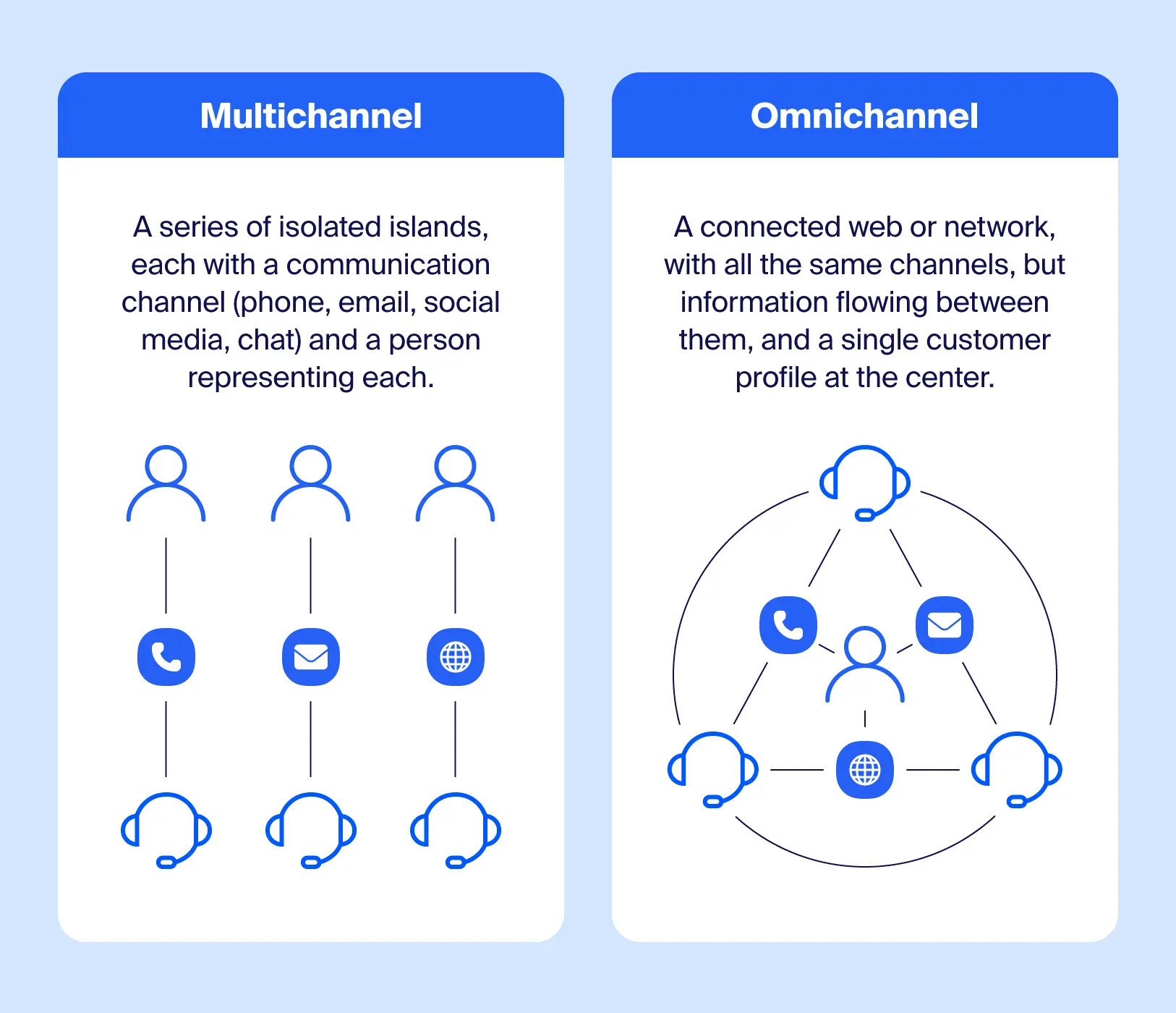
Customers expect fast, seamless support no matter how they reach out. Imagine a customer starts a conversation with a chatbot on your website, follows up via email, and later calls your support team. If each interaction exists in a silo, they'll have to repeat their issue every time — leading to frustration and wasted time.
But with an omnichannel approach, agents can see the full conversation history, enabling faster, more personalized, and frictionless support.
For businesses, this often means higher customer satisfaction, stronger brand loyalty, and increased efficiency. Omnichannel communication can help improve engagement and encourage repeat interactions.
An effective omnichannel strategy can enhance multiple touchpoints throughout the customer journey. By connecting interactions across multiple channels, businesses can create a smoother, more personalized experience that leads to higher satisfaction, better efficiency, and stronger brand consistency.
Omnichannel experiences can make contacting customer support feel effortless. When people can switch between channels without repeating themselves, they're more likely to feel valued and heard. AI-powered chatbots can handle routine inquiries while handing off complex issues to live agents, keeping responses quick and personalized. A seamless experience builds trust, often leading to higher satisfaction and long-term loyalty.
Disconnected channels can slow down resolutions. An integrated system gives agents full visibility into past conversations, enabling them to resolve issues faster without backtracking. Automating repetitive tasks like appointment scheduling or order tracking frees up agents to focus on higher-value interactions.
Inconsistent messaging can weaken brand trust. Standardized templates, centralized knowledge bases, and unified workflows help maintain service quality across chat, phone, email, and social media. When agents pull from the same knowledge base and use preset guidelines for tone and messaging, organizations can provide more consistent responses across channels.
Customer interactions generate valuable data, but siloed channels make it difficult to track preferences. An integrated system captures real-time insights, helping agents personalize support. For example, if a customer frequently asks about a product feature, agents can proactively share relevant resources, making support more helpful and engaging.
A successful omnichannel strategy connects multiple support channels into a seamless experience that can be consolidated into one view. Each channel plays a key role so customers receive fast, efficient, and personalized service.
Live chat provides real-time support for quick problem-solving, while AI-powered chatbots handle routine inquiries 24/7. Chatbots can answer FAQs, guide customers through troubleshooting, and escalate complex problems to human agents. This helps reduce agent workload and shorten response times.
Email remains a critical channel for handling detailed or non-urgent requests. A ticketing system helps organize, track, and prioritize emails so no request falls through the cracks. Automated responses can acknowledge inquiries instantly, setting clear expectations for resolution times.
Customers expect brands to be responsive on platforms like Facebook, Twitter, WhatsApp, and Instagram. Social media support enables businesses to handle public inquiries efficiently while using messaging apps for real-time conversations. Integrating these channels into a unified omnichannel system helps teams track and manage all interactions in one place.
Despite the rise of digital channels, phone support remains essential, especially for urgent or complex issues. Interactive voice response (IVR) systems help route callers to the right department or provide self-service options for quick resolutions. When integrated with other channels, phone support enables agents to pull up customer history, making conversations more efficient.
If your support team handles payments, integrating a secure payment solution can make a big difference. Many solutions connect payment methods in one place and support smooth transactions, whether customers pay over the phone, via chat, or in your app. This approach can help agents accesspayment details or address billing questions more efficiently.
Many customers prefer to find answers on their own before reaching out for support. A well-organized knowledge base with FAQs, how-to guides, and troubleshooting articles empowers customers to resolve issues independently. AI-driven search functions and personalized recommendations can make self-service even more effective, helping to reduce support requests while improving customer experience.
Building a strong omnichannel strategy requires more than just adding new support channels. It requires creating a seamless, connected experience across all customer touchpoints. Here's how to do it effectively:
Before making changes, evaluate where your current support system stands. Identify which channels you already use, which channels customers prefer, and where customers experience friction.
Analyze response times, resolution rates, and customer feedback to pinpoint gaps and figure out where customers may be getting frustrated.
Mapping the customer journey is a critical exercise for businesses — where do interactions break down or require customers to repeat themselves? Use these insights to prioritize improvements and build stronger customer experience channels.
Disconnected channels often lead to inconsistent service. Invest in a customer engagement platform that consolidates interactions across various communication channels into a single dashboard. This allows agents to access customer history instantly, reducing repetitive questions and improving response times. Look for systems that integrate with CRMs, help desks, and AI tools to create a full-picture view of every customer.
A seamless experience depends on well-trained agents who can navigate multiple channels effortlessly. Instead of siloing teams by channel, train agents to handle inquiries across different platforms with the same level of quality.
Provide hands-on training for tools like chat platforms, ticketing systems, and AI chatbots so agents can switch between them without disrupting the customer experience. Role-playing real-world scenarios can also help them practice managing complex cross-channel interactions.
When developing an omnichannel customer service strategy, create standardized responses that both human and virtual agents can apply across all channels. Without standardization, customers likely won't feel a substantial difference in quality, even if you've made major changes internally.
For example, if a customer receives different answers to the same issue from agents on text and voice channels, they may become frustrated and lose trust in your brand. Make sure all your agents have adequate training on the standard responses and lines of conversation for each issue type.
AI-driven tools can reduce workload and improve response times by handling routine inquiries, routing conversations, and providing agents with real-time insights. Implement chatbots for FAQs and basic troubleshooting, set up automated workflows for ticket prioritization, and use AI-powered sentiment analysis to detect conversational patterns that may indicate customer dissatisfaction.
Automation doesn't replace human support but enhances it, allowing agents to focus on high-value interactions that require a personal touch.
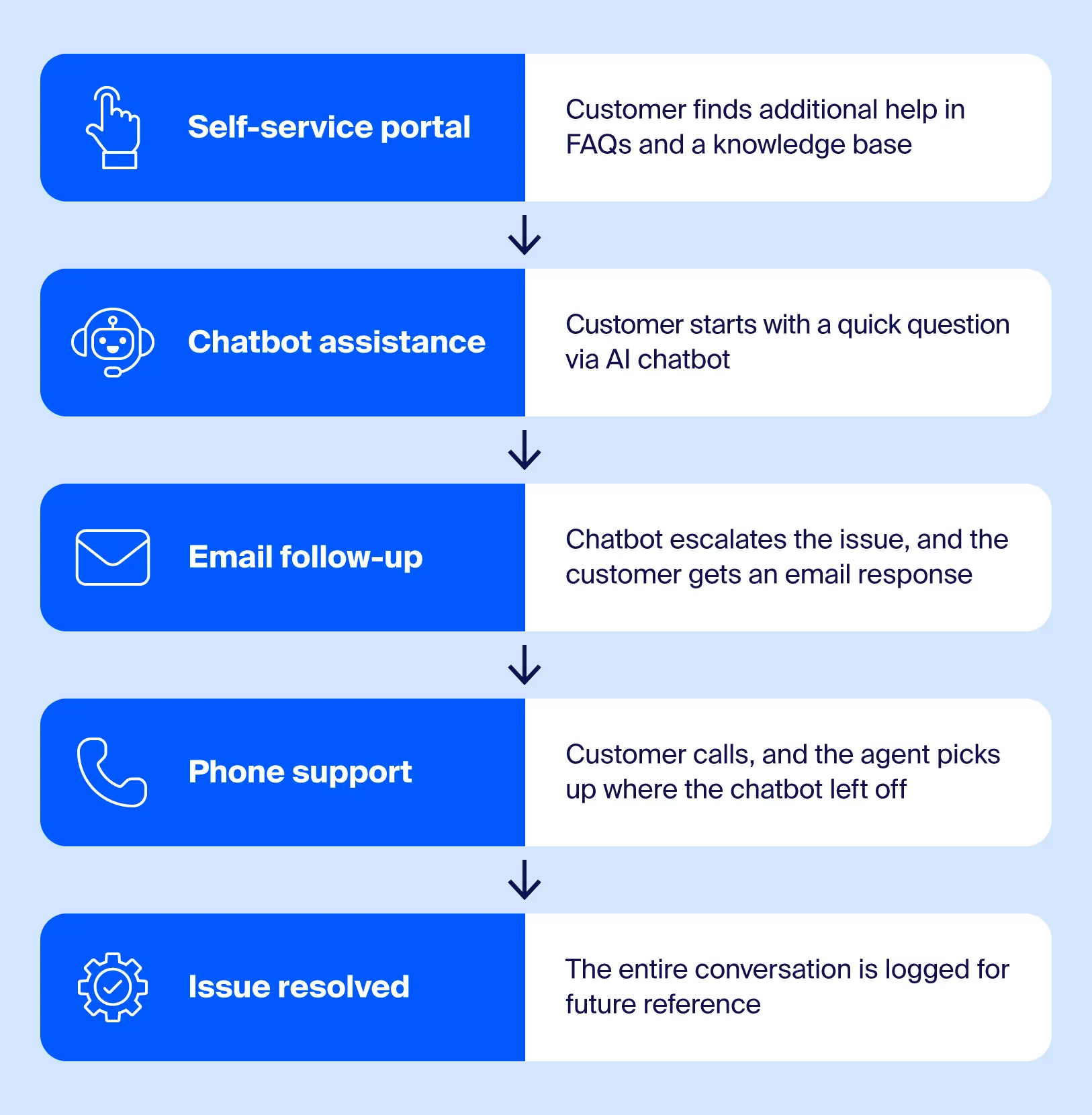
Here's what omnichannel customer service looks like in action.
Security and trust are essential to delivering excellent customer service, especially in industries like finance and healthcare, where customers share sensitive information. By routing verified customers directly to the right agent, businesses can reduce friction while protecting customer data.
For example, a credit union can use an omnichannel contact center to help streamline authentication workflows using prior interaction data and verification processes.
Keeping customers informed reduces frustration and improves satisfaction. With AI-powered automation, businesses can send real-time updates via SMS, email, or chat about order status, service outages, or appointment reminders.
A telecom provider, for instance, can automatically notify customers about upcoming billing due dates or network maintenance. If a customer replies with a question, the system can escalate the conversation to a live agent with full context for a smooth experience.
Customers expect seamless transitions when initiating a support request rather than having to provide their information or explain the problem again on a new channel or with a new agent. Omnichannel customer service unifies interactions across SMS, chat, phone, and video so agents have full visibility into past conversations.
For example, a tech support team can allow a customer to start troubleshooting via live chat and, if needed, escalate to a voice or video call with the same agent — without losing conversation history. This can reduce frustration, speed up resolution, and improve customer satisfaction (CSAT) scores.
Different industries require tailored customer service solutions. Here's how various industries can benefit from an omnichannel approach:
Implementing an omnichannel strategy comes with challenges, from integrating multiple systems to maintaining consistency across channels. Here's how businesses can overcome these obstacles and deliver seamless omnichannel customer experiences.
Problem: Many businesses struggle with disconnected support platforms, leading to fragmented customer data and inefficiencies. Without proper integration, agents lack a unified view of customer interactions, forcing customers to repeat themselves across different channels.
Solution: Omnichannel contact center software can centralize interactions across chat, email, phone, and social media into a single platform. Seamless CRM, knowledge base, and support system integrations give agents full conversation history, allowing them to provide faster and more personalized support. Native dashboards can also help managers track key metrics in one convenient view.
Problem: Customers expect the same level of service whether they contact support via chat, phone, email, or social media. But inconsistent messaging and response quality can damage trust and frustrate customers.
Solution: Standardized response templates, AI-driven suggestions, and a centralized knowledge base can help agents deliver uniform answers. With an omnichannel solution, businesses can create preset workflows and messaging guidelines, making sure customers receive the same quality of service across every channel.
Problem: While AI-powered chatbots and automated workflows improve efficiency, over-reliance on automation can lead to impersonal customer experiences and frustration when customers need human assistance.
Solution: Use AI-powered virtual agents to handle simple requests while smoothly transferring complex issues to live agents with full conversation history. This reduces wait times while providing customers the right level of support at every step.
Problem: Handling customer data across multiple channels introduces security risks and compliance challenges, particularly in highly regulated industries such as finance and healthcare. Businesses must protect sensitive information while providing seamless support.
Solution: Use contact center software with built-in security features like encrypted communications, role-based access controls, and features designed to support organizations’ compliance efforts with applicable industry requirements
Omnichannel customer service isn't a nice-to-have — it's how modern businesses deliver the seamless, personalized support customers expect. By connecting channels, unifying data, and empowering agents with full context, organizations can reduce friction, resolve issues faster, and build the kind of loyalty that drives long-term growth.
The businesses that get this right don't just improve customer satisfaction — they can turn their support operation into a competitive advantage with the right omnichannel customer solutions.
Omnichannel customer service can help organizations reduce operational inefficiencies and improve customer retention. A seamless support experience can lead to higher customer satisfaction, impacting loyalty and repeat business.
AI-powered automation and self-service options can help reduce operational workload by handling routine inquiries, freeing agents to focus on high-value interactions. Faster resolutions and reduced agent workload can also contribute to cost savings and increased productivity.
Successful omnichannel customer service relies on a centralized contact center platform that integrates multiple communication channels, including chat, email, phone, and social media. AI-powered virtual agents help automate routine inquiries, while CRM integrations provide agents with full customer history for personalized support.
Other essential tools include ticketing systems, knowledge bases, IVR, and analytics dashboards for tracking customer interactions and service performance.
Omnichannel support simplifies workflows by giving agents a complete view of customer interactions across all channels. This reduces repetitive conversations and allows agents to provide faster, more personalized responses.
AI-driven assistance helps streamline tasks like note-taking and case routing, improving efficiency. With better data and real-time coaching tools, agents can focus on delivering higher-quality customer service while helping reduce repetitive manual work for support agents.