
Your guide to getting started with ZoomMate
Everything you need to start using ZoomMate: notes, search, workflows, and AI tools — all inside Zoom Workplace.
Zoom's native meeting and conversation data positions it as the context layer that every AI agent can call into. Learn how Zoom's Agentic Search capabilities compare across the enterprise AI landscape.
 6 min read
Published on August 11, 2026
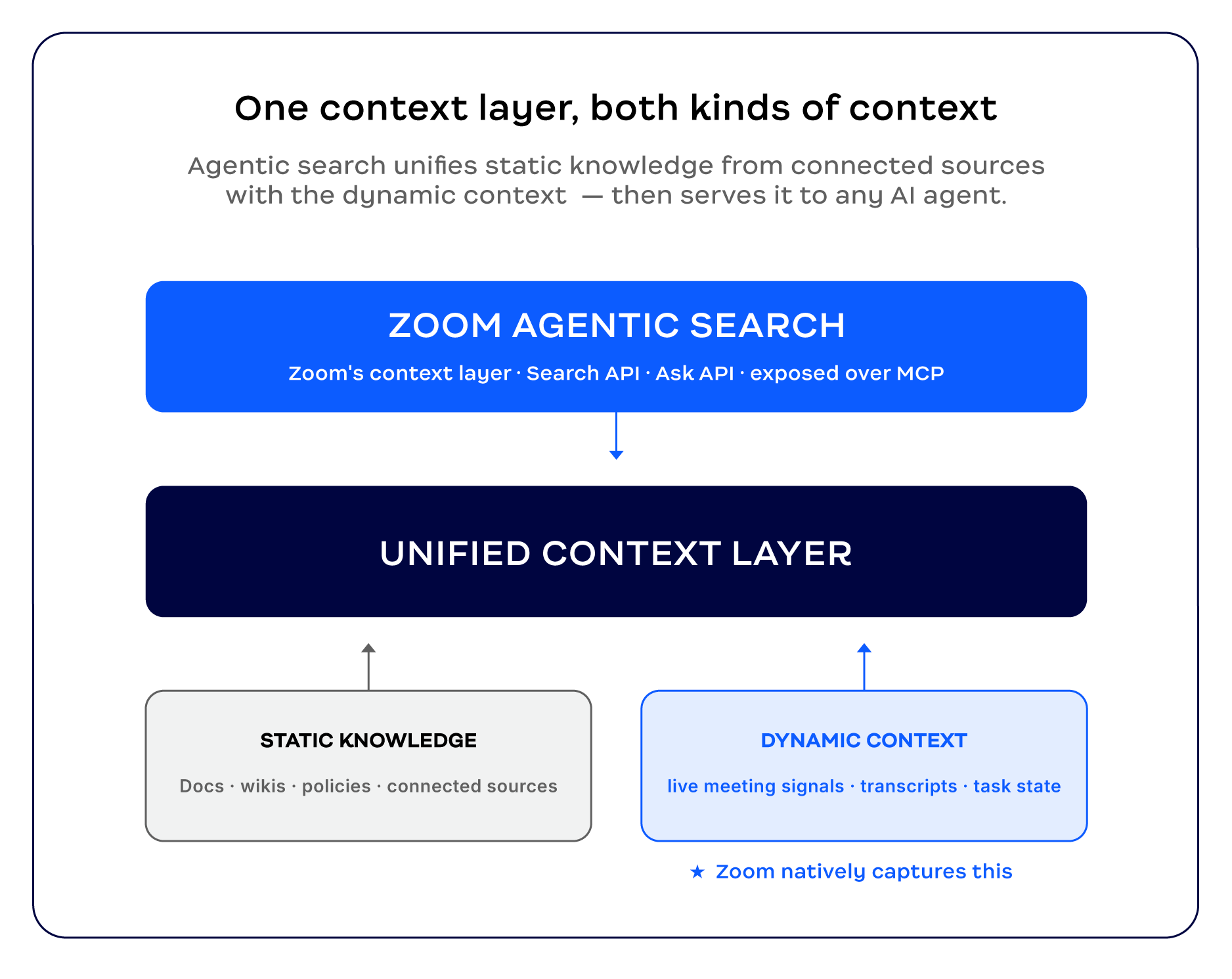



The industry agrees that a good context layer beats a bigger model. We'd add one thing: a context layer that only indexes static content is missing where most work actually happens. Zoom's agentic search is being built to unify both signals: static content retrieved from integrated third-party platforms and the dynamic context of meetings and real-time dialogue that may not be formally documented by the organization, giving AI agents visibility.
An AI agent is only as good as its context — not its model.
A centralized context layer beats federated, tool-by-tool retrieval in both output quality and token use. When an agent has to call each connector separately and stitch the results together, it spends its budget on the plumbing: more tool calls, more reasoning loops, and more half-relevant data in the context window. A well-designed layer could have returned the relevant material directly.
We agree with that thesis. We also think the conversation has a basic open question: what do we mean by "context"?
When people say "context layer" today, they almost always mean static knowledge. This includes the docs, wikis, policies, and knowledge bases that compose an organization's documented source of truth. It's already been written down, and centralizing it absolutely beats querying ten systems independently.
Static knowledge answers one type of question: "what's documented." It has little to say about "what's happening right now." The meeting that wrapped an hour ago, the project a teammate is heads-down on today, and the decision that has changed since anyone last checked. This is dynamic context, a different kind of context entirely.
Dynamic context is information about what's happening in your organization right now that hasn't been captured as institutional knowledge. It might live in a conversation, a meeting, or a transcript. The source doesn't matter; what matters is that it often isn't extracted or surfaced afterward. Dynamic context isn't sitting in a wiki waiting to be indexed. It's produced continuously as people work, and it goes stale fast.
Two examples make this concrete:
A deal's real status. A signed contract (static) says a renewal closed in March. Whether the account is actually healthy depends on what the customer's champion said during this morning's call that the budget was just frozen for next quarter. That fact exists nowhere but the conversation itself, until something captures it.
Who's actually driving the launch? An org chart (static) says who sits on which team. Who is actually carrying this week's launch, and what they committed to deliver by Friday, only exists in the standup where they said it out loud. It was never anyone's job to file that as a document.
How much each type of context matters depends on the question. Some questions are almost entirely answerable from the knowledge base — dynamic context is a footnote. Others can only be answered from the conversation itself, because no document holds the answer. A context layer that only handles one type will miss the other half of the questions people actually ask.
This is why the distinction is important: an AI agent that only accesses static knowledge may respond using outdated context. Here's what that looks like in practice:
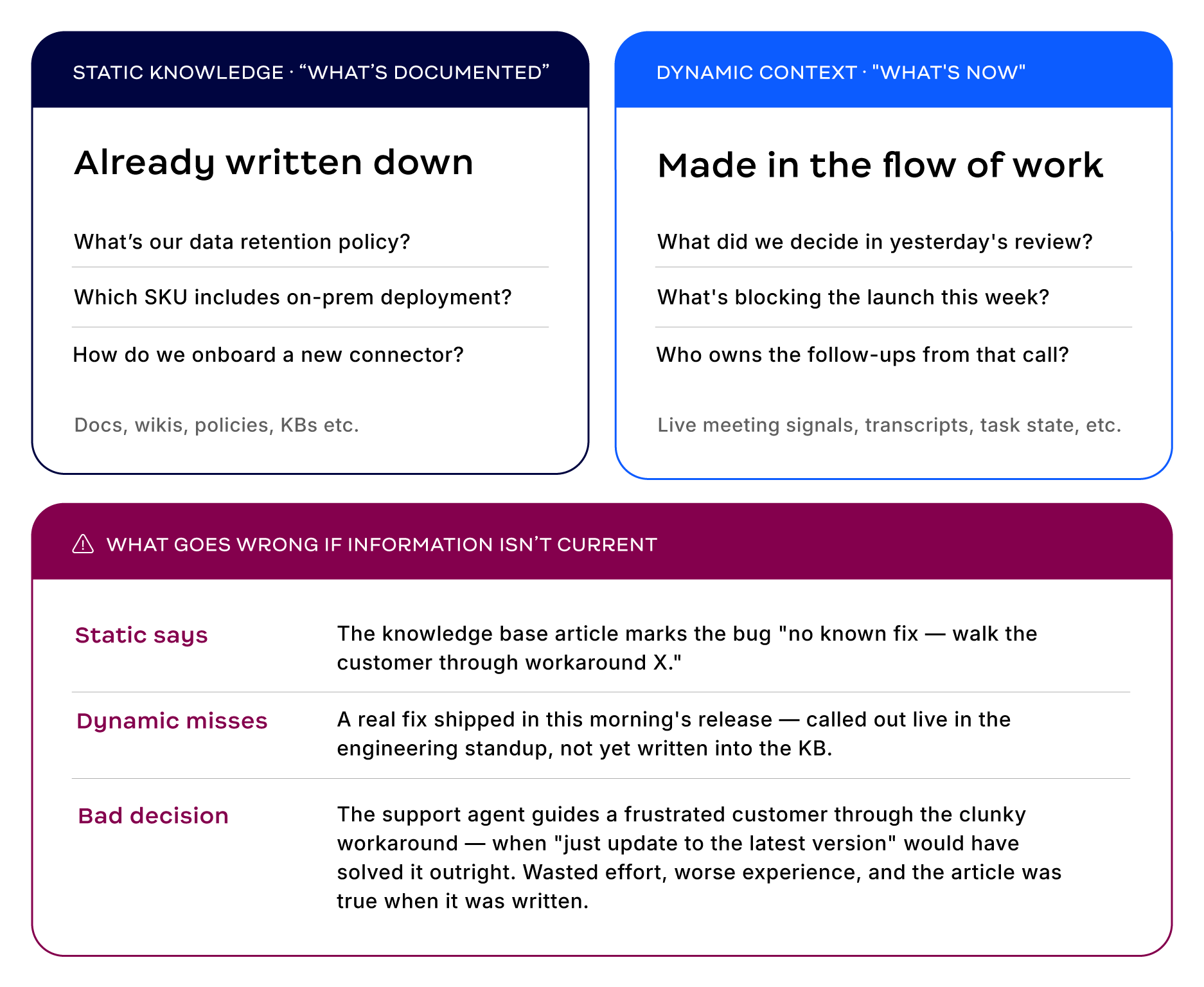
A context layer built solely from indexed knowledge will always be static, regardless of how good its ranking becomes. Some signals are never documented in the first place. A layer made up only of live signals has the opposite problem: it is current, but may not be correct. Together, they cover each other's weaknesses. Static knowledge grounds answers in verified facts, while dynamic context reflects the current state of the work.
Zoom's agentic search is built as Zoom's unified context layer. It brings together the static knowledge already flowing through your connected sources with the dynamic context that happens on Zoom.
Dynamic context is the differentiator. It's what most context layers can't reach — recent meetings and transcripts, active projects and tasks, what changed and when — none of it lives in a doc, it only exists in the conversation itself.
Indexing every document captures what is already settled, but leaves out work that is still in motion. Agentic Search is built so that an agent can ask one question and receive both the settled truth and the current state, ranked and ready to reason over.
Coverage, or what a context layer can see, is only part of the argument. How the layer is used also matters, and the effect is visible even within a single platform's tools.
To illustrate, we ran the same request — Review the last week of meetings and compile the follow-ups — through Claude as the agent, twice, changing only how it could reach the context. In the first run, Claude had raw retrieval tools only: no ranked search, just the ability to list meetings and open them, so it had to fetch and read every meeting to decide what was relevant (brute force). In the second run, Claude connected to Zoom via MCP and used the Search API instead, asking the layer directly and getting back only what mattered. Same agent, same request, same week — the only variable was the retrieval path, and the token consumption tells the story.
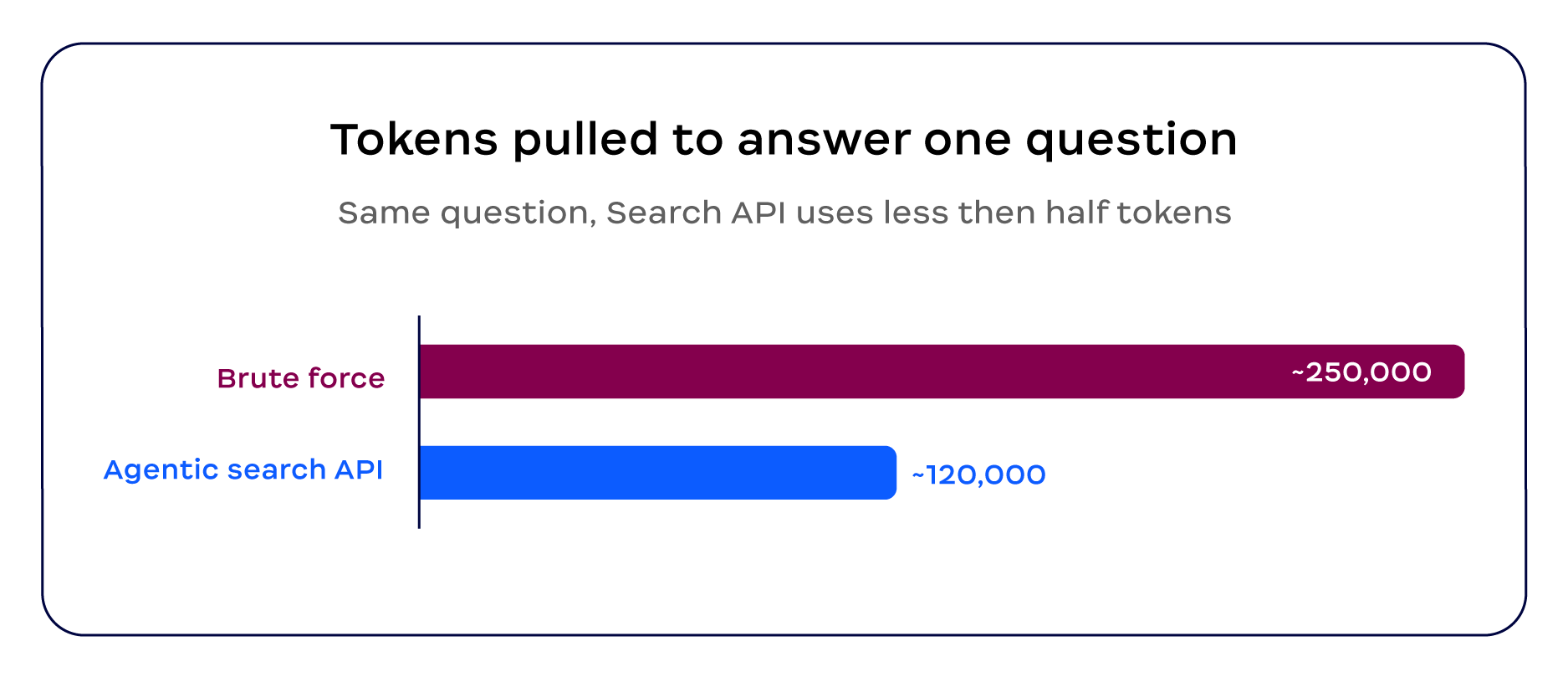
The gap matters more than the token count. Even within a single, well-integrated source, the retrieval method determines how much unnecessary work an agent does. Across a dozen federated connectors or agents, the inefficiency compounds. Each connector has its own retrieval quality and payload size, leaving the model to sort relevant material from noise. At that point, excess token use becomes a meaningful part of the cost.
Ask API handles that choice for the agent. It's the answer-generating mode of Agentic Search: retrieval and synthesis both happen server-side for the query before anything reaches the agent's context window. The agent asks a question and receives a synthesized, work-ready answer in a single call, using the fewest tokens of all paths.
What makes that possible is that Ask API runs a full agentic retrieval loop, the same searching, checking, and re-asking, but none of that intermediate material lands in the agent's context window.
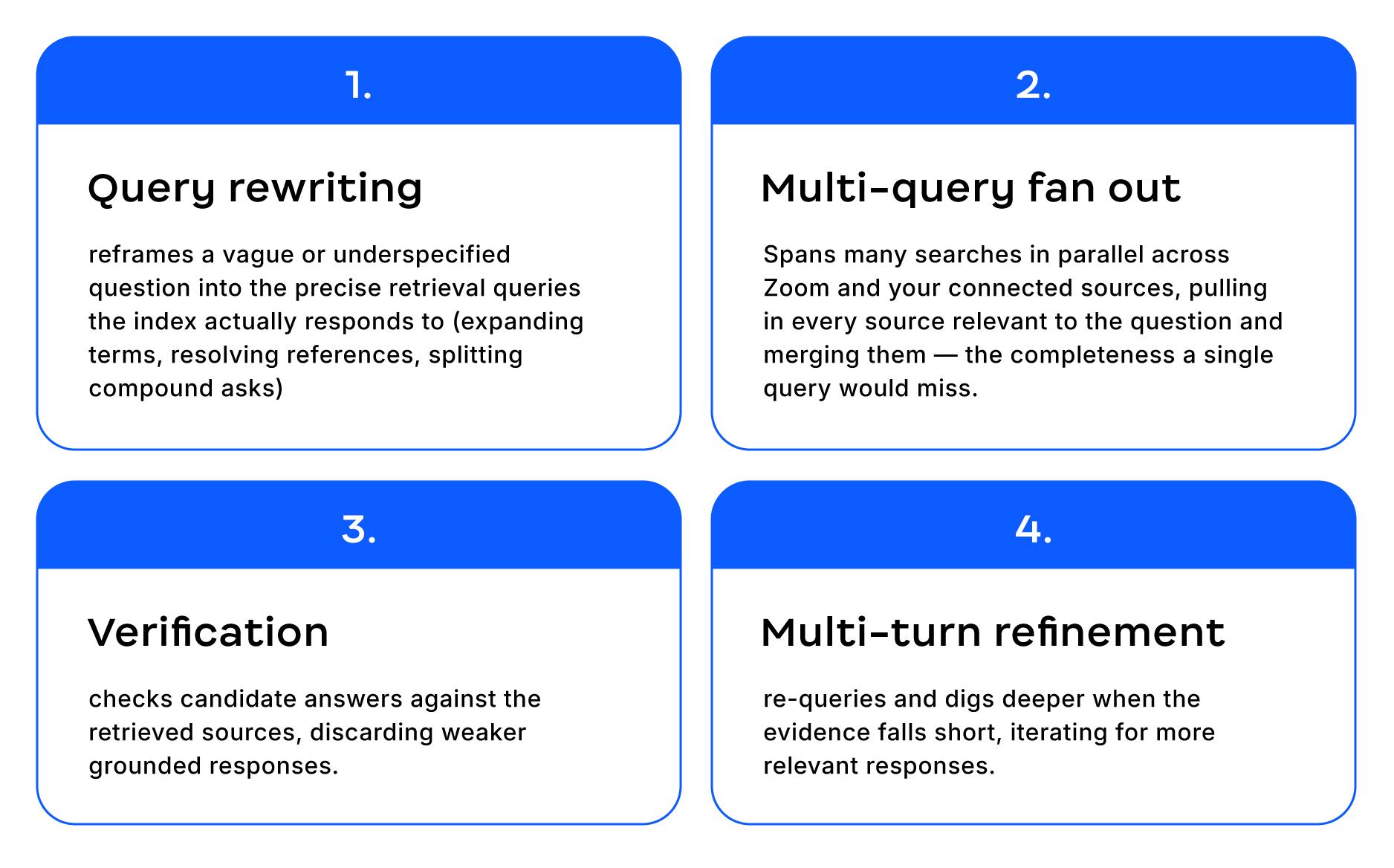
The agent sees one request and one grounded answer. The search-and-fetch sequence, oversized transcripts, and decisions about how deeply to search stay on the server, where the data already lives.
And because that fan-out spans every source connected to the layer, not just Zoom, the answer is complete. Point Ask API at your CRM, docs, tickets, and wikis alongside Zoom, and the layer decides which of them are relevant to each question — pulling dynamic context and your third-party static knowledge together to complement the query. The agent doesn't have to know where the answer lives or wire up ten connectors; it asks once, and the response reflects everything your organization knows rather than one system's slice.
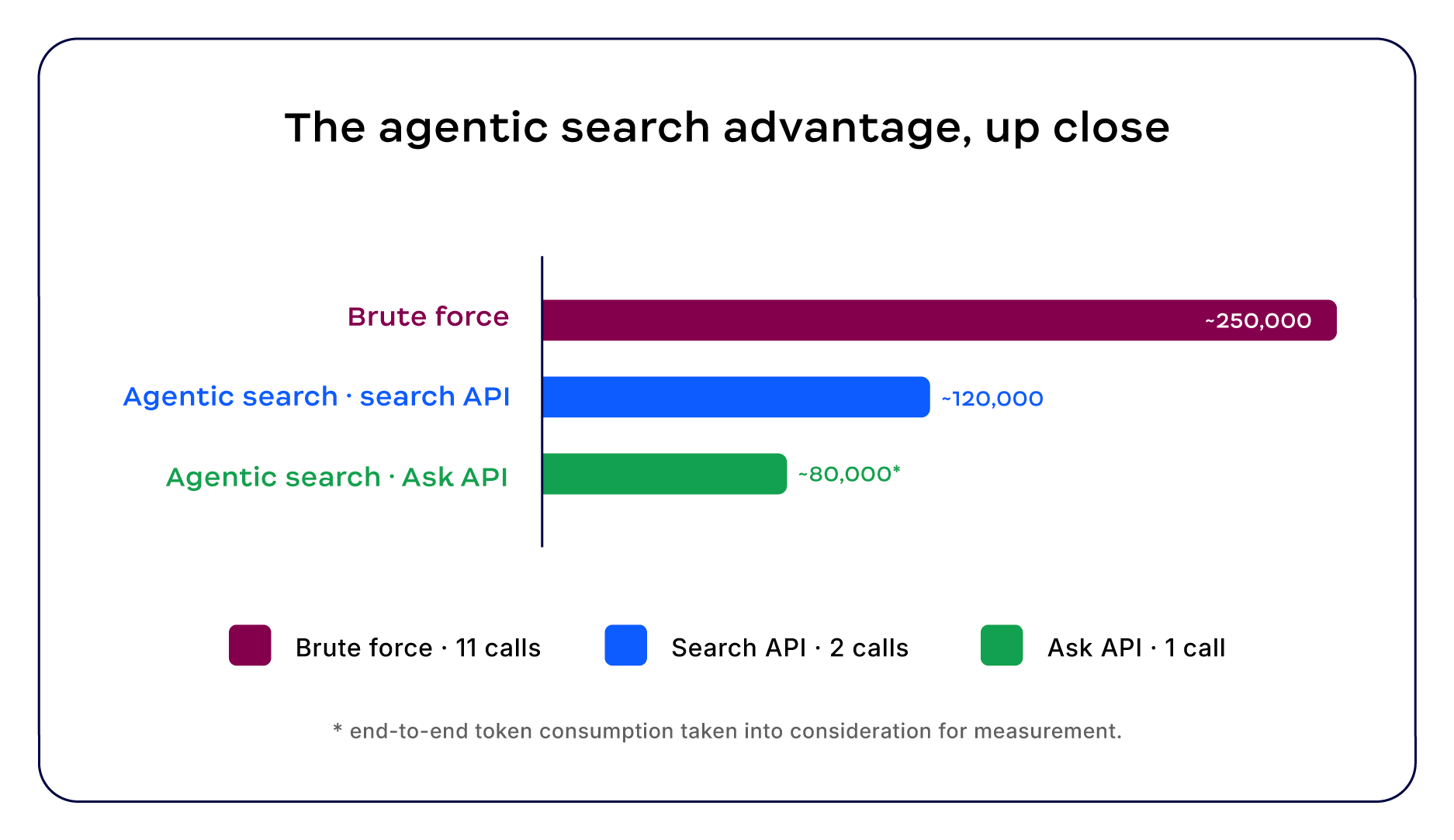
Token consumption is measured end-to-end. Reported figures include both Claude and ZoomMate token usage where each is involved.†
"Context layer" means something a little different depending on who's building on it. Some teams want the raw context to reason over themselves; others want the finished answer. So agentic search offers two entry points into the same unified context layer.
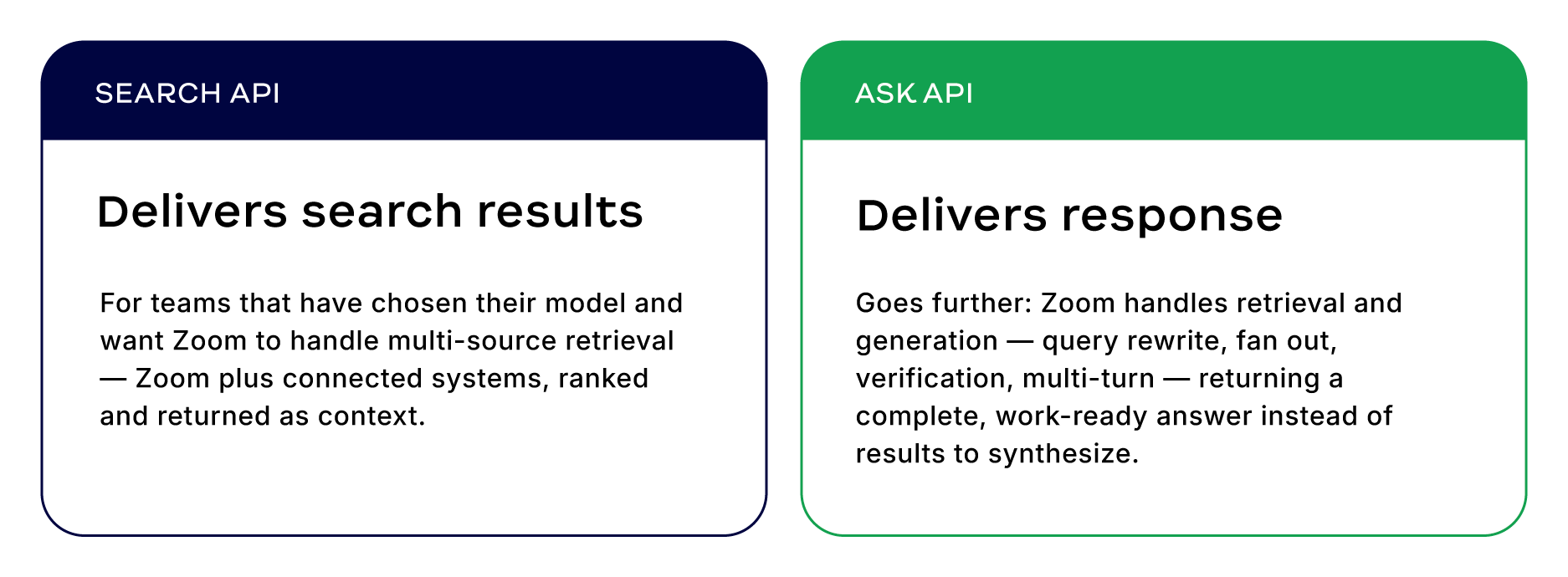
Delivered anywhere, over MCP. Zoom's MCP server exposes both APIs for agentic search to any supported agent surface, including Claude, Codex, your own customer-facing UI, or any MCP-capable agent, enabling on-demand retrieval of Zoom meetings, messages, and documented knowledge, with authentication and permissions handled for you.
Both APIs draw on the same unified context layer — static knowledge plus dynamic context, spanning Zoom and your connected sources.
Zoom's agentic search is a capability designed to meet teams wherever they already work. There are two ways to access it.
The first is ZoomMate, Zoom's native AI teammate. For users already in the Zoom ecosystem, agentic search is built directly into the ZoomMate experience. Ask a question in ZoomMate and the full context layer — meetings, docs, chat, and 10+ connected sources — is already working behind the scenes. This path is optimized for everyday knowledge workers who want grounded, cited answers in the flow of work.
The second is via MCP, which exposes the same underlying context layer to any external agent surface — Claude, Codex, OpenAI, or a custom-built UI. Through Zoom's MCP server, developers and enterprise teams can connect their preferred AI interface directly to Zoom's unified retrieval layer using the Search API (which returns ranked results for teams that want to bring their own model) or the Ask API (which handles retrieval and synthesis end-to-end, returning a complete, cited answer in a single call). Both APIs draw on the same context — static knowledge from connected sources plus the dynamic context of live meetings that no file-based platform can replicate.
Retrieval is the lever. When it works well, every agent built on top becomes cheaper, faster, and more accurate. Agentic search is where Zoom does that work.
Indexing static context captures what's already been documented; dynamic context, brought from meetings that no index can see; and agentic search unifies both into a single context layer. Delivered to any UI over MCP, it gives every AI agent what's documented and what's happening in a single call. Better context, fewer tokens.
That layer spans Zoom and your connected third-party sources, including CRM, docs, tickets, and wikis. Ask API searches across them and pulls in the material relevant to each answer. That's the real payoff of a unified layer: completeness. One endpoint that grounds every agent in your dynamic and static content together, providing a single source of truth for everything your agents need to know.
Unlock the full potential of Agentic Search with a ZoomMate plan. Then, integrate through Zoom's MCP server to deploy the Search and Ask APIs† across Claude, Codex, or your preferred MCP-enabled agent ecosystem.
Methodology. Figures are directional, drawn from a real run over a single user's 7-day calendar (89 meeting instances) and rounded for illustration. The Ask API figure (*) is a projection at roughly half of Search API retrieval, pending a direct benchmark. Actual token counts vary by query, payload size, and connected sources, and exclude fixed system-prompt overhead shared by all approaches.
†Search API requires an eligible Zoom Workplace or ZoomMate paid plan, and Ask API requires a ZoomMate paid plan and available Zoom AI credits. Token consumption values shown in this article reflect ZoomMate and Claude token usage.