
Your guide to getting started with ZoomMate
Everything you need to start using ZoomMate: notes, search, workflows, and AI tools — all inside Zoom Workplace.
 16 min read
Published on March 26, 2025



Are your customers waiting too long on hold? Are your agents overwhelmed, leading to burnout and high turnover? Managing a contact center comes with immense pressure — balancing efficiency, customer satisfaction, and agent well-being is no easy task. In today's customer-first world, where expectations are higher than ever, even small inefficiencies can lead to lost revenue and a damaged reputation.
This is where effective call center management makes all the difference. A well-run contact center is essential for smooth operations, empowering agents, and delivering exceptional customer experiences. But despite advancements in AI, automation, and omnichannel communication, many contact centers still struggle with outdated processes, technology gaps, and operational inefficiencies.
In this guide, we'll break down the key aspects of call center management, from setting clear goals to leveraging the right tools so you can turn challenges into opportunities and drive long-term success.
Call center management is the strategic oversight of a contact center's operations for better efficiency, agent productivity, and high-quality customer service. It involves managing agents, implementing technology, setting customer service standards, and optimizing workflows to maintain smooth day-to-day operations. Effective contact center management means handling customer interactions professionally, minimizing response times, and maintaining consistent service quality.
Key responsibilities include:
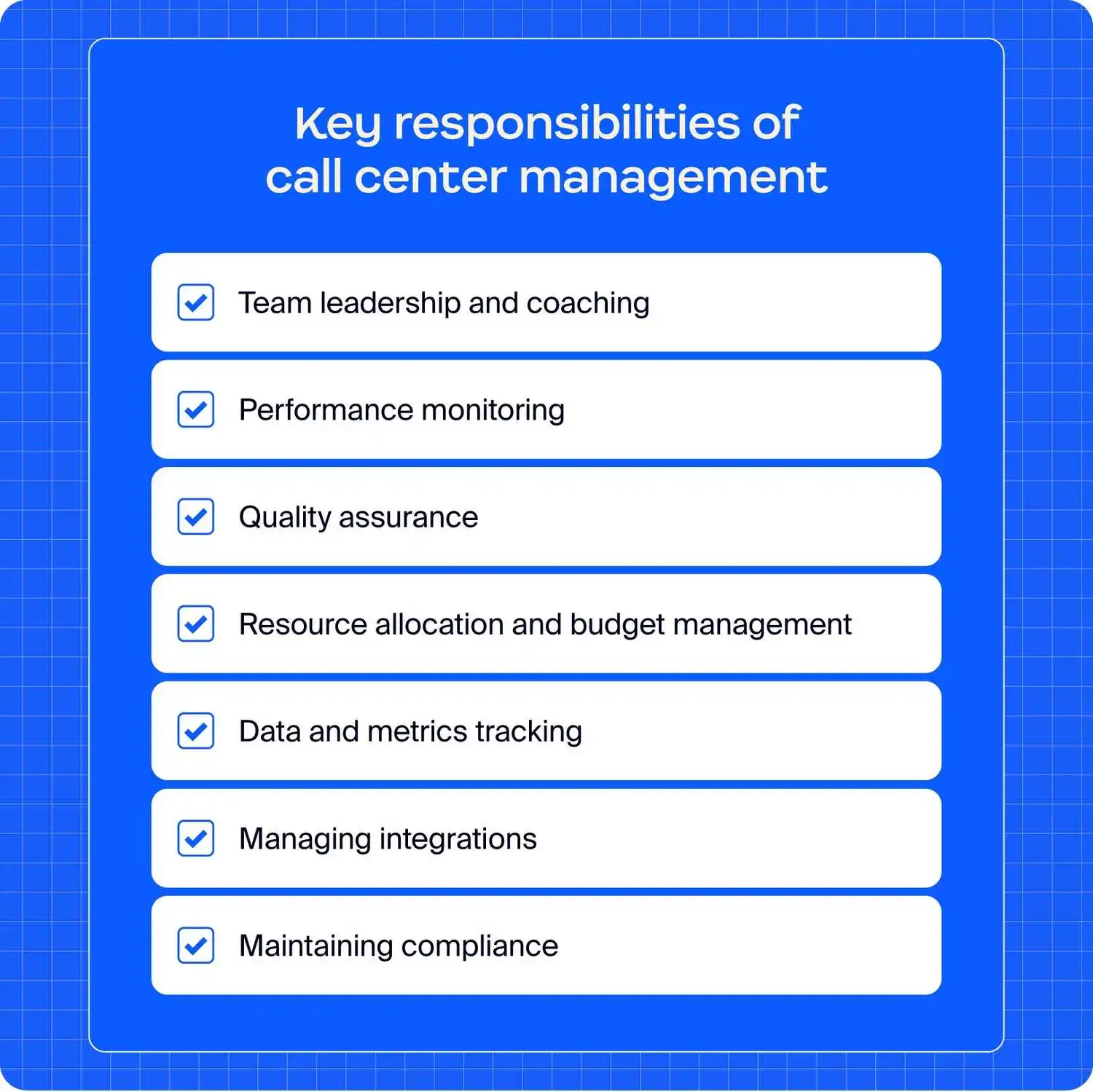
For a call center to work as a well-oiled machine, it requires a clear division of roles and responsibilities: those who answer calls, those who coach and lead others, and those who set the operational strategy. Often, these roles are broken down into positions such as high-level management, middle-level call center supervisors, and individual contributors, all of whom work together to support the customer.
Call center managers oversee contact center operations and strategy. They set KPIs, handle workforce planning and staffing, and monitor systems and workflows to keep things running smoothly. Additionally, they are responsible for compliance and contact center performance management. While they likely aren't often handling their own calls, they may step in as needed to help out.
Call center supervisors handle day-to-day call center supervision and agent performance. This includes monitoring call queues, stepping in to handle escalations, and maintaining service levels. Much of their role involves coaching agents and providing feedback to help them improve and provide the best customer support. Supervisors also often serve as a bridge between the agents and leadership.
Call center agents are frontline representatives who directly interface with customers by phone, email, chat, or other methods. Their job is to resolve customer issues and answer inquiries, often following defined scripts and workflows. They must blend speed with customer empathy and deliver a positive experience while meeting performance goals and KPIs.
Effective call center management requires a structured approach that balances customer satisfaction, agent performance, and operational efficiency. Here are the call center best practices that matter most.
Setting clear goals and tracking the right metrics is key to running an efficient call center. Without them, it's hard to measure success or know how to improve call center operations.
Start by defining what matters most — whether it's reducing wait times, resolving issues on the first call, or improving customer satisfaction. Once you have your goals, choose measurable key performance indicators (KPIs) to track progress and make data-driven decisions. Regularly review these metrics and adjust as needed to keep your team on track.
Here are some key call center KPIs to track:
Pro tip: Start by setting a baseline for each KPI using historical data. Then, create small, achievable targets for improvement, such as reducing AHT by 5% over the next quarter.
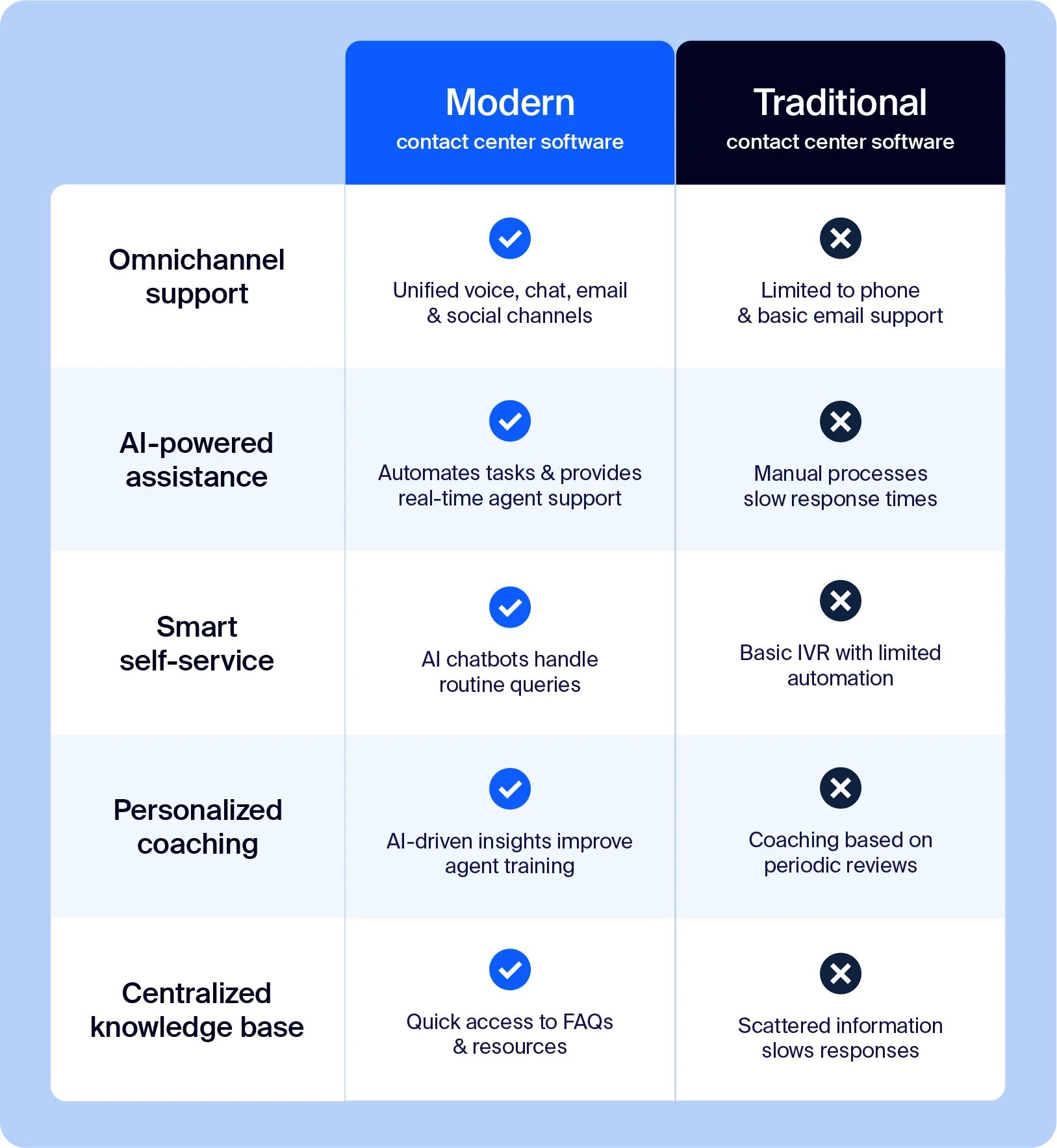
Cloud-based contact center software can improve efficiency by integrating key tools like call routing, real-time analytics, and AI-driven customer support into one platform. It helps managers monitor agent performance, track KPIs, and automate routine tasks, reducing wait times and improving service quality.
For example, AI-powered call routing connects customers with the right agent based on their history, enabling faster resolutions. With remote and hybrid work becoming more common — industry research shows that a growing share of workers are now hybrid — cloud solutions can help keep teams connected and productive from anywhere. Additionally, many cloud-based platforms offer security controls such as data encryption and role-based access controls, helping safeguard sensitive customer information and support organizational compliance efforts.
Pro tip: Start by identifying your biggest challenges — analyze call center reports for recurring issues like long wait times, high abandonment rates, or low first-call resolution. Gather feedback from agents and customers to pinpoint pain points. Once identified, look for a cloud-based, AI-powered omnichannel contact center software that directly addresses these issues, run a small-scale test, and track improvements before rolling it out fully.
Training programs are key to boosting team performance and delivering great customer service. They help agents handle different situations, stay updated on company policies, and use new tools effectively. Ongoing training builds confidence, reduces mistakes, and improves first-call resolution. Plus, agents who feel supported are more likely to stay engaged and stay with the company. Your training shouldn't be a one-time thing — combine onboarding with regular learning opportunities.
Pro tip: Ask agents and supervisors about the challenges they face to shape your training. Use real scenarios and role-playing to make learning hands-on. Track progress with quizzes and check-ins so agents are improving over time.
Quality management (QM) keeps your call center running smoothly so that agents can meet service standards and deliver great call center customer experiences. Start by defining clear evaluation criteria — what does a great call sound like? Look at factors like tone, accuracy, problem resolution, and adherence to scripts or policies. Then, set up a system to regularly review calls, chats, and emails. Use a mix of AI-driven analytics and human evaluations to get a full picture of agent performance.
Feedback is just as important as monitoring. Share specific, constructive feedback with agents and provide coaching where needed. Make QM a two-way conversation — encourage agents to ask questions and share their challenges. This makes quality assurance feel like support, not micromanagement, and helps build a stronger, more confident team.
Pro tip: Use scorecards with weighted criteria to track agent performance consistently. Combine automated analytics with manual reviews to spot trends and address issues before they impact customer satisfaction.
A well-planned schedule keeps your call center running smoothly while helping prevent burnout and understaffing. Start by analyzing call volume trends to identify peak hours, slow periods, and seasonal fluctuations. Use this data to create shifts that balance agent availability with customer demand. Workforce management (WFM) software can automate scheduling so the right number of agents are available without overstaffing or leaving gaps.
Flexibility is just as important as structure. Offer shift swaps and part-time options to accommodate agent needs while maintaining coverage. Keep an eye on absenteeism and performance metrics to adjust staffing as needed. A well-organized schedule not only helps improve efficiency but also helps keep agents engaged and reduce turnover.
Pro tip: Use historical data and real-time analytics to forecast staffing needs. Build a buffer by scheduling extra coverage during peak hours and having on-call agents ready to step in when needed.
A motivated team delivers better customer service, so creating a positive work environment is essential. Recognize top performers with incentives, shout-outs, or small rewards — feeling valued keeps agents engaged. Encourage open communication by regularly checking in with your team, addressing concerns, and making them feel heard. A supportive culture helps reduce stress and improve job satisfaction.
Burnout is a real challenge in call centers. Prevent it by setting realistic performance expectations and offering mental health resources to make sure agents get enough breaks. A happy, well-supported team is more productive and provides better customer experiences.
Pro tip: Build engagement with team-building activities, mentorship programs, and career growth opportunities. Even small gestures, like celebrating milestones or offering flexible scheduling, can make a big difference in morale.
Tracking the right KPIs helps you measure success, spot issues early, and make informed decisions. Focus on key metrics like average handle time, first-call resolution, customer satisfaction, and agent productivity. Use this data to pinpoint problem areas — for example, if FCR is low, agents may need better training or access to customer history. If AHT is too high, workflow bottlenecks or inefficient processes might be the cause. Analyzing trends over time helps you refine strategies, improve training, and optimize workflows.
Real-time dashboards make it easier to stay on top of performance. Set up automated reports that track trends and alert you to issues before they escalate. Regularly reviewing this data allows managers to adjust staffing, coaching, and call routing to improve overall efficiency.
Pro tip: Customize dashboards to highlight your most critical KPIs and set up automated alerts for key thresholds, like rising wait times or drops in CSAT. Meet with your team weekly to review insights and adjust strategies accordingly.
Regular feedback between agents and managers creates a culture of continuous improvement. Schedule one-on-one coaching sessions to review performance metrics, discuss challenges, and provide constructive feedback. Encourage agents to share their own insights — frontline employees often spot inefficiencies that managers might miss. Making feedback a two-way conversation boosts morale and helps fine-tune processes.
Customer feedback is just as important. Use post-call surveys, customer sentiment analysis, and review trends to identify areas for improvement. If customers frequently report long wait times or unresolved issues, adjust workflows or provide additional training. Turning feedback into action strengthens both agent performance and customer satisfaction.
Pro tip: Use AI-driven sentiment analysis, voice analytics, and automated surveys to collect real-time customer insights. For internal feedback, create an open-door policy or set up anonymous suggestion forms to encourage honest input from agents.
Strong agent performance starts with clear goals, ongoing coaching, and regular performance reviews. Set measurable objectives — like improving first-call resolution or reducing average handle time — so agents know what success looks like. Then provide real-time coaching by reviewing call recordings and offering actionable feedback. Instead of just pointing out mistakes, highlight areas for growth and offer targeted training to help agents improve.
Performance reviews should go beyond just numbers. Meet with agents regularly to discuss challenges, recognize achievements, and set personalized improvement plans. When agents feel supported rather than micromanaged, they're more motivated to perform at their best.
Pro tip: Use call analytics and agent scorecards to identify performance gaps. If an agent struggles with a specific area — like handling difficult customers — offer targeted training or role-playing exercises to build their confidence and skills.
Automation helps call centers run more smoothly by reducing manual tasks and allowing agents to focus on customer interactions. AI-powered chatbots and interactive voice response (IVR) systems can handle routine inquiries, freeing agents for complex issues. Automated call routing makes sure that customers are directed to the right department based on their needs, cutting down on wait times and improving resolution rates.
Ticket management systems also streamline workflows by automatically categorizing and prioritizing support requests. This can prevent backlog issues so that urgent cases get handled first. By integrating automation with your CRM, agents gain instant access to customer histories, making interactions faster and more personalized.
Pro tip: Choose automation tools that integrate with your existing software and align with your team's workflow. Start with high-impact areas, like call routing and chatbots, before expanding automation to other processes.
Customer satisfaction should be the driving force behind all call center management strategies. When customers have a positive contact center experience, they are more likely to remain loyal, recommend your services, and boost your brand's reputation. Managers should equip agents with the tools, training, and support needed to resolve issues quickly and effectively. Listening to customers and addressing their concerns with empathy can turn negative interactions into positive ones.
Integrating customer satisfaction metrics, like CSAT or Net Promoter Score (NPS), into daily performance tracking helps keep satisfaction top of mind. Regularly review feedback and encourage agents to ask customers for their input to continually improve service quality.
Pro tip: Incorporate customer satisfaction into daily workflows by setting aside time during team meetings to review feedback, discuss challenges, and recognize agents who've delivered outstanding customer service.
Clear communication channels are crucial for effective call center management so information flows seamlessly between agents, managers, and customers. For agents, having direct access to internal knowledge bases and real-time support from supervisors allows them to quickly resolve customer inquiries.
For managers, providing regular updates through team meetings or messaging platforms helps keep everyone aligned on goals and expectations. Additionally, having clear, structured scripts and guidelines for customer interactions helps prevent agent confusion for consistency in service delivery.
Unified communications as a service (UCaaS) platforms can help you do this by centralizing communication tools, such as voice and video, into a single environment. For instance, platforms like Zoom Workplace combine messaging, video meetings, and other collaboration tools into one platform, enabling agents to easily connect with supervisors or managers without interrupting their workflows.
When you combine Zoom Workplace with Zoom Contact Center, you can unify internal communication with customer interactions. Rather than working from disparate systems, you can manage issue escalations, loop in leadership, and pull up important information during live interactions. This can help improve speed, productivity, and the overall customer experience.
Pro tip: Use Zoom Chat for real-time communication between agents and managers. You can streamline workplace collaboration by creating dedicated channels for each team and project, so relevant information is easily accessible and organized.
Giving agents the freedom to make decisions improves customer satisfaction and reduces escalations. Define clear guidelines for agents to resolve issues independently, such as offering discounts, waiving fees, or expediting requests within set limits. Encourage creative problem-solving by allowing them to go off-script when necessary to provide personalized solutions.
Pro tip: Establish decision-making parameters and provide real-life case studies during training. Regularly review outcomes to refine policies and boost agent confidence.
Real-time performance tracking lets managers monitor agent performance as it happens, providing immediate feedback. With live data, managers can adjust coaching on the spot to help improve service delivery and prevent issues. For example, if an agent is struggling, managers can step in during a call to offer guidance before the situation worsens. This quick response helps keep service quality high and resolve problems early.
Real-time tracking also helps managers spot top performers so they can be recognized to reinforce positive behavior and boost morale.
Pro tip: Use performance tracking tools with easy-to-read dashboards and set up alerts for issues or key moments. This lets managers act quickly without feeling overwhelmed by too much data.
As your business communication grows, your call center needs to scale to handle increased demand without compromising service quality. Build a flexible infrastructure with cloud-based technology that allows for easy expansion. Invest in adaptable training programs to quickly onboard new agents so they meet your quality standards.
Zoom Contact Center's scalable platform can help you manage increased volume smoothly as your business expands. Consider implementing automation and AI tools to streamline repetitive tasks so you can grow without sacrificing service quality.
Pro tip: Plan for future demand by regularly reviewing staffing levels, technology needs, and agent capabilities. Invest in scalable solutions that can handle more volume while maintaining high standards of service.
One of the most effective ways to reduce contact volume while still meeting customer needs is by providing self-service options. This means giving customers a clear path to address their own issues first, especially for simple tasks like checking account details or resetting a password.
Common self-service options include FAQs, knowledge bases, or chatbots. Customers can quickly find answers at their own pace, and agents can handle more complex interactions that require expert assistance.
A helpful solution for self-service support is Zoom Virtual Agent, which uses conversational AI to gather customer details and guide them through a resolution. Zoom Virtual Agent can handle routine questions and escalate to a human as needed — while providing context into what's already been discussed.
Pro tip: Review your highest-volume, repetitive inquiries and identify which can be automated or handled via self-service. Be sure to provide a clear escalation path to help prevent customer frustration.
Employee engagement is a crucial part of a well-run call center, but the stress and demands of the job can sometimes require you to take steps to improve engagement. In addition to building a positive work environment and staffing fairly, you should invest in coaching and development for your agents. This can help foster motivation while giving agents a chance to grow their skills and develop their careers.
Team connection matters, too, especially when remote or hybrid environments keep people from being in the same place every day. Leverage tools like Zoom to allow agents to connect with each other when they need assistance or support.
Pro tip: Keep agents aware of their progress with regular feedback and offer development opportunities for those performing well.
Connect your contact center platform with other systems, such as your CRM or ticketing system, to enable smooth data flow. This makes it easier for agents to access customer histories and ultimately resolve issues faster. Plus, integrating AI tools into your workflows can improve productivity through features such as transcription, summaries, and sentiment analysis.
Integrations done right can save time and reduce manual work, while also enabling better reporting, forecasting, and performance tracking by connecting systems and reducing data silos.
Pro tip: Focus on integrations that will reduce manual work for agents. Don't just add tools or set up interactions for the sake of it — make sure it will actually eliminate friction for the team.
Omnichannel customer service lets customers contact your company through multiple channels (e.g., phone, chat, text) while maintaining a consistent experience. Instead of treating each channel separately, an omnichannel strategy lets context follow the customer across channels.
Using this approach can help create smoother customer interactions while also increasing agent efficiency. Agents can jump into conversations right where they left off, even if the channel has changed, and customers get to communicate in the way that best fits their needs. Over time, this can enhance customer loyalty as they feel supported at every point.
Pro tip: Start by enabling customers to switch between channels without repeating themselves; for instance, they might start in chat but then pick up the phone to connect verbally. Make sure to track interactions in one place so agents can always pull up the full conversation history.
Effective call center management not only drives smoother operations but also enhances customer experience and overall business performance. Here's a more detailed look at how it can make a difference:
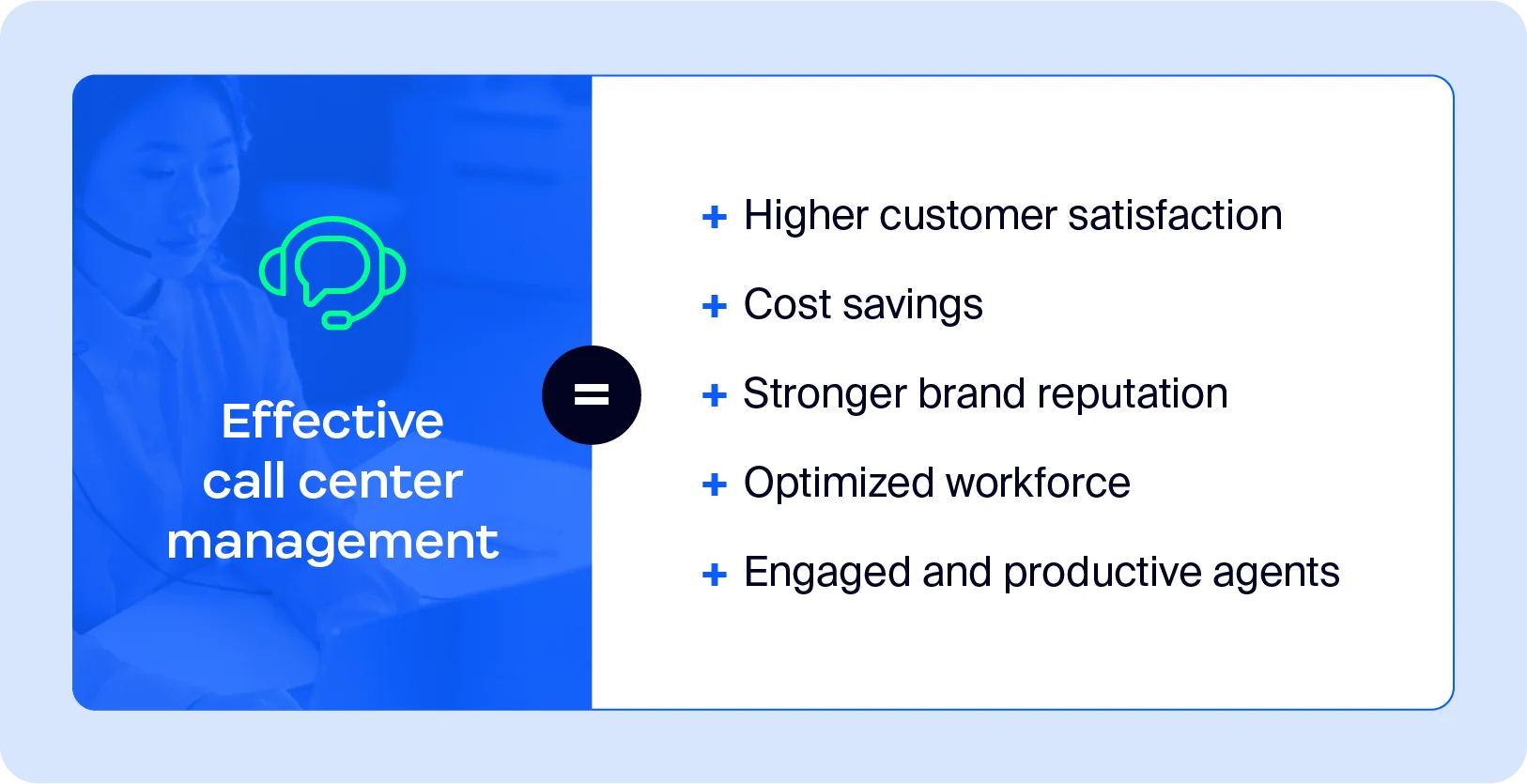
Effective call center management is an ongoing process — not a one-time setup. The right combination of clear goals, consistent coaching, smart technology, and a focus on both agent and customer experience creates a contact center that performs well today and scales for tomorrow.
The hierarchy in a call center typically follows a structured chain of command:
Managing a call center requires balancing customer satisfaction, employee experience, and efficiency and productivity all at the same time. And it's often a high-pressure, fast-moving environment to boot! One of the biggest challenges can be workforce management, as it takes effort to accurately forecast demand and schedule the right number of agents without burning out the team. Plus, managers have to make sure agents are trained properly and consistently follow processes to stay in compliance with company policies and other regulations.
To manage a call center better, focus on setting clear goals, using the right technology, providing thorough training, and keeping communication open. Regularly tracking performance, gathering feedback, and prioritizing customer satisfaction will also help boost efficiency and service quality.
To implement this, use tools like performance dashboards and offer ongoing training opportunities so your team has easy access to support when they need it.
The best management style for call centers is a balanced approach that combines strong leadership with a focus on coaching and support. It's helpful for managers to provide clear direction while also empowering agents through ongoing training, open communication, and regular feedback for both individual and team success.