

Your guide to getting started with ZoomMate
Everything you need to start using ZoomMate: notes, search, workflows, and AI tools — all inside Zoom Workplace.
 9 min read
Published on April 15, 2026



After years of excitement around using generative AI to summarize documents, draft emails, and synthesize data, businesses are moving past these isolated AI bots toward agentic AI systems.
This shift comes as 98% of business leaders agree that artificial intelligence is essential to growth, and many expect it to do more than just summarize and respond to queries.
Agentic AI helps businesses make decisions, execute tasks, and automate multi-step workflows with minimal human intervention. The goal isn’t to replace humans, but to act as a force multiplier for their work.
In this guide, we’ll walk through the definition of agentic AI, what makes it different from other AI models, how it works, and the way it’s already transforming numerous industries.
Agentic AI refers to autonomous AI systems that can plan, reason, and act independently to achieve a shared goal.
Unlike traditional AI, which focuses on a single task at a time, agentic AI coordinates one or more agents to reason toward a goal, split larger goals into smaller steps, make decisions, and execute actions with little to no human intervention. The term “agentic” refers to these models' ability to take initiative and act autonomously with minimal human oversight.
Think of it like this: A traditional AI tool may handle simple tasks, like sending a notification when inventory levels reach a certain threshold, but an agentic AI system will check for missing or low-stock items, notice supplier delays, look for an alternative supplier, email the new supplier for quotes, compare prices with your budget, and place the order. If configured correctly, it can do all this before you even realize there was a problem.
Agentic AI is built on top of large language models (LLMs), so it can naturally read, understand, and generate text just like generative AI. However, the core difference between generative AI vs. agentic AI lies in the planning, action-taking, and self-correcting capabilities that the latter provides, making it an extension of your workforce.
| Zoom’s federated AI approach combines Zoom’s own small language models with advanced open- and closed-source models to improve domain-specific performance, increase speed, and enable cost-effective execution. Book a free demo to see how you can drive outcomes with Zoom AI Companion 3.0’s agentic capabilities. |
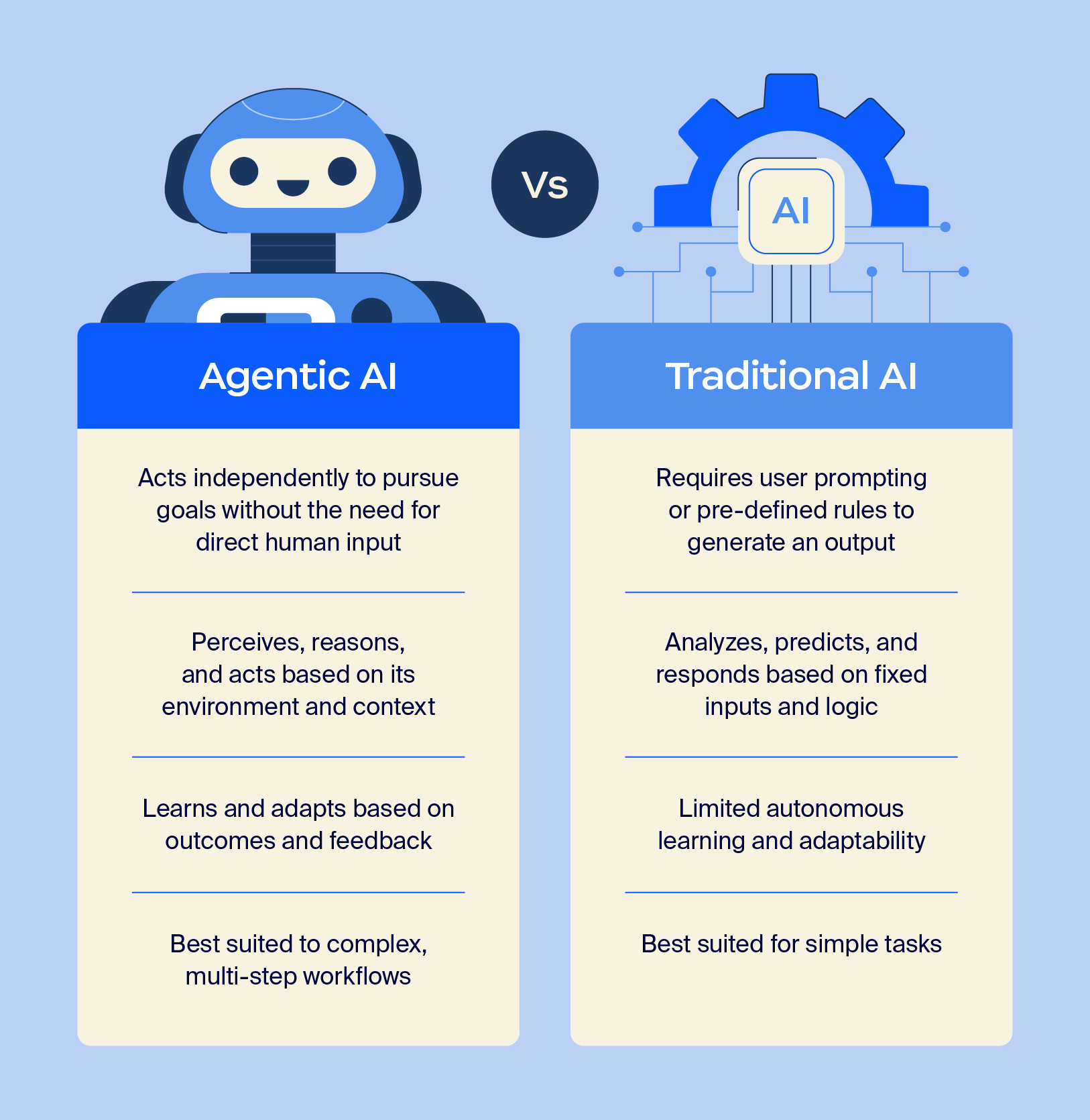
Agentic AI and traditional AI are often used interchangeably. In fact, most of Google’s searches around agentic AI meaning stem from this confusion.
While both belong to the same book titled “Artificial Intelligence,” the difference shows up in their execution style.
Traditional AI, including generative AI, refers to older chat-based AI models that can respond to simple questions and execute one-off prompts. They’re reactive and wait for a direct command before every step.
Agentic AI, on the other hand, coordinates one or more agents to reason, act, and execute a shared goal. Agents are like a self-directed team rather than a single helper. Agentic AI is proactive, largely autonomous, and goes beyond simple question-and-answer interactions to execute multi-step workflows.
Understanding the difference helps in deciding whether you need simple automation or true operational autonomy.
|
Agentic AI |
Traditional AI |
|
|
Autonomy |
Acts independently; can pursue goals without constant human prompts |
Reactive; only responds when a user triggers it |
|
Planning |
Plans in real time based on the goal and environment |
Follows pre-defined rules and decision trees |
|
Action-taking |
Performs activities within a digital or physical environment |
Responds with text outputs with actions usually taken by humans |
|
Goal orientation |
Long-term; driven by high-level, complex goals |
Short-term; designed for quick, specific tasks |
|
Adaptability |
Dynamic; agent learning helps the system learn from past interactions and the feedback loop |
Static; requires manual instructions when data or situation changes |
|
Task complexity |
Best for complex, open-ended tasks |
Best for simple, linear tasks with predictable output |
|
User role |
Low; handles end-to-end planning, reasoning, and execution with minimal human in the loop |
High; requires human inputs at every stage |
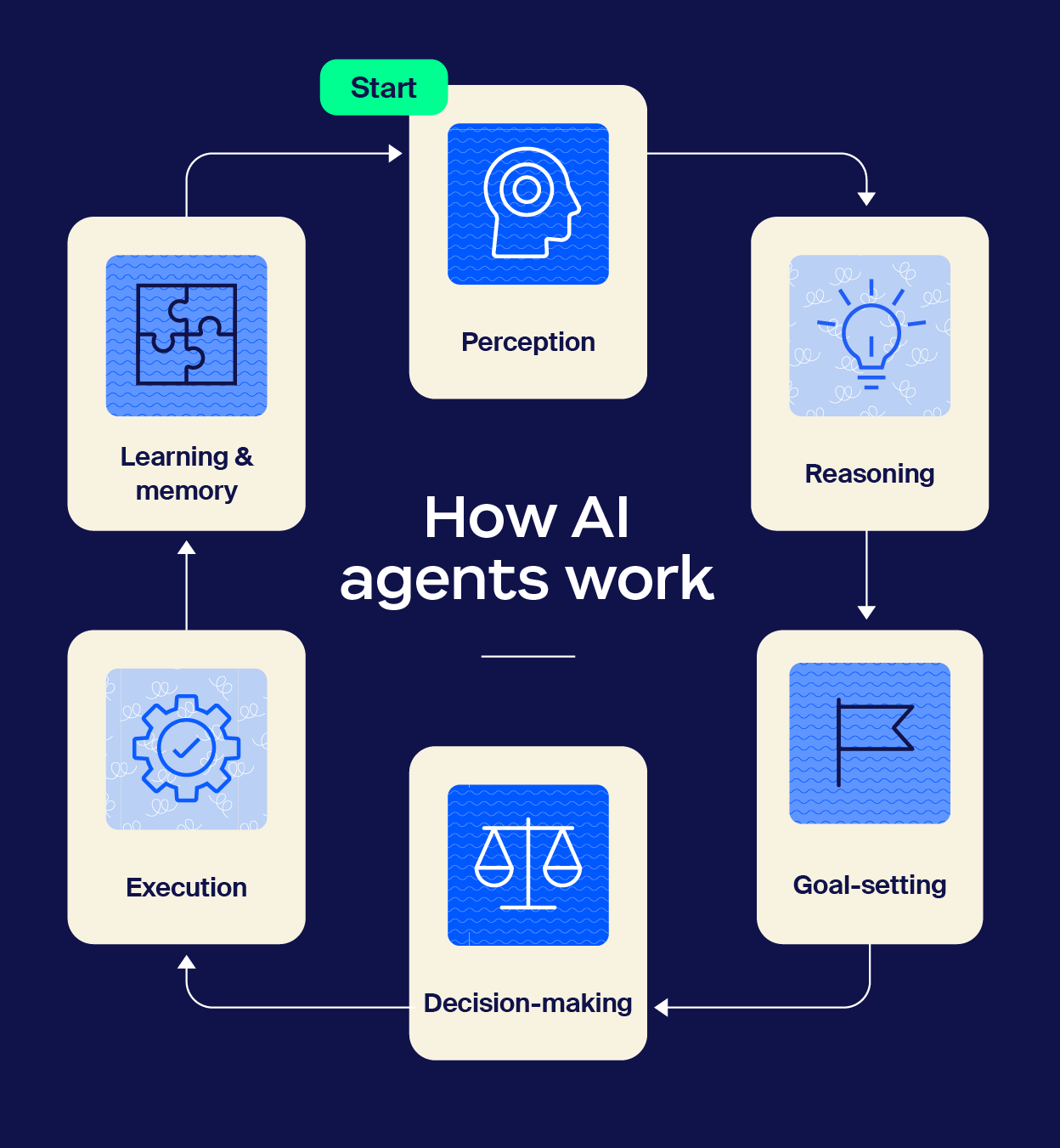
Let’s say you’ve hired a new, highly capable remote employee. You ask them to plan and book a company offsite. You don’t tell them which mouse buttons to click or which specific websites to visit — you trust them to figure it out. They check calendars, compare flight prices, remember that the CEO hates early morning departures, and book the tickets.
In a nutshell, this is exactly how agentic AI is designed to work. These systems rely on a sophisticated architecture built around six key characteristics:
Just as traditional computers perceive binary code, agentic AI perceives the environment using data in all its forms, whether text, visual, structured, or unstructured, and from multiple sources, like knowledge bases, sensors, APIs, and user inputs.
Based on the information, it interprets signals and forms a context around them. That state becomes the basis for reasoning and action.
Once the context is built, the AI analyzes the core tasks using LLMs.
Because human inputs can be vague, agents use internal thought processes, or what’s coined as “agents’ internal monologue,” to understand the goal. This means AI agents literally talk through the problem internally before acting.
To do so, it uses one or more reasoning frameworks, such as Chain of Thought (CoT) reasoning, Tree of Thought (ToT), and ReAct (Reason + Act), to iteratively think, test an assumption, and then think again, mimicking human problem-solving.
If a goal is ambiguous, it may autonomously reason using heuristics and probabilistic inference to fill in the gaps. The whole point of this step is to consider all potential consequences of different actions before committing to a single path.
Suppose we delegate the “plan a company offsite” task to an agentic AI system. Here’s how the reasoning may look:
“The goal is to plan and book a company offsite for next month. First, I need to check the team’s calendar availability. I see the only free block where all executives are available is the 15th-17th. Next, I need to find a venue for 50 people under the $15,000 budget. The Mountain Resort is available but costs $18,000. The Lakeside Inn is $12,000 but requires a three-hour drive. Since the budget is a hard constraint and the drive is within the four-hour policy limit, I will prioritize the budget and select the Lakeside Inn, then look for shuttle options.”
This ability to weigh conflicting information and use logic to derive a solution is what separates an agent from a script.
Next, the system breaks the high-level objective into smaller, logical steps and determines the best sequence to achieve them.
Continuing with our offsite example, the agent breaks the trip plan into a dependency graph of subtasks:
If a task is too large to execute at once, the AI establishes subgoals and milestones.
Again, this proactive behavior allows the system to adjust tasks and steps autonomously to reach the outcome without waiting for new prompts.
In this stage, the agent has to identify the most effective course of action. For this, it uses a mix of utility functions, priority-based decision models, and probabilistic decision models to achieve the best outcome.
If it hits a roadblock, it recalculates its path and makes decisions in real time.
Suppose it tries task 3 and finds that the shuttle company is fully booked. It instantly sets a new subgoal — say, research train schedules and group Uber vouchers — and continues with the new plan.
In this step, autonomy is paramount. Agents reason with each other to make decisions and self-correct to the next best options.
Once the plan is set and decisions are made on your behalf, it decides which tools (APIs, code interpreters, browser actions) are needed to execute the workflow.
As agentic AI can access admin-installed plugins on external tools, it can directly interact with and run tasks on these third-party applications.
While executing, if an API call fails or a booking website goes down, agentic AI systems have built-in error handling. This means, instead of terminating the process, it’ll analyze the error. If the error is temporary, it’ll retry after two minutes. If not, the AI will self-correct and look for the next best action.
Most companies deploy guardrails at this stage because agents communicate in an opaque, black-box environment, and no one really knows what’s brewing.
So, to protect everyone’s interests, they set boundaries that specify where the agent can act independently and where it must wait for human approval.
For example, it can click through the booking website to the payments page, but then ask you to approve the transaction manually.
Agentic learning is the biggest differentiating factor. Unlike generative AI, which remains the same until explicitly prompted, agentic AI learns from past interactions and experiences.
For this, the AI relies on episodic memory. It stores past actions, interactions, and feedback in a memory database. With every new piece of information, the AI updates its procedural memory. The next time a similar task or query comes up, the AI can handle it more efficiently.
However, the memory component is not enabled by default and must be added via vector stores or databases.
Agentic AI is already in use across many industries. SMBs lean on it for everyday workflows, while enterprises adopt it for scale and speed. Let’s break down some real-world examples of agentic AI in 2026.
According to Gartner, high-volume, early-stage recruiting will go AI-first in 2026. There are two main drivers: hype around AI automation and pressure to reduce costs. Both can be addressed by implementing AI systems.
Unilever uses agentic AI to fast-track its campus hiring by automating the end-to-end process, from application to assessments and video interviews. The result is a 75% reduction in recruiting time and cost savings exceeding £1 million.
Agentic AI in talent acquisition can support more consistent candidate information organization, helping reduce manual inefficiencies from the initial stages of recruiting.
Nearly 90% of consumers want to use AI in future travel, whether for itinerary planning or end-to-end trip bookings.
For example, Booking.com uses agentic tools to assist customers and partners with decision-making and conflict resolution. The AI can reserve accommodations, compare flights and villas, and even rent a cab.
For end-to-end travel automation, NorthBay uses agents to create, book, and rebook itineraries in real time without human involvement. This has led to 20%-30% higher booking conversion and up to 40% lower support costs.
Retail and shipping operations rely on agentic systems mainly for inventory management, order prioritization, and route optimization.
The urgency to adopt AI-powered contact center software has never been greater in CX. Here are two good examples.
Implementing agentic AI systems means having a team of digital workers perform tasks for you with full autonomy. However, this also increases the risk of things going off track or getting stuck in an endless loop.
Here are six best practices to follow:
Pro tip: You can create and deploy your own custom AI agents via Zoom AI Studio.
With tools like Zoom Virtual Agent and Zoom AI Companion, teams can run workflows that span channels, remember conversations, and coordinate multiple agents to handle complex customer queries.
For SMBs, this means handling more support requests without growing headcount. And for enterprises, it means managing complex workflows with clearer boundaries. Zoom’s AI-first approach helps businesses leverage agentic AI to execute complex tasks quickly and connect with customers at scale.
Agentic AI matters because it can plan, reason, and carry out actions on your behalf, helping you cut down repetitive, time-consuming tasks and focus on high-value work.
Yes. Teams must manage governance, prevent misuse of tools, and proactively monitor for unexpected behavior as systems take on greater autonomy.
AI agents are generally categorized into five types based on their architecture:
Yes, OpenAI now offers ChatGPT agents that can reason and perform actions independently.