
Your guide to getting started with ZoomMate
Everything you need to start using ZoomMate: notes, search, workflows, and AI tools — all inside Zoom Workplace.
 6 min read
Published on September 5, 2024




Ever wondered how those massive call centers manage to connect you with the right person so quickly? The secret is automatic call distribution, or ACD. This technology manages customer calls (and now chats, emails, SMS, and social media messages) to a contact center, routing them to the most suitable agents in a flash. Think of it as a high-tech receptionist that never sleeps.
ACDs can be the difference between a smooth workflow and incoming call chaos. We'll explore how ACDs can be used to boost efficiency, improve customer service, and help your business stay ahead of the competition.
Automatic call distribution is a technology that intelligently manages incoming interactions to a contact center. Instead of manually routing calls, ACD phone systems automatically direct calls to the most suitable agent to improve efficiency and customer satisfaction.
At its core, ACD optimizes agent utilization and minimizes customer wait times. The system analyzes various factors to determine the best fit for each incoming call, like:
This helps distribute incoming calls evenly. ACD phone systems can also prioritize calls based on urgency or customer importance so critical issues are addressed promptly.
But routing calls is just the tip of the iceberg. Behind the scenes, ACD software like Zoom Contact Center can employ sophisticated algorithms to monitor agent status, track call duration, and analyze historical data. By leveraging these insights, ACD systems can predict call volumes, optimize agent scheduling, and provide valuable performance metrics.
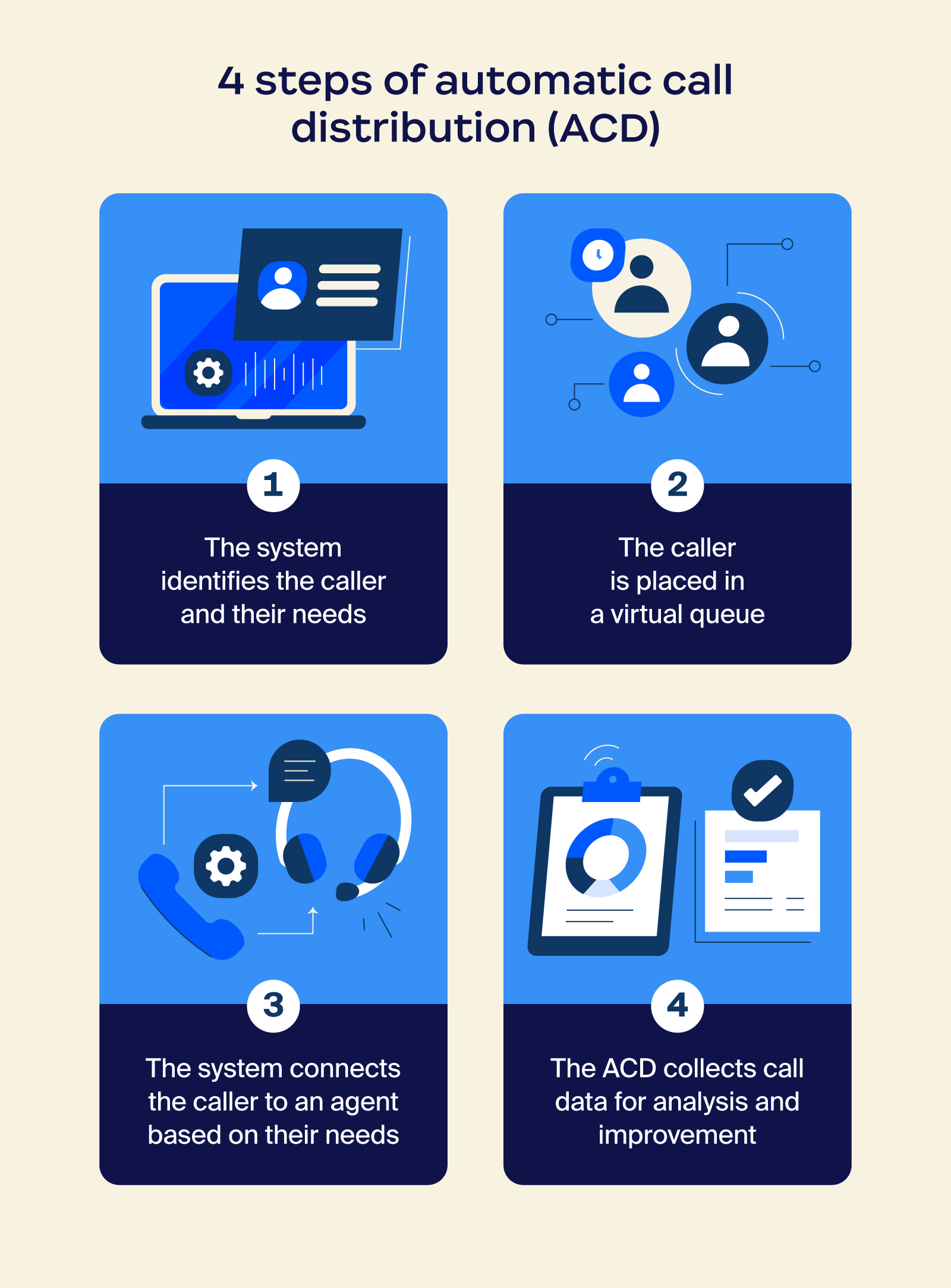
The call center ACD process typically involves the following steps:
ACDs use different strategies to route incoming calls to agents. The best method depends on your business needs and call volume. Here are some common ACD routing methods:
| ACD routing methods | |
|---|---|
| Round-robin | The simplest method — calls are distributed to agents in order, like passing a ball around a circle. |
| Skill-based routing | A smarter system in which calls are sent to agents with the skills to handle the specific issue. For example, a billing question goes to the billing team. |
| Longest idle agent | Sends the call to the agent who's been waiting the longest to take a new call. |
| Least occupied agent | Assigns the call to the agent with the shortest active call. |
| Priority-based routing | Gives certain callers or call types priority, like VIP customers or urgent matters. |
| Time-of-day routing | Adjusts call distribution within a certain timeframe, for example, during typical 9-5 working hours. |
| Simultaneous routing | Calls are routed to all agent phones simultaneously, typically improving the average speed of answer, a critical call center metric. |
By automating these processes, ACD software significantly enhances traditional and cloud contact center efficiency, reduces wait times, and improves customer satisfaction.
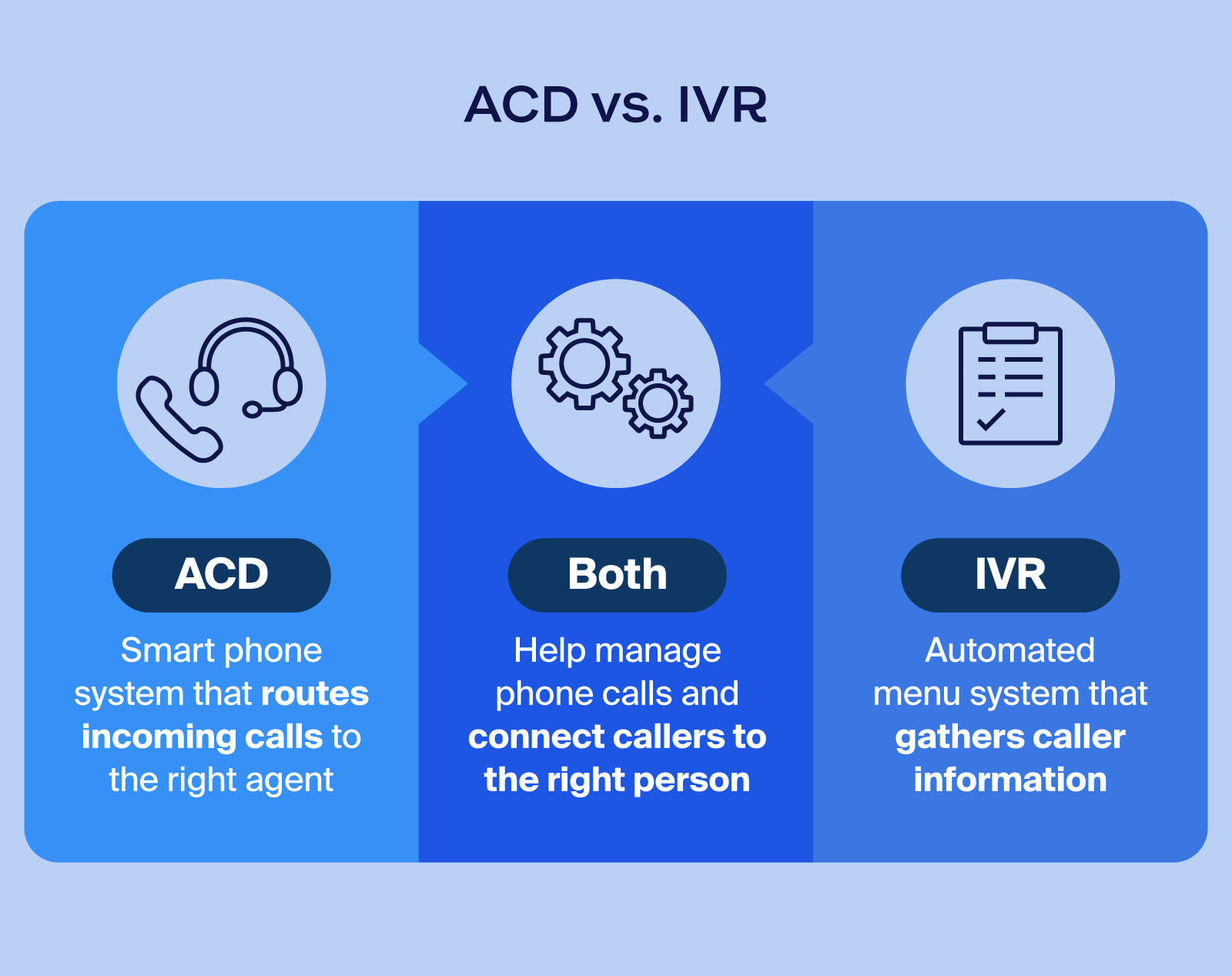
Automatic call distribution and interactive voice response (IVR) are often used together to optimize call center operations, but they serve distinct purposes. By combining the two, call centers can manage call volume, improve caller satisfaction, and optimize agent productivity more effectively.
| ACD | IVR |
|---|---|
| Back-end technology is primarily responsible for automatically routing incoming calls to available agents and minimizing wait time. | An automated menu system that interacts with callers to gather information and direct them to the right service or agent. |
| Functions as a traffic controller, directing calls to the most appropriate agent based on factors like skillset, availability, or call priority. | Provides callers with guided self-service options and reduces call volume by addressing common inquiries without escalating to an agent. |
| Used to create a streamlined workflow by distributing calls evenly among agents. | Used to handle initial caller interaction and qualification, not call distribution. |
An automatic call distributor offers numerous benefits to both customers and agents alike, including:
To make the most of your contact center, your ACD system needs to pack a punch. Besides just sending calls to agents, it should have some extra tools to help you and your team shine.
Here are some key features to look for:
Integrating ACD in call center operations can be a game-changer. By intelligently routing calls, reducing wait times, and balancing workloads, you’ll empower agents to deliver exceptional customer service while enhancing customer satisfaction.
Zoom Contact Center offers a robust ACD solution combined with a suite of powerful features to elevate your customer interactions. Learn what Zoom can do for all your contact center business needs today.
IVR collects caller data and sends it to the ACD system, which then uses it to route the call to the correct agent.
Call center ACD can improve agent productivity by automatically balancing workloads, reducing idle time, and allowing agents to focus entirely on resolving customer inquiries within their specific areas of expertise.
There are numerous ACD routing methods, but some of the main ones include skill-based routing, longest-idle-agent routing, and round-robin routing.