
Your guide to getting started with ZoomMate
Everything you need to start using ZoomMate: notes, search, workflows, and AI tools — all inside Zoom Workplace.
 4 min read
Published on June 29, 2026
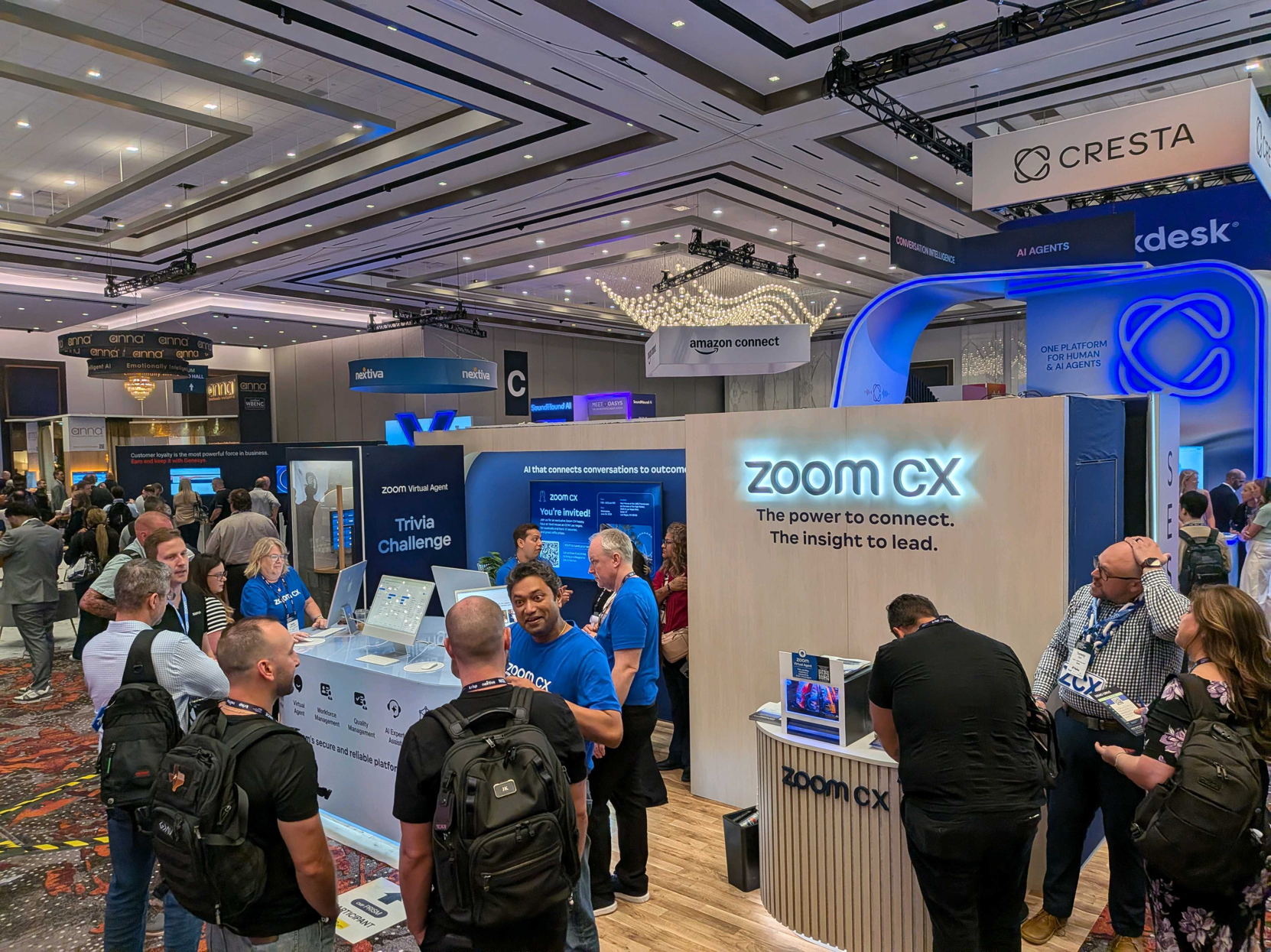



At CCW Las Vegas 2026, Zoom CX delivered a clear message to contact center and customer experience leaders: deploying AI is only the beginning. The real challenge is visibility: knowing whether AI is working, where it's failing, and how to improve it.
In this blog, we'll explore the latest innovations from Zoom CX, including what launched this week at Customer Contact Week (CCW), and real customer outcomes proving the platform story.
Zoom CX is Zoom's contact center and customer experience platform, bringing together Zoom Virtual Agent (AI-powered self-service), Zoom Contact Center (omnichannel routing and agent desktop), AI Expert Assist, CX Insights, Workforce Management and Quality Management into a single, unified system. Unlike point solutions that require separate vendors for automation, analytics, and compliance, Zoom CX brings each layer of the contact center onto one platform, with one customer data model, one agent desktop, and one administrative layer.
One of the most anticipated sessions at CCW 2026 was a fireside chat with Kentis Gopalla, Head of Product for WEM and the ZCX Ecosystem.
Gopalla tackled the question on everyone's mind: you bought the platform, you ran the pilot, you presented the business case. So why are customers still repeating themselves, agents still drowning in wrap-up work, and leadership still asking where the ROI is?
His message was clear: deploying AI is not the finish line. It's the starting line.
"You don't have an AI problem. You have a visibility problem. The data to improve your customer outcomes already exists inside your conversations, your operations, your workforce metrics. The question is whether you're using it."
Systems built for isolated interactions often lack shared memory, persistent context, and a clear path to resolution. Gopalla identified four stages where AI investment stalls:
Gopalla then laid out a practical framework for closing the gap: drive self-service resolution, optimize in real time, and close the loop with insights.
The goal isn't managing more conversations. It's completing them. Zoom CX is built to deliver with persistent context across every channel and less behind-the-scenes friction burning out agents.
Announced on June 22, Agent Architect is Zoom Virtual Agent's new AI-powered agent creation tool. Agent Architect lets you create production-ready voice and digital AI agents from a single prompt. No workflow expertise needed. Just describe what you want the agent to do, and it handles the rest: interpreting your intent, filling in the gaps, connecting the right data sources, and generating a deployable workflow in minutes.
What makes it different from a basic builder is how the agents actually work. Agents created with Agent Architect can reason through requests, collaborate with other agents, and orchestrate interactions across systems and channels, not just follow a script.
For CX teams that have been stuck in planning mode, this removes the biggest bottleneck. Less time building means more time improving.
Zoom Contact Center's AI Expert Assist 3.0 is a hybrid agentic and intent-based system: a meaningful step beyond classic intent-only tools that surface suggestions without acting on them. Four capabilities define this release:
Smart orchestration. When an agent handles a complex interaction with guidance coming from multiple sources, Smart Orchestration consolidates that guidance into a single, unified action path. Agents get one clear next step, not a list of competing suggestions.
Workflow automation. AI Expert Assist can now complete multi-step tasks in third-party systems — with human approval required before execution: CRM updates, order lookups, and case creation on the agent's behalf. Agents review and confirm before the system acts, keeping humans in the decision loop while eliminating repetitive task work.
Redesigned Expert Assist Agent Builder. The configuration interface has been rebuilt around guided, generative prompt-driven setup. Building a new Expert Assist workflow that previously took weeks now takes minutes.
Agent tracing. Every AI action within Expert Assist generates an auditable record: what the AI reasoned, which tools it used, and what decision it reached. Agent Tracing gives supervisors and compliance teams the visibility they need to trust that AI is working as intended, and to identify and correct it when it isn't.
Live AI interpreter: Zoom Contact Center now supports bi-directional simultaneous interpretation, natively built into the platform. It works across both voice and digital channels, eliminating language as a constraint on which agents can handle which customers.
General Manager of Zoom CX, Chris Morrissey, sat down with CX Today for an on-site video interview at CCW. The conversation covered Zoom's AI-native approach to the contact center, and why a unified platform produces fundamentally different outcomes than a stack of point solutions.
The interview covered five themes:
AI that is native, not bolted on. It's not about the number of AI features on a product sheet. It's whether AI is embedded natively across the full contact center stack, so automation, agent assist, analytics, and compliance all share the same data model and can act on context that siloed tools can't see.
Outcomes over features. The conversation was anchored in measurable results, not positioning. Resolution rates, containment, CSAT, and cost per interaction were the benchmarks, not feature counts.
The unified agent experience. Most agents are still tabbing between multiple windows in their contact center. When Zoom Virtual Agent escalates to a live agent, the full customer context (issue type, prior interactions, sentiment signals) travels with it, with no reintroduction and no data handoff gap.
Human-first AI. Human oversight is a design principle in every AI capability Zoom ships. AI is built to assist and elevate agents, not replace them: Workflow Automation requires human approval before executing tasks, and Agent Tracing gives supervisors a full audit trail of every AI decision.
The tension CX leaders face. Boards want AI ROI, customers want to feel heard, and agents are asked to deliver both at once. Morrissey shared his perspective on where the line sits and what "human-first, AI-powered" actually means when the pressure is on.
CCW 2026 made one thing clear: it is no longer a question of whether to use AI in your contact center. The real question is whether you have the visibility to know if that AI is actually working.
That is the gap Zoom addressed directly at CCW this year. The four stages Kentis Gopalla outlined: no data, siloed data, no insights, no feedback loop. These were not abstract concepts. They were problems every leader in that room recognized from their own organization. And each announcement Zoom made was a direct, product-by-product response to one of those gaps.
Zoom CX now offers outcome-based pricing, aligning cost directly to the result customers are actually purchasing: resolution. You pay when the AI resolves the issue (specific pricing terms, conditions, and eligibility vary — contact your Zoom representative for details). That shift moves the conversation away from feature evaluation and toward outcome accountability. It also reflects how Zoom is thinking about its own responsibility to customer results going forward.
For CX leaders mapping out their AI roadmap, Zoom's CCW 2026 presence gives a useful frame: look for the platform that does not just deploy AI, but gives you the tools to know it is working, improve it continuously, and prove the results to your organization.
What is Zoom CX and what does it include?
Zoom CX is a contact center and customer experience platform that brings AI-powered self-service, omnichannel routing, agent assistance, operational analytics, and workforce engagement management together under one platform. Rather than requiring separate vendors for each layer of the contact center stack, Zoom CX runs automation, agent desktop, quality management, compliance, and insights on a shared data model and administrative layer.
The platform includes Zoom Virtual Agent for AI-powered self-service; Zoom Contact Center for omnichannel routing and the agent desktop; AI Expert Assist for real-time agent guidance and workflow automation; CX Insights for operational intelligence; and Zoom Compliance Manager for regulated-industry archiving and governance. The unified architecture means every layer shares the same customer profile: context travels with the interaction from virtual agent to live agent without gaps.
How does Zoom Virtual Agent's agent performance suite help contact centers improve over time?
Agent performance suite gives contact center teams three feedback mechanisms that most AI deployments lack. Agent performance enables pre-deployment simulation and post-launch real-time dashboards tracking resolution rates, containment, CSAT, and cost per interaction. Quality management for Zoom Virtual Agent scores AI agent interactions continuously, surfacing where automation is falling short before failure compounds. Knowledge base (KB) suggestions extracts insights from escalated interactions that human agents resolved and recommends knowledge base updates, with human oversight applied before changes take effect.
Together, these three capabilities create the feedback loop that converts a deployed AI agent into an improving one. Organizations can identify and address Virtual Agent gaps in near real time rather than waiting for a quarterly review.
What does "outcome-based pricing" mean for Zoom Virtual Agent?
Outcome-based pricing ties Zoom Virtual Agent's cost to resolved interactions rather than seat counts, channel fees, or per-minute consumption. Organizations pay when the AI successfully resolves a customer request, not for the infrastructure it runs on.
For finance leaders evaluating AI ROI, outcome-based pricing converts the investment from a fixed platform cost to a variable cost that scales with successful resolution. It also changes the vendor relationship: Zoom's commercial interest is aligned to making the AI work better because better resolution rates directly affect per-interaction cost.
How does Zoom CX handle AI quality and human oversight?
Every AI capability in Zoom CX is designed with human oversight as an explicit architectural principle. Workflow automation in AI Expert Assist completes multi-step tasks in third-party systems but requires human approval before execution. Agent tracing generates auditable records of AI reasoning, tool usage, and decision flow, giving supervisors and compliance teams the ability to review and correct AI behavior. KB suggestions applies recommended knowledge base updates only after human review. Quality management for Zoom Virtual Agent scores AI interactions and surfaces issues to supervisors rather than applying fixes autonomously.
The principle is consistent across the platform: AI handles the work that benefits from automation; humans retain oversight over decisions that carry consequence.
What is CX Insights and how is it different from standard contact center reporting?
CX Insights is Zoom Contact Center's conversational intelligence and operational analytics layer, designed to replace manual reporting workflows: weekly spreadsheet exports, end-of-week coaching reviews, and static dashboards that show what happened but not why.
The practical difference is interaction speed and context. A supervisor who sees a CSAT dip can click on that signal and CX Insights automatically scopes the relevant transcripts and opens an investigation, with no export, no filter setup, and no waiting. Memory learns team structures, KPI definitions, and investigation patterns over time, enabling the platform to provide increasingly relevant insights as it accumulates organizational context.
What is Agent Architect?
Agent Architect is a prompt-driven creation tool in Zoom Virtual Agent that lets teams build production-ready AI agents from a single description. It automatically interprets intent, connects data sources, and generates deployable workflows in minutes. Unlike standard builders, Agent Architect uses reasoning and orchestration to create agents that can collaborate and act across systems, not just follow scripts.
What is the Agent Performance Suite?
The Agent Performance Suite is a performance optimization layer for Zoom Virtual Agent that tracks resolution rates, containment, and customer satisfaction across every interaction. It combines real-time dashboards, quality management, and continuous learning to help organizations measure and improve both virtual and human agent performance.
What's new in AI Expert Assist 3.0?
AI Expert Assist 3.0 introduces agentic task execution, allowing AI to not only suggest actions but complete them with agent approval. It consolidates guidance from multiple sources into a single action path, generates automatic interaction summaries, and provides real-time coaching insights, helping live agents work faster and with more consistent, relevant guidance.