
Webinars & Events

Why marketing teams trust Zoom for their most important virtual events

Zoom Webinars Plus and Events were named a Leader — and received above-average customer feedback. Here's what that means for your events program.
6 min read

Published on June 23, 2026

Image Placeholder
Kimberly Storin
Kimberly Storin
Chief Marketing Officer

Kimberly Storin is a marketing and communications leader known for transforming brands and driving sustainable growth. She serves as Zoom’s chief marketing officer and oversees the brand, communications, product marketing, enterprise marketing, and regional marketing teams.  

Kim joined Zoom in 2025 from Zayo. She was the chief marketing and communications officer and built the company’s first-ever marketing function, elevated its brand reputation, integrated three acquisitions, and contributed to three consecutive years of bookings and revenue growth. Prior to Zayo, Kim held marketing leadership roles at a variety of tech companies, from a SaaS start-up to a Fortune 50, and was an M&A consultant at Deloitte earlier in her career. Kimberly serves as Chair of the Women’s Fund for the Austin Community Foundation and is also a founding member of the Austin chapter of Women in Revenue. 

She earned a Bachelor of Business Administration in Management Information Systems from the University of Texas at Austin and an MBA from the University of Southern California’s Marshall School of Business.
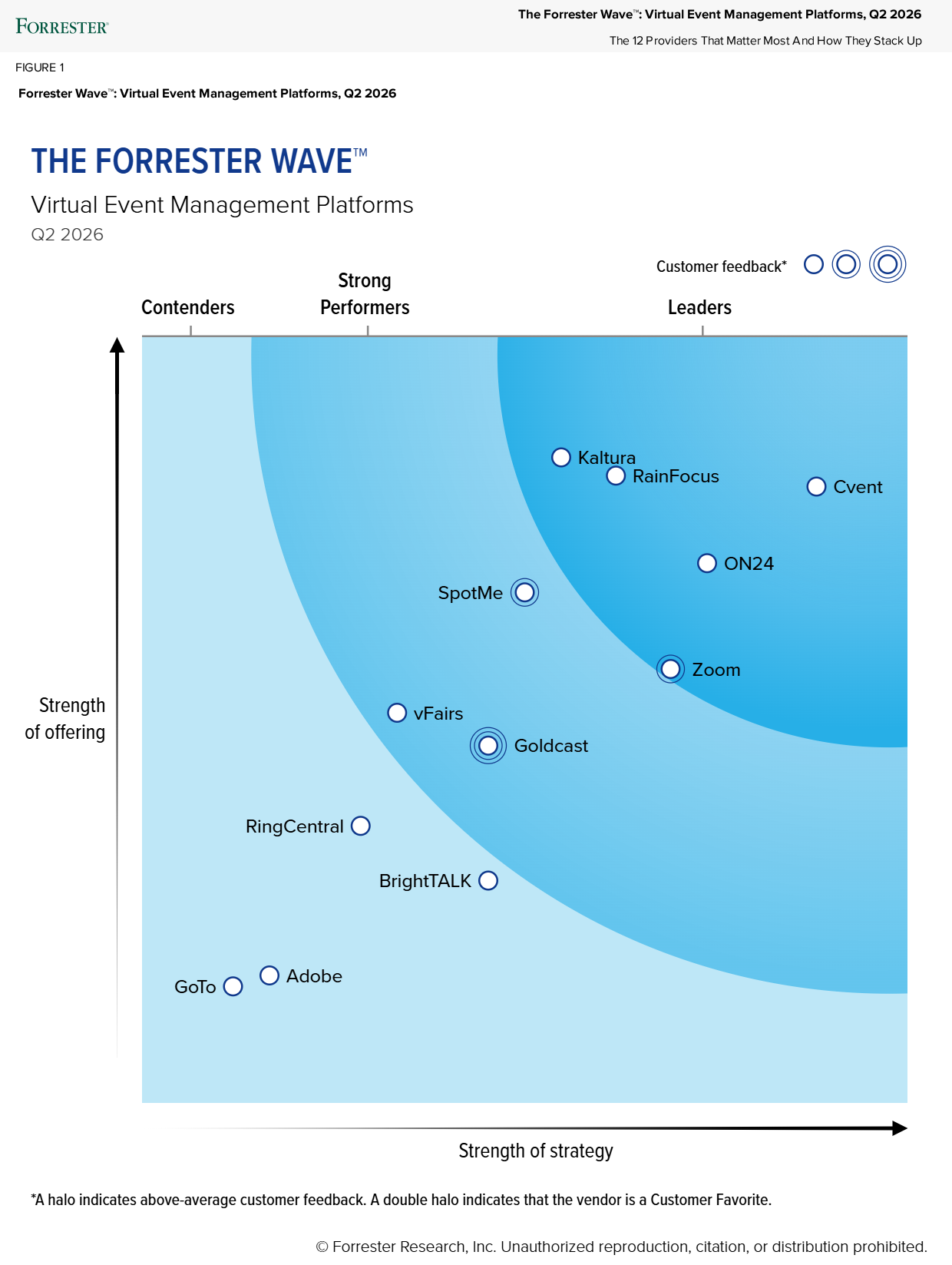

We're proud to announce that Zoom has been named a Leader in The Forrester Wave™: Virtual Events Management Platforms, Q2 2026 — an independent evaluation by Forrester Research that evaluated the top providers in the category across current offering, strategy, and customer feedback.
 
Being named a Leader matters. But here's what makes this recognition different: we received above-average customer feedback.
 
That's not something we said. It's what our customers told Forrester, independently, when asked to evaluate their experience with our platform.
 
For marketing leaders deciding where to run their demand generation webinars, customer summits, and large-scale virtual conferences — that distinction matters. It’s not a case study we wrote or a metric we self-reported. It's customer feedback, collected by Forrester's analysts, from the teams who actually run events on our platform.

Read The Forrester Wave™: Virtual Events Management Platforms, Q2 2026

Forrester does not endorse any company, product, brand, or service included in its research publications and does not advise any person to select the products or services of any company or brand based on the ratings included in such publications. Information is based on the best available resources. Opinions reflect judgment at the time and are subject to change. This report is part of a broader collection of Forrester resources, including interactive models, frameworks, tools, data, and access to analyst guidance. For more information, read about Forrester's objectivity here.

What The Forrester Wave™ evaluates

The Forrester Wave™: Virtual Events Management Platforms, Q2 2026 assessed vendors across 31 criteria organized into three dimensions: current offering, strategy, and customer feedback.
 
Key evaluation criteria included:
 
  • Streaming, simulive, and production capabilities
  • Event registration management
  • Audience engagement and interaction
  • Platform security, reliability, and scalability
  • Reporting, analytics, and benchmarking
  • Data capture and use
What makes the Forrester Wave a useful benchmark for marketing leaders is exactly this: it's a scored evaluation applied equally to every provider in the category — not a feature list a vendor assembled about themselves.

Why we were named a leader

Zoom Webinars Plus and Events were evaluated together as a combined portfolio in the Q2 2026 Wave. Zoom believes the recognition as a leader reflects strengths across the criteria that enterprise marketing teams weigh most heavily.
 
We're reliable at scale — and we can show it.
Zoom Webinars supports up to 1 million view-only attendees, depending on your webinar license capacity (U.S.). We've supported more than 9 million webinars annually (Forrester Wave: Virtual Events Management Platforms, Q2 2026). When your product launch or customer summit goes live in front of a global audience, that track record isn't a nice-to-have — it's the foundation everything else depends on.
 
We cover the full event lifecycle in one place.
Zoom Events gives marketing teams branded event hubs, multi-session scheduling, networking lobbies, expo floor capabilities, and customizable ticketing — the infrastructure for multi-day virtual conferences without the complexity of coordinating multiple vendors. Zoom Webinars handles the broadcast end: high-attendance presentations with lead capture, Q&A, polling, and CRM integration built in.
 
We make production faster without sacrificing quality.
Capabilities built into Zoom Workplace — including event content generation, event image generation, webinar summary, and post-event smart recap — help marketing teams produce and repurpose event content more efficiently. Human review is built into each output, which is how AI should work in a professional content workflow.
 
Your team already knows how to use it.
Zoom Events and Zoom Webinars build on a platform most speakers, organizers, and attendees already use. That familiarity reduces speaker prep time, cuts onboarding overhead, and eliminates the technical friction that drives attendee drop-off before an event starts.
 
Forrester's analysts summarized it directly:
"Zoom is a strong choice for organizations prioritizing security, reliability, scalability, and AI‑enabled productivity, especially those already standardized on Zoom's UCaaS platform."
(Source: "The Forrester Wave™: Virtual Events Management Platforms, Q2 2026," Forrester Research, Inc., June 2026)
 
We also appreciated Forrester's recognition of our strategic vision:
"Zoom's above-par vision positions webinars and events as an extension of an organization's communications and collaborations stack, offering clients access to adjacent products such as Zoom Docs and Tasks to optimize event planning and collaboration."
(Source: "The Forrester Wave™: Virtual Events Management Platforms, Q2 2026," Forrester Research, Inc., June 2026)
 
That's exactly how we think about it. Virtual events shouldn't live in a silo, they should connect to the tools your team already uses to plan, collaborate, and follow up.

The customer feedback distinction

Recognition as a leader in a Forrester Wave reflects Forrester's analyst assessment. Customer feedback reflects something different: what actual platform users told Forrester when asked to evaluate their experience.
 
We received above-average customer feedback in the Q2 2026 evaluation.
 
Every vendor in a Forrester Wave can describe their capabilities. Customer feedback is what those customers said after running real events on the platform — after dealing with live production pressures, onboarding speakers, extracting post-event data, and measuring results against pipeline goals.
 
That gap between what a platform promises and what customers actually experience is exactly what this recognition closes. For marketing leaders evaluating platforms, it's a qualitatively different signal than anything a vendor produces about themselves.

What this means when you're evaluating platforms

The Forrester Wave criteria map directly onto the questions any marketing or events team should be asking. Here's how to translate the evaluation framework into your own vendor assessment:
 
Key question to ask any vendor: "Can you show me a live event you've powered at our anticipated audience size — and what does your uptime record look like in the last 12 months?"
 
  1. What is the platform's proven ceiling for live event streaming? Know your largest anticipated audience and pressure-test against that number — not a controlled demo.
  2. How does it capture and activate first-party data? Every registration, session attendance, poll response, and CTA click is a behavioral signal. A platform that routes those signals directly into your CRM and marketing automation system turns one event into weeks of qualified follow-up. Ask specifically: what data fields are captured, in what format, and which integrations are native vs. requiring a third-party connector.
  3. Does it cover the full event lifecycle in one place? Every integration point is a potential failure point. Registration, live production, engagement tools, recording, on-demand hosting, and post-event analytics should live in one system.
  4. What AI-assisted tools are available — and how is human oversight built in? Content generation, smart recap, and post-event email compose reduce production hours for lean marketing teams. Confirm that human review is a designed part of the workflow, not an afterthought.
  5. What do customers who use the platform at scale actually say? Vendor case studies are useful. Independent customer feedback collected by an analyst firm — especially feedback that distinguishes one Leader from another — is a different category of signal entirely.

For a deeper guide to planning and hosting virtual events

Virtual events in practice: customer results

We'd love to show you what we can do

For Zoom, being named a Leader in The Forrester Wave™: Virtual Events Management Platforms, Q2 2026 reflects what Zoom Events and Zoom Webinars deliver in practice: a platform that is reliable at any scale, familiar enough that speakers and attendees don't need training, and capable of covering the full virtual event lifecycle from registration to post-event pipeline.
 
Being a Leader with above-average customer feedback reflects something more direct for us: it's what our customers said, independently, to Forrester's analysts.
 
Access your copy of The Forrester Wave™: Virtual Events Management Platforms, Q2 2026 → Access here — and explore how Zoom Events and Zoom Webinars can support your next event program.

Our customers love us

Okta
Nasdaq
Rakuten
Logitech
Western Union
Autodesk
Dropbox

Zoom - One Platform to Connect