Achievements

15 years, 15 perspectives: How AI will redefine human collaboration

AI won't just automate work, it will fundamentally change how work gets done. Zoom Founder & CEO, Eric Yuan, on why he believes the next 15 years will be more human, not less.
5 min read

Published on July 14, 2026

Image Placeholder
Eric S. Yuan
Eric S. Yuan
CEO

Eric founded Zoom in 2011 to deliver happiness and bring people together in a frictionless video environment. Zoom’s communications platform continues to transform the way global organizations connect, communicate, and collaborate. As the company’s chief executive, Eric led Zoom to one of the highest-performing tech IPOs of 2019.

Business Insider named Eric one of the Most Powerful People in Enterprise Tech in 2017. In 2018, Glassdoor recognized him as the top CEO for large U.S. companies. In 2019, he was recognized in the Bloomberg 50 as a leader changing the game in global business. Time Magazine named Eric its 2020 Businessperson of Year as well as one of the 100 Most Influential People of 2020. He was also named Comparably's Best CEO for Diversity in 2021.

Prior to founding Zoom, Eric was corporate vice president of engineering at Cisco, where he was responsible for Cisco's collaboration software development. Eric was also one of the founding engineers and vice president of engineering at Webex.

Eric is a named inventor on 11 issued and 20 pending patents in real-time collaboration.

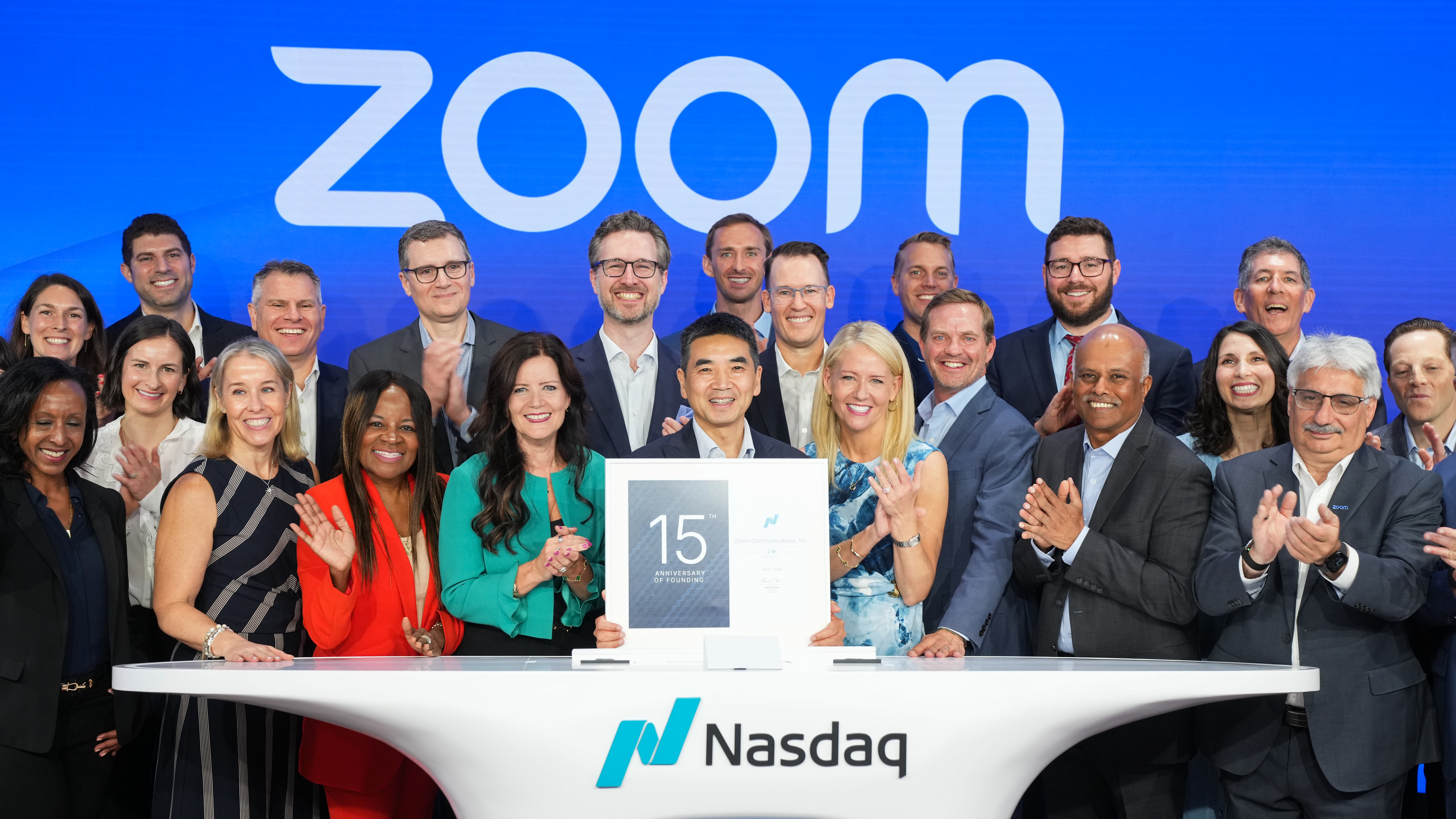
Today I'm in New York where we rang the Nasdaq bell to celebrate Zoom's 15th anniversary. Standing there with our team, I couldn't help but think back to the summer of 2011, when I signed the lease for our very first office in San Jose. Suite 404, just 645 square feet.

Not wanting a suite number commonly associated with an http error code, I changed it to 478 for good luck. In Chinese culture, those numbers represent "rise and prosper," and for a brand-new company, I figured we could use all the good fortune we could get. Maybe that luck is still working.
 
What has happened over the past 15 years is far beyond anything I could have imagined. It's the perfect moment to reflect on how far we've come and look ahead to what's in store, not just for Zoom, but to what I believe will define the future of work for all of us.

Looking back to look forward

I started Zoom with one simple mission: to deliver happiness.
 
That mission was born from a few defining experiences. As a young boy in China, I dreamed of the innovative world of Silicon Valley after reading the stories of HP and Apple. It took me nine visa rejections before I finally made it here to the US. 
 
In my early days at WebEx, I saw firsthand how much people struggled to simply connect. Then, as I progressed in my career, I learned how bureaucracy can block innovation.
 
So, in 2011, I decided to start over from scratch. Just me, a small team, a big dream, and an unwavering belief that if we truly cared about customers, everything else would follow.
 
Over the past 15 years, I've learned a few lessons that continue to guide me to this day:
 
  • The most valuable feedback comes from customers who leave. Early on, I personally called customers who canceled their subscriptions to understand why and how we could help.
  • Building for scale isn't optional, it's a mindset. When millions of people are counting on you to stay connected, you have to be ready before they need you. And now we've connected them, we're simplifying and improving how work gets done.
  • The secret to proactivity is care. When you care deeply about others, you naturally think ahead and build better.
By taking these core lessons to heart, we've grown from a scrappy unknown brand to a household name. But now to the future and what lies ahead.
 
There are many things I'm excited about as I look forward, many of which, I believe, will shape the way we work now and in the years to come.

15 perspectives on the next 15 years

These aren't predictions from a crystal ball. They're convictions shaped by 15 years of building, listening, and learning alongside our customers and our team. Some of them are already happening. Others will take time. I share them not as certainties, but as an invitation to think about the future together.
 

1. The next decade won't be about working more, it will be about accomplishing more

AI is set to remove the friction between conversation and action. That's at the heart of our AI strategy here at Zoom. The tools that follow your conversation, summarize, and execute will free people to focus on creativity and strategy, not coordination. The real revolution isn't about speed. It's about clarity. When work flows naturally from what we say and decide, we'll finally spend our time on what matters most.
 

2. The meeting where nothing gets decided will become increasingly rare

AI will help ensure every meeting has purpose, context, and follow-up, and if a meeting isn't adding value, it becomes a lot easier to skip it entirely.
 
The best meetings will feel lighter, faster, and more human, because everyone will be more present and the fumble of busy work (note-taking and figuring out next steps) will be gone.
 

3. Coordination work will dramatically shrink

The time-intensive work like team coordination, scheduling, note-taking, and follow-ups is well on its way to becoming automated.
 
The real value will come from human insight, connection, and empathy, things machines can't replicate, and what we long to spend more time on. Imagine a world where your ideas move forward while you sleep, because of the context and direction you've given your AI tools, and your energy goes toward solving problems, not managing them.
 
That's the kind of progress that can make work joyful.
 

4. The future of daily work is about turning every conversation into completed work

Meetings, chats, and emails will all connect to outcomes. The goal isn't just communication, it's completion. For 15 years, Zoom has hosted the conversations that matter most to organizations. Now, with AI, we're closing the gap between what gets discussed and what actually gets done.
 
Imagine finishing up a meeting and seeing the next steps already in motion. That's not a pipe dream; it's happening now and it's defining the next chapter of productivity.
 

Help build the future of work at Zoomtopia 2026

5. AI's biggest impact will be helping humans live their best lives

There's a big fear that AI is coming to take your job. I believe the most powerful AI won't replace people. It will help them not only work together better, across time zones, languages, and organizations, but also live longer thanks to the incredible breakthroughs healthcare AI will enable. The magic happens when technology fades into the background and humans become the focus. That's when innovation really comes into its own and leads the charge.
 

6. The next era belongs to companies that build around the customer experience

For too long, customers have had to adapt to companies' internal systems. The winning businesses will be those who design everything from the outside in. When you start with care and design processes through the eyes of your customers, you end up with simplicity. And, more often than not, simplicity wins.
 

7. The most successful companies will use AI to put human collaboration front and center

I believe technology should make people more connected, not more isolated. The best AI will serve to strengthen trust and teamwork. It will help us listen better, understand faster, and act with more empathy. In this way, technology becomes a bridge, not a barrier.
 

8. The next wave of AI transformation will come from solving real human problems

The breakthroughs won't just come from adding infrastructure or large language models. They'll come from an application approach that makes daily work simpler and more human. The most profound impact may come from AI in biotechnology, which I believe will cure diseases that were previously terminal, such as cancer, Parkinson's disease, and dementia. The companies and institutions that focus on true human problems and lead with care will come out on top.
 

9. Technology should serve people, not the other way around

Every product decision should start with one question: does this make life better for the people using it? When we build with empathy, we build things that last. The best technology is so simple and intuitive that it disappears into the background and lets people shine.
 

10. Innovation depends on bottom-up ideas reaching decision makers

At big companies, good ideas can often die in the middle layers. The best architecture isn't just about technical factors, organizational process is a huge part of it too. The companies that stay flat, open, and curious will keep reinventing themselves long after others slow down.
 

11. The future of innovation is borderless

Talent is everywhere. The companies that embrace global collaboration will build products the rest of the world hasn't imagined yet. The next great idea might come from a developer in Nairobi, a designer in São Paulo, or a teacher in Seoul, and that's something to celebrate and embrace.
 

12. The companies that chose trust during remote work will lead the future

The pandemic forced every leader to decide: control or trust. Those who trusted their people built stronger, more resilient cultures. Trust moves faster and is a lot more effective than control. I believe a culture of trust is the ultimate barometer of success for every business.
 

13. Hybrid work is here to stay

Time has proven that hybrid work is not a trend, it's the new baseline. Flexibility is now a core expectation, and companies that resist it risk losing great talent. The future belongs to organizations that measure outcomes, not office hours.
 

14. I believe the four-day work week will become a reality

Not because of new laws, but because AI will make it possible. This isn't the first time technology has redefined what the normal work week looks like. A century ago, the idea that workers deserved two days off felt radical, until it didn't. The shift happened because new tools made it economically viable, not because attitudes changed first. We're at a similar inflection point today.
 
AI is quietly eliminating the coordination overhead, the status updates, the scheduling back-and-forth, and the coordination drag that fills so many hours without creating real value. When that friction disappears, the case for a shorter week stops being idealistic and starts being practical.
 
In my view, productivity won't drop. For most knowledge workers, I believe it's set to rise, giving everyone more personal time back.
 

15. Care is the ultimate competitive advantage

I'll end with this as it's core to everything we do at Zoom. Retention, innovation, and customer loyalty all come down to one thing: do your people genuinely care? When they do, everything else follows. If there's anything the past 15 years have taught me, it's this: care isn't a soft value, it's a hard strategy. It's what turns good companies into great ones.


The next 15 years

Fifteen years ago, Zoom was a bet that simplicity and human connection could win. That bet paid off because of the people who believed in it, our team, our customers, and the millions of people around the world who trusted us to keep them connected when it mattered most.
 
Now we're entering a new chapter. The question is no longer whether AI will transform work. It's whether we'll continue to build it in a way that makes work not only easier, but more human and enjoyable.
 
I don't know exactly what the next 15 years will look like. But I know how we'll approach them: with curiosity, with humility, and with the same belief that got us here. 

If you build something people love, and you never stop listening, the best is always yet to come.

Be part of the conversation at Zoomtopia 2026 Register today to shape the future of work with us.

Our customers love us

Okta
Nasdaq
Rakuten
Logitech
Western Union
Autodesk
Dropbox

Zoom - One Platform to Connect