
Your guide to getting started with ZoomMate
Everything you need to start using ZoomMate: notes, search, workflows, and AI tools — all inside Zoom Workplace.
 9 min read
Published on February 28, 2025



In the fast-paced world of contact centers, managing high call volumes while delivering exceptional customer service is no small feat. Agents often start calls with limited information, which can lead to longer handling times and customer frustration. This is where automatic number identification (ANI) makes a difference.
ANI identifies the caller’s phone number so that an agent doesn’t have to spend time trying to identify them. Instead, they can start the call with all the background information and customer history associated with that phone number. Contact centers use this information to identify callers, pull up relevant records, and route calls more efficiently, reducing wait times and enhancing the overall experience.
ANI (automatic number identification) is a telecommunications feature that automatically captures and transmits the phone number of an incoming caller to the recipient. While it’s often compared to caller ID, ANI is a more sophisticated technology that provides the phone number via the network signaling system—a more reliable method even when caller ID is blocked or unavailable.
ANI enables agents to access relevant customer data before answering the call. This helps:
Glean insights to streamline workflows: enabling automated systems to verify caller identities, flag potential fraud, and prioritize certain customers based on predefined criteria.
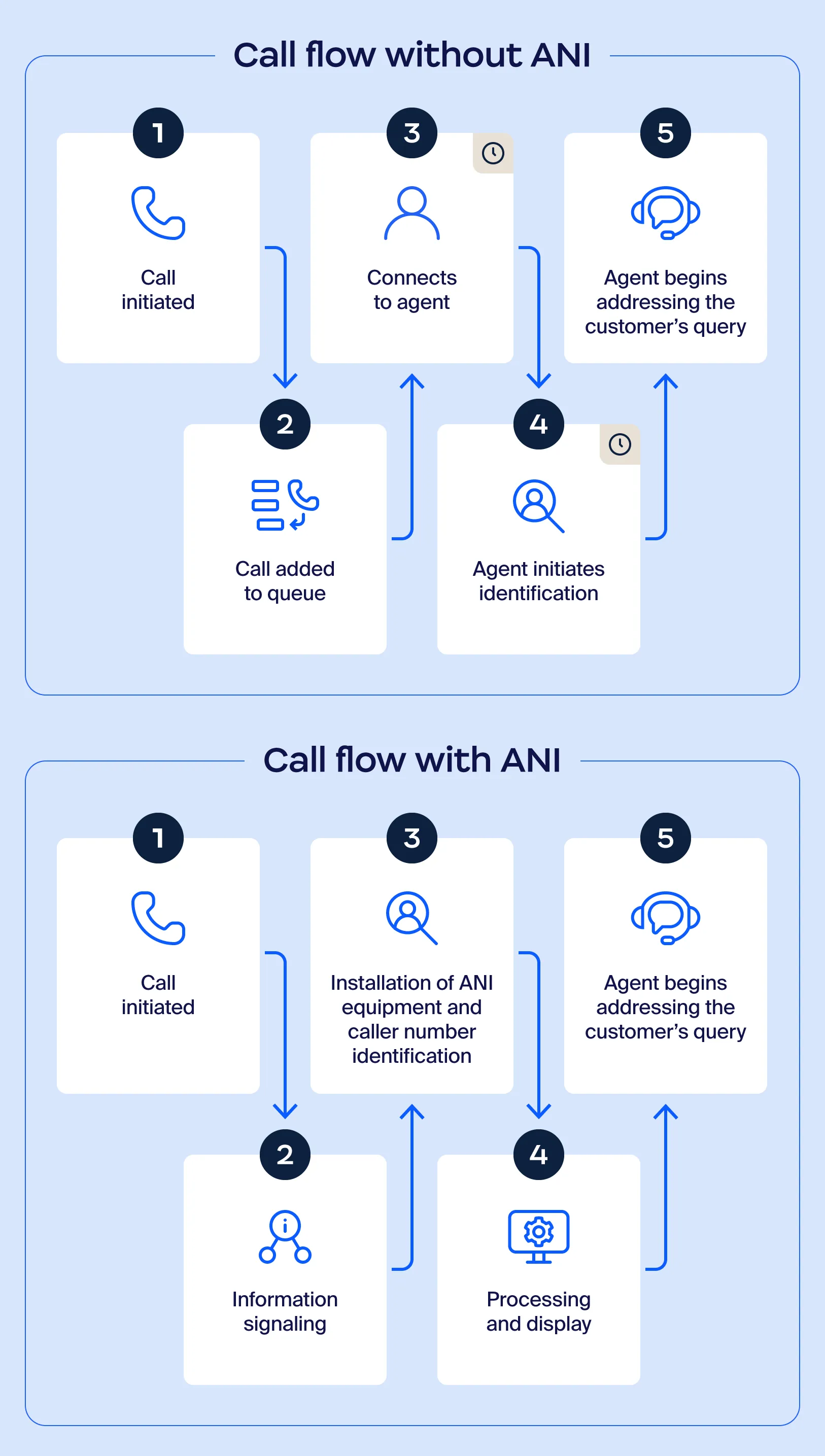
ANI functions by capturing the caller’s phone number and transmitting it to the recipient via the telecommunication signaling system. When someone places a call, it doesn’t just travel directly from one phone to another. Behind the scenes, a signaling system routes the call through the network, sending the caller’s phone number and other information via separate channels so it reaches its destination before the recipient answers.
Once received, ANI data integrates with the contact center’s customer relationship management (CRM) or call management systems. This lets agents instantly access customer profiles, transaction history, or other details. Additionally, ANI is often paired with automated routing systems to direct calls to the appropriate department or agent based on predefined rules like geographic location, customer status, or previous interactions.
Although dialed number identification service (DNIS), ANI, and caller ID all deal with call-related information, they serve distinct purposes within the telecommunications and contact center ecosystem. Understanding these differences can clarify the meaning of ANI and help businesses determine how to best utilize each feature.
Together, these tools can enhance contact center operations, but ANI and DNIS stand out for their utility in high-volume, professional environments.
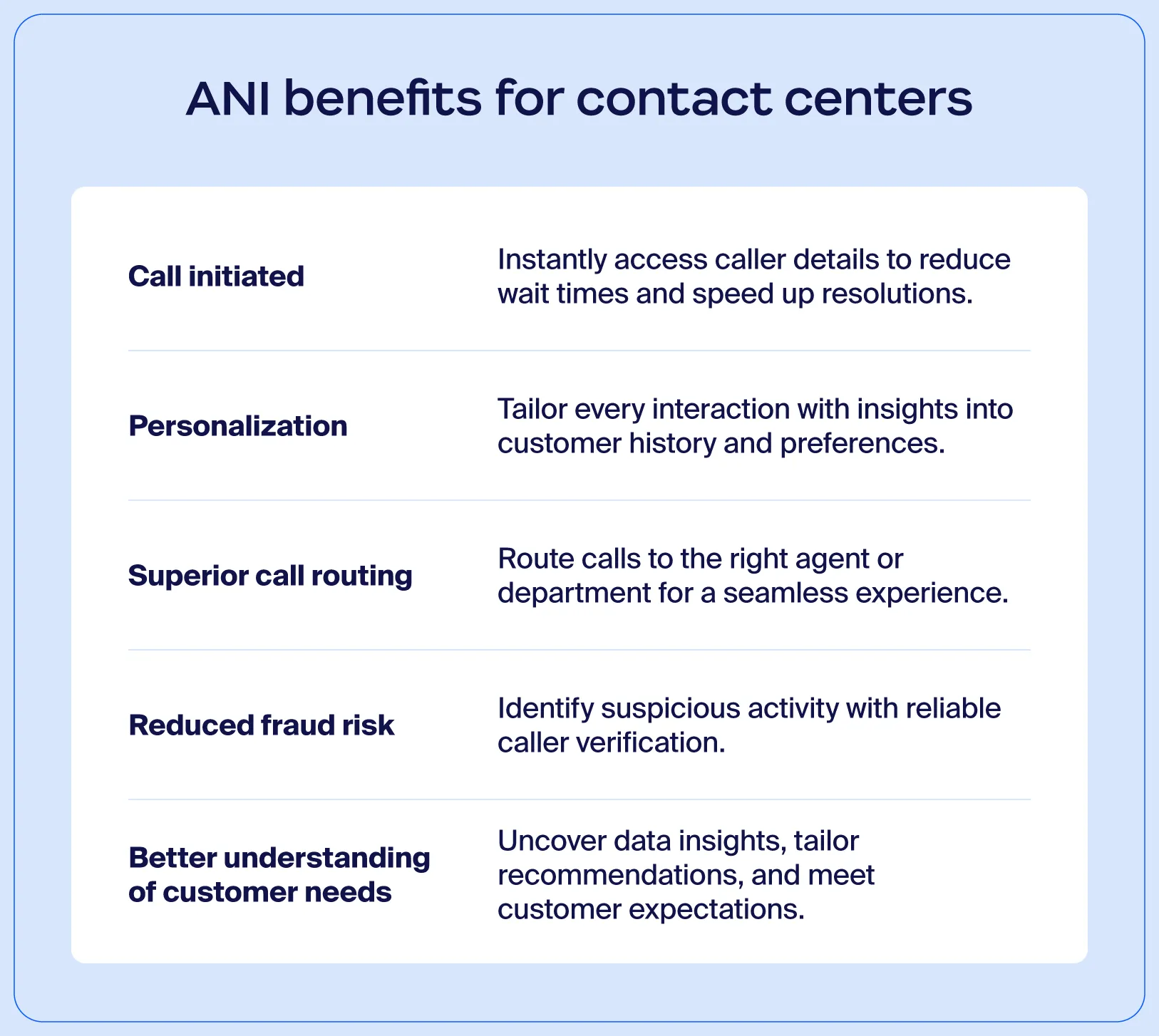
Automatic number identification offers several advantages that help contact centers improve efficiency, customer interactions, and overall operations. Here’s what ANI can help you do:
A personalized experience is just as important as excellent audio quality and a hiccup-free customer journey, as customers feel valued when agents know who they are and what they need.
Since ANI enables contact centers to recognize customers as soon as they call, agents can greet them by name and access relevant information immediately. This eliminates the need for repetitive questions, such as asking for account numbers or prior interactions, and creates a smoother experience.
With ANI, agents no longer need to manually verify caller information, such as account numbers or other identifiers. The caller’s number is automatically matched with the contact center’s database, pulling up their records in real time. This enables customer service automation, resulting in shorter wait times and greater efficiency.
ANI can be integrated with automated call distribution systems to route calls more effectively. For example, calls can be directed to specific departments or agents based on the caller’s location, account status, or previous interactions. This reduces misrouting and connects customers to the right person the first time, leading to fewer transfers, shorter call times, and higher first-call resolution rates.
Better routing means fewer transfers, shorter call times, and higher first-call resolution rates, which are important for maintaining high customer satisfaction levels.
ANI provides an added layer of security by verifying the caller’s number. Contact centers can flag suspicious or unrecognized numbers and reduce the risk of fraud or unauthorized access. This capability is particularly valuable for businesses in industries such as finance and healthcare that handle sensitive information.
For example, if someone tries to use your information to make changes to your account through customer support, agents can flag the unrecognized phone number and try to confirm the caller’s identity.
Because ANI pulls up customer details immediately, agents can tailor their interactions to the caller, making personalized recommendations (and opening opportunities for upselling and cross-selling) based on the customer’s history, preferences, or past inquiries. Even better, if a call center integrates ANI with its CRM data, agents can gather even more useful information before engaging with the customer.
For example, if a customer previously inquired about an upgrade, the agent can proactively suggest options during the call.
Collecting ANI data across calls enables contact centers to analyze call center metrics such as call frequency, peak call times, and call abandonment. Understanding these helps optimize operational resources and improve call routing, thereby reducing wait times and improving the customer experience.
Call centers can also look at resolution rates, average calls per customer, and escalation rates, which they can use over time to improve workflows and agent training programs. Additionally, companies can connect calls to specific campaigns, ads, or landing pages, helping determine the conversion rates and which campaigns drive the most engagement.
Adding automatic number identification to your contact center software is a straightforward process that starts with evaluating your current telephony system and contact center solutions. Many modern contact center platforms already support ANI functionality, either natively or through integrations.
Check whether your current provider offers ANI functionality. Otherwise, you’ll need to look into reliable, scalable service providers and compare their features to find the best fit for you. Once you’ve implemented ANI, you can connect it to your CRM system and call routing tools to extend its functionality.
Ready to take your contact center to the next level with ANI? Zoom Contact Center offers a Contact Center as a Service (CCaaS) solution, including robust ANI and call handling capabilities to help you streamline operations and elevate customer satisfaction. Reach out today to explore how our solutions can support your business goals and create a better customer experience.
Still have questions about automatic number identification? Here are answers to some of the most common queries to help you better understand how this technology works and its implications for your contact center.
ANI is a telecommunication feature primarily used by service providers to capture and transmit the caller’s phone number for billing and operational purposes. It provides reliable data that cannot be blocked by the caller.
Calling line identification (CLI), also known as caller ID, is a feature that allows end users, such as businesses or individuals, to display the caller’s number on their phone or device. CLI data can be manipulated or withheld by the caller, making it less reliable in some cases.
ANI screening is a process that uses ANI data to identify and filter incoming calls based on predefined criteria. For example, businesses can use ANI screening to prioritize calls from premium customers, block known spam or fraudulent numbers, or route calls to specific departments based on the caller’s location.
While ANI provides valuable caller information, businesses must handle this data responsibly to protect customer privacy and comply with data protection regulations.
Most reputable contact center software providers incorporate robust security measures, such as encryption and data access controls, to safeguard ANI data. However, it’s important for businesses to work with providers that prioritize compliance with privacy laws such as GDPR or CCPA and to implement internal policies that limit access to sensitive data.
ANI can work across multiple phone systems, including VoIP, mobile phones, and landlines. However, you may see varying degrees of effectiveness across different networks or technologies.
It’s not as easy to manipulate ANI as it is caller ID. ANI is generally considered more reliable than caller ID in many contact center environments and is often used for billing, call routing, and emergency services. However, while the average person isn’t likely to tamper with ANI, it isn’t immune to manipulation by sophisticated methods.
ANI can improve business outcomes by providing caller information before the call is answered. This data can lead to quicker call routing, more personalized customer experiences, better fraud detection, and improved analytics. Together, these can bolster the business's efficiency and security, as well as improve the customer experience.