How to call a phone from a computer in 5 simple steps
Learn how to call a phone from a computer in five easy steps with Zoom. Simplify workflows, manage customer calls, and connect with your team faster.
Updated on March 13, 2026
Published on March 13, 2026
Deciding between VoIP vs. landline for your business can be challenging. You need a stable phone system that remains reliable at all times, but you also need to scale and handle increasingly high call volumes. So, which choice is best?
VoIP sends voice data over the internet, while landlines rely on physical, wired telephone infrastructure. While the basic functionality — making and receiving calls — is the same with both, it’s crucial to understand the unique benefits and trade-offs of each.
Although landlines have been the bedrock of business communication, VoIP is quickly emerging as an attractive choice due to the flexibility and features the technology offers. In fact, the VoIP market is projected to grow at an 11.8% compound annual growth rate by 2029. In this post, we’ll break down the differences and pros and cons of VoIP and landlines, as well as how to make the decision.
Voice over Internet Protocol (VoIP) is a technology that enables voice call transmission over internet networks rather than traditional telephone lines. When someone places a VoIP call, their voice is converted into digital packets, transmitted over the network, and reassembled at the other end.
As VoIP is software-based, it operates over an internet connection and can run on desk phones, computers, laptops, mobile devices, or integrated apps. For example, Zoom’s VoIP offering, Zoom Phone, combines standard business phone features (like call forwarding and transferring) with cloud delivery on supported devices.
A landline, or traditional phone line, transmits calls over physical wiring. Traditionally, this has been copper wiring, but more modern landlines may use fiber or digital integrated services, then carry calls via circuit switches and dedicated paths.
When you dial a landline number, a signal travels through the wired network and connects via telephone switching nodes to the end destination. Because of the dedicated circuit, the call quality is generally stable and consistent.
While both landlines and VoIP systems transmit calls and allow voice conversations, the main differences between them are the method of transport and the level of flexibility available.
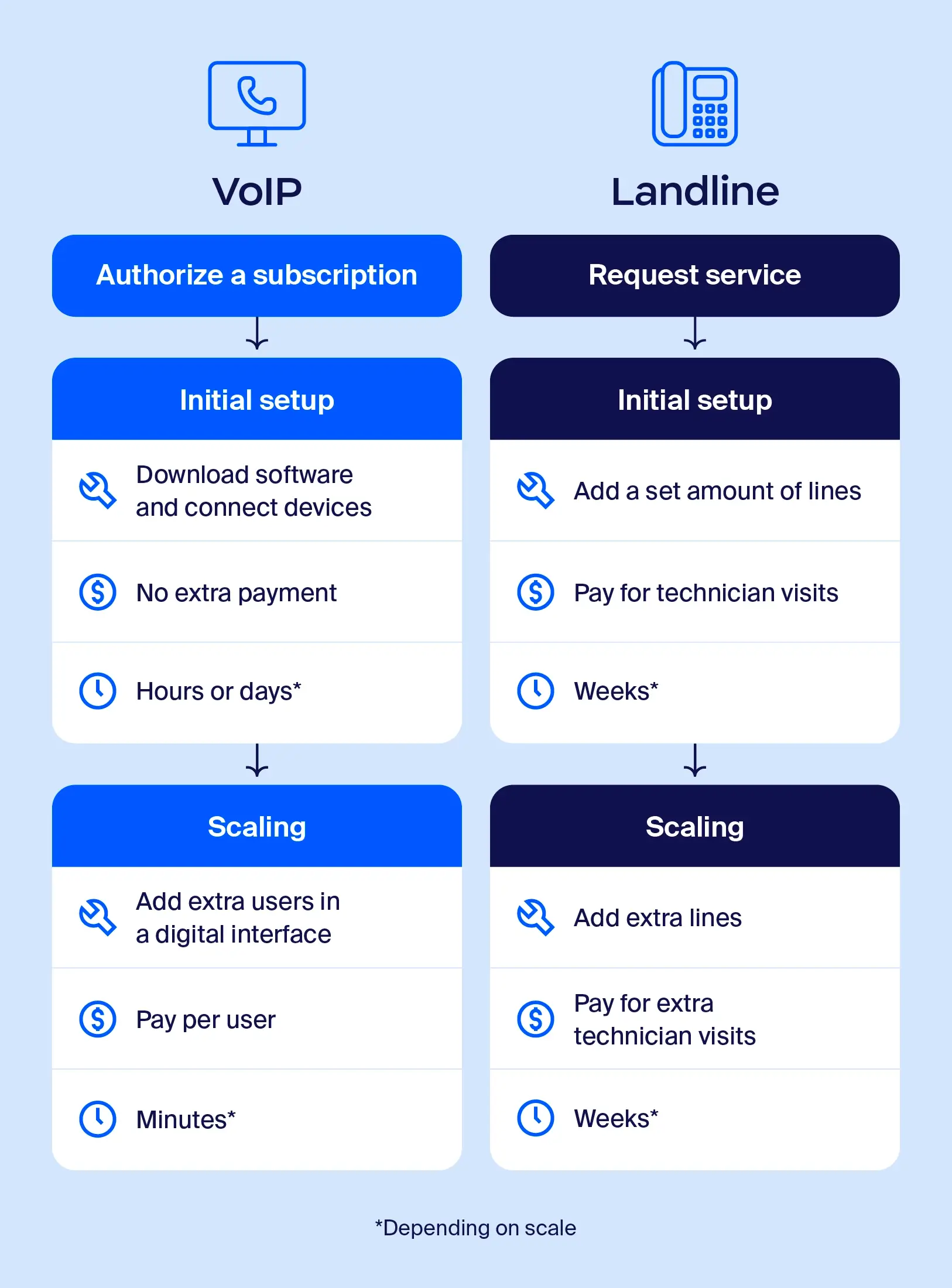
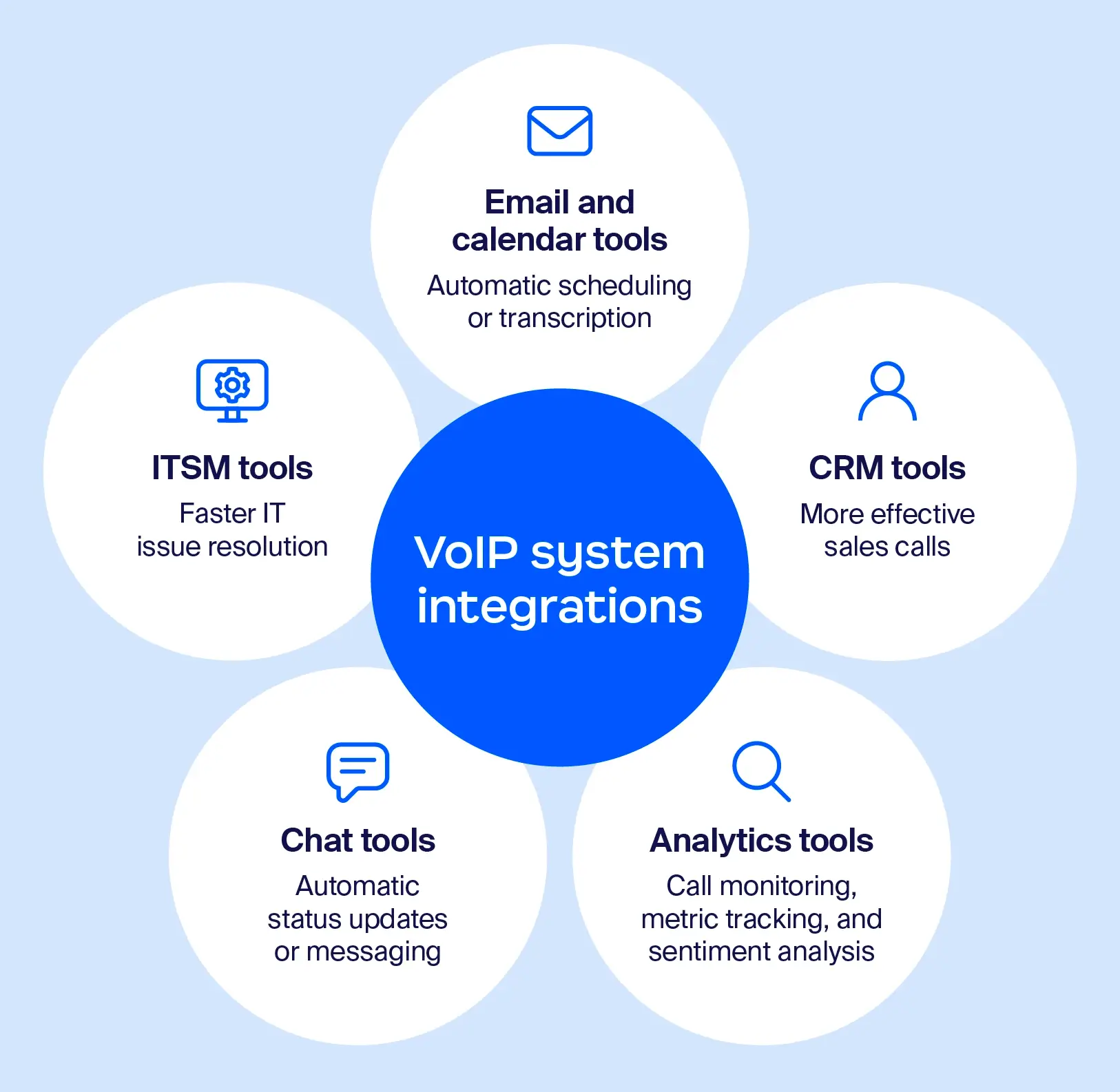
For instance, VoIP coexists with other digital services and works over data networks, while a landline requires a dedicated telephony network. VoIP can integrate with software systems and provide other features, offering greater scalability than a landline, which is constrained by fixed infrastructure and feature limitations.
Check out the quick reference chart below, including some VoIP vs. landline pros and cons.
|
Characteristic |
VoIP |
Landline |
|
Feature set |
Voice calling, call forwarding, auto attendants, voicemail, software integrations, analytics |
Voice calling, voicemail |
|
Call quality |
Often excellent; subject to latency, packet loss, and jitter |
Typically consistent and predictable |
|
Equipment requirement |
Network infrastructure, internet service, phones or devices, and possibly adapters |
Wired telephone network, physical phones |
|
Flexibility |
Easy to make and answer calls from locations with an internet connection |
Requires presence at fixed location connected to a landline |
|
Cost |
Lower costs for operation, especially for adding new lines or calling long distances |
Higher costs for international/long-distance calling and additional lines |
|
Scalability |
Simple to add or remove lines, add features, or adapt to growth |
More difficult to scale; requires infrastructure updates to add new lines |
|
Reliability and uptime |
Very reliable with strong internet and network stability |
Very reliable |
|
Security |
At risk of cyber threats without implementing security measures |
Fewer cyber-related threats |
While landlines may seem outdated when you consider your home phone setup (if you still have one), they still have a place in the business world thanks to their simplicity and stability.
Here are a few key benefits of setting up a business landline:
While there’s a lot to like about a landline, there are some key drawbacks to be aware of before making the VoIP phone vs. landline decision. These include:

VoIP addresses many of the critical limitations of landline systems and brings several benefits to growing businesses with high call volumes. These include:
While VoIP is a powerful tool, it isn’t without its challenges. However, most potential drawbacks of VoIP can be mitigated with careful planning, the right infrastructure, and a best-in-class technology provider. Here are a few potential challenges:
For full functionality, VoIP systems need power, so an unexpected outage can impact service for devices connected to power; however, charged mobile devices such as laptops and smartphones may still operate.
Because VoIP runs over the internet, you’ll need a strong connection to avoid poor call quality. You can mitigate this risk by using a VoIP system that maintains quality during peak usage and avoids bottlenecks that can occur when excessive data and voice traffic compete for bandwidth, slowing down or distorting calls.
Also, look for platforms that provide support functionality and reliable computer audio, even when connectivity is strained. With Zoom Phone, you can add a module (Zoom Phone Local Survivability) that is designed to maintain a subset of Phone features when connectivity to Zoom Phone is lost.
VoIP isn’t location-dependent, which poses issues in the event of an emergency. Call routing is more complex, and your location isn’t as easily discovered. However, with advanced systems like Zoom Phone, you can configure a physical registered location that will be submitted to emergency services.
Some older phone systems may not be compatible with VoIP. That said, some systems like Zoom Phone can support analog telephone adapters and line integration with its survivability module. It also supports both cloud- and hybrid-based setups, which can help teams transition to more modern tools gradually.
VoIP may be vulnerable to cyberthreats, like spoofing or denial-of-service (DoS) attacks, if not properly secured. VoIP service providers like Zoom support enterprise-grade security certification standards to help meet compliance requirements.

If you’re considering adding VoIP to your business, you’re in good company: Recent VoIP statistics show that the global VoIP services market is projected to reach approximately $264 billion by 2029. The projections show that as organizations become more distributed and adopt remote or hybrid work, they’ll be looking for the flexibility, scalability, and cost savings that VoIP systems provide.
If your business operates from a small office with a stable phone setup, or you happen to be in a location with weak internet offerings, or in an industry that requires fixed-location emergency services, a landline may still be the best choice.
But with VoIP, your business may be better positioned for growth, whether that means being ready for higher call volumes, expanding your geographical reach, or integrating with new features and systems.
VoIP is also often included in broader unified communications as a service (UCaaS) platforms, enabling workflows that include video and text-based messaging. A platform like Zoom Workplace can bring your communications stack together, enabling stronger collaboration across the board.
Deciding between VoIP and landline phone service requires thorough research and careful consideration. While a landline may seem to offer more stability and security, modern VoIP providers can offer systems with robust security measures and high availability. In fact, Zoom Phone offers a 99.999% uptime SLA.
Zoom Phone can be purchased separately or bundled with Zoom Workplace Pro. With Workplace Pro, Zoom Phone becomes just one part of a unified communications platform, where you’ll also get access to collaboration and productivity tools like video meetings, chat-based messaging, clips, whiteboards, docs, and more. You’ll have everything you need in one place, allowing you to replace your landline and scale your business workflows.
Try Zoom Phone today to streamline your business’s communications.
VoIP is used to make phone calls over the internet, rather than a traditional landline. It’s typically set up on a cloud phone system, softphone app, desk phone, or unified communications platform.
Yes, a VoIP phone can replace a landline. While it won’t work in exactly the same way, you can use a physical phone to place and receive calls with VoIP just like you would with a landline. In fact, this is how many modern offices operate.
It can be tricky to decide on VoIP vs. landline for business, but in many cases, VoIP will be your best bet. VoIP often offers better flexibility, scalability, features, and cost savings. While landlines do offer reliability and simplicity, VoIP is increasingly the more compelling option for many organizations.
VoIP benefits call centers by enabling call routing and queuing to help manage high call volumes, as well as call analytics and dashboards. Many VoIP systems can integrate with call center tools like CRMs and ticketing systems, and can easily support remote agents.