Meet Zoom AI Companion, your new AI assistant!
Boost productivity and team collaboration with Zoom AI Companion, available at no additional cost with eligible paid Zoom plans.
 10 min read
Updated on March 16, 2026
Published on March 16, 2026



The correlation between employee engagement and organizational success is strong: One Gallup study found that businesses with high engagement are 23% more profitable and 14% more productive.
Given these clear benefits, it stands to reason that employee engagement should be a top priority for employers. However, the employee engagement rate in the U.S. has fallen to a shocking 31%, representing a 10-year low.
This isn’t due to a lack of effort, but rather a crisis point born out of inefficient processes, missed connection opportunities, and friction points in the modern, flexible working environment. In this article, we’ll explore the data-driven insights you need to shift from surviving the engagement crisis to engineering a high-performing, connected workforce.
Employee engagement trends define performance and profits across industries, borders, and time. In many ways, an organization’s ability to engage its employees effectively can determine whether or not they’re able to achieve their goals, both short- and long-term.
These must-know statistics offer valuable insights into the current state of employee engagement and why it’s important to foster a healthy work culture that yields higher engagement rates.
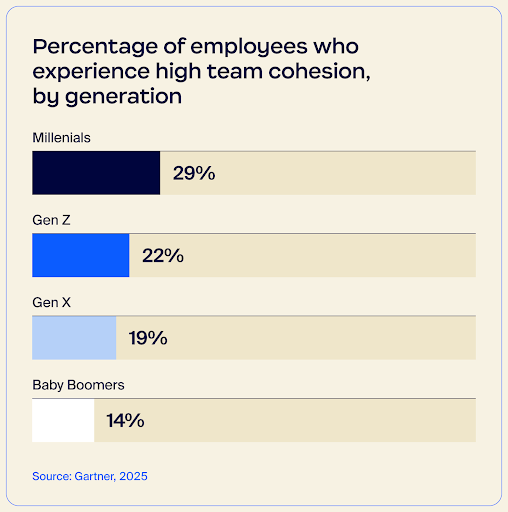
high-team-cohesion-bar-chart | A bar chart displaying the percentage of employees who experience team cohesion, broken down by generation.
With employee engagement data across industries showing historic lows, understanding the ins and outs of the issue has quickly become a necessity.
These statistics help show what facts are behind the recent drop in employee engagement rates and how organizations can adjust their strategies and communication to the new reality.
Generally, companies with higher engagement rates outperform those with lower employee engagement. That’s because there are strong correlations between employee engagement and productivity, profitability, and other traditional measures of success.
These statistics demonstrate the tangible benefits of improving employee engagement — and why investing in the necessary technology and collaboration platforms is worthwhile. They also show the clear drawbacks associated with letting engagement fall by the wayside.
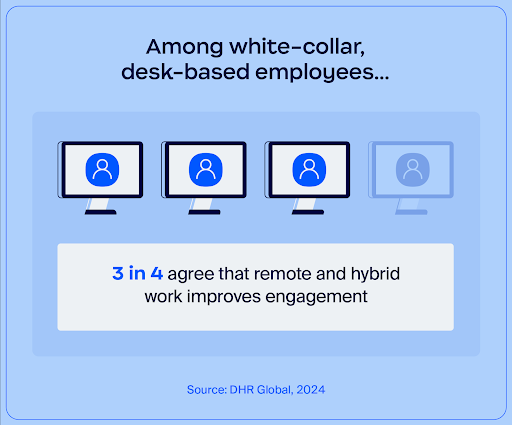
remote-and-hybrid-work-effect-on–white-collar-employee-engagement | A chart showing how many white collar, desk-based employees agree that remote and hybrid work are engagement drivers.
Contrary to what some may believe, data shows that the emergence of hybrid work, remote, or otherwise flexible work arrangements has had a positive impact on employee engagement for companies that have adapted adequately.
With flexible work emerging as a high-demand perk nearly as important as competitive pay and benefits, organizations that have made an active effort to build an ideal hybrid work environment are reaping the benefits of the shift.
These workforce engagement statistics show the strong correlation between employee engagement and employee retention. Studies reveal that employees are actively seeking out companies that have strong engagement-related policies and initiatives.
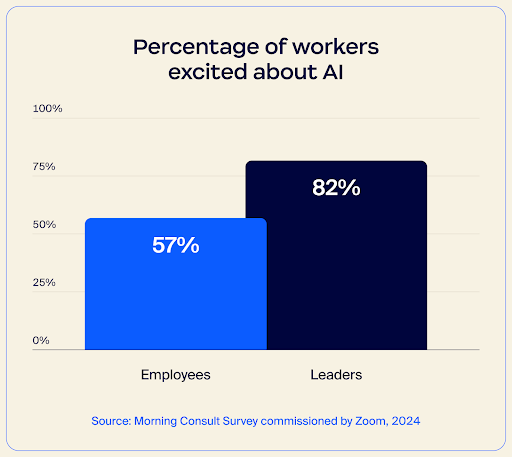
workers-excited-by-ai | A chart displaying the difference in excitement about AI between leaders and employees.
Possibly the biggest disruptor in employee engagement trends over the past few years has been the emergence of AI. By implementing AI assistants like Zoom AI Companion in their workflows, companies are giving employees smart tools to help them produce their best work.
Leaders are mostly convinced about AI’s benefits. However, employees are more skeptical, citing concerns about job security. This highlights a need for careful change management, transparent multi-channel communication, and clear assurances when implementing AI for employee engagement.
Implementing an employee engagement initiative is no easy feat. Many organizations are working diligently to keep their talent engaged and on board, yet engagement rates have consistently fallen to today’s 10-year low.
With that said, building a successful employee engagement initiative is far from impossible. The right tools can help. With platforms like Workvivo, you can support your organization’s efforts to strengthen collaboration, connection, recognition, and retention all in one platform.
Learn how Workvivo and Zoom’s broader suite of collaboration tools can help you build a company culture that sticks, get people engaged with their work, and make people want to stay for the long haul.