

Your guide to getting started with ZoomMate
Everything you need to start using ZoomMate: notes, search, workflows, and AI tools — all inside Zoom Workplace.
Published on April 28, 2026



Somewhere in your organization right now, an employee just opened a browser tab to use a tool IT didn't approve — because the approved one crashed during the one meeting that couldn't afford to fail.
They didn't file a ticket. They didn't send a complaint. They just worked around you.
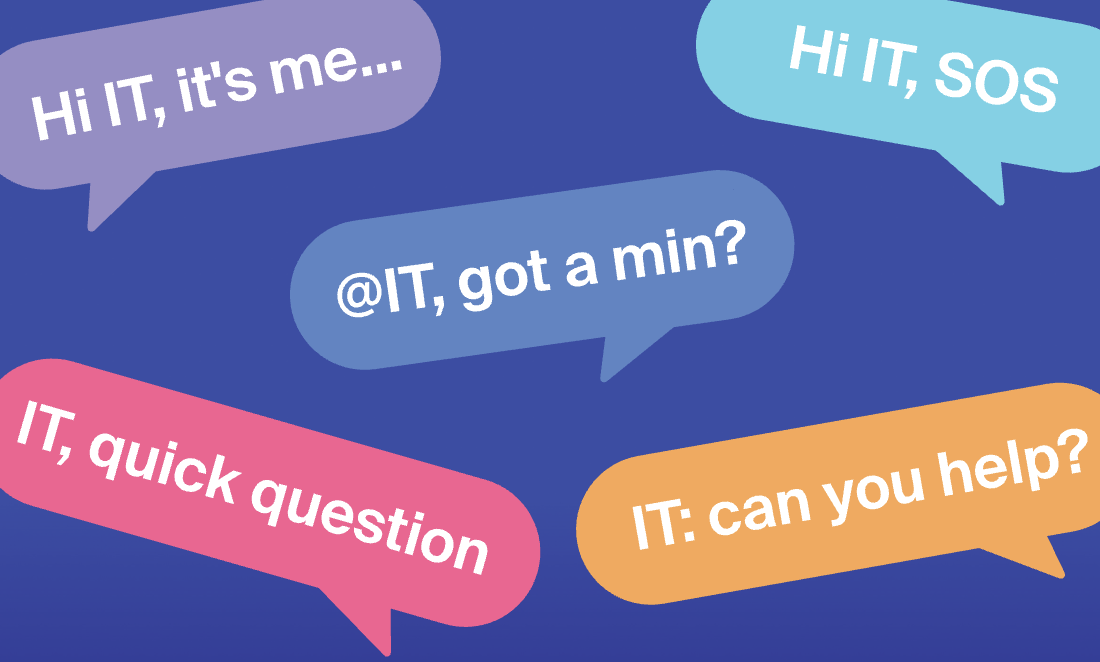
And they're not alone. Across enterprises everywhere, employees are quietly broadcasting their frustration — in message boards and chat threads, in all-hands Q&As, in the kind of blunt, unfiltered feedback that only surfaces when people feel invisible. The "Dear IT" letters are already written. We asked employees to share these frustrations with us, and recently displayed them on the big screen in Times Square.
These comments aren't noise. They are data points.
At Zoom, we've spent years listening to both sides of this conversation — the employees exhausted by tools that don't work, and the IT leaders carrying the weight of a vendor portfolio that has quietly outgrown its usefulness. We know your job is hard. We also know that the message buried inside that employee feedback may be the most valuable architecture input you have right now.
This is your playbook for what to do with it.
The average enterprise employee switches between nine or more applications in a single workday. Each switch carries a cost — not just in time, but in context. The idea forming in a meeting disappears by the time someone opens a project management tool. The decision made on a call never makes it into the follow-up email. The action item lives in a chat thread that three people are in and four people aren't.
This is integration debt. And unlike financial debt, it doesn't appear on a balance sheet — it shows up in delayed decisions, duplicated work, and a creeping organizational slowness that leaders struggle to name but everyone feels.
The numbers make it concrete. According to the Zoom + Deloitte Productivity Payoff Study, 94% of employees encounter challenges somewhere in the meeting lifecycle — preparing, running, or following up. Employees report losing on average 1.6 hours each week just preparing for meetings, and another 10 minutes per meeting dealing with technical issues. That friction adds up to measurable business impact: lost revenue, slower hiring, and lower productivity. These are more than soft costs. They're real drag on the enterprise.
The pressure on IT leaders right now is equally specific: reduce stack complexity, secure the enterprise, and scale AI responsibly — all while keeping the business running and customers productive. This is a transformation mandate wrapped in an operational constraint.
What makes this moment different is that the case for reducing disconnected tools no longer has to be built from scratch. Employees are already making it for you. Loudly. Publicly. And with a specificity that no analyst report can replicate.
Employee frustration with a fragmented communication stack is an unfiltered audit of your architecture. Full stop.
When people complain that their tools don't talk to each other, they're describing integration debt. When they say a meeting platform crashed at the worst possible moment, they're surfacing reliability gaps. When they work around approved tools — and they are, right now, in your organization — they're telling you exactly where your stack is failing the business.
The Zoom + Deloitte Productivity Payoff Study puts a number to it: over 90% of employees regularly use two or more collaboration platforms. Different tools for internal work, external meetings, and async collaboration — a fragmented reality that employees have already been forced to navigate on their own. This is the kind of bottom-up signal that typically takes quarters to surface through formal channels, now delivered in real time.
Our point of view is direct: the people have spoken, and they want tools that work in the moments that matter most — the mission-critical, business-defining, this-has-to-work-right-now moments. That preference is unwavering organizational alignment waiting to be activated.
Consider what that alignment actually gives you:
The core message here is simple: IT leaders who reduce the disconnected tools that are dragging their organizations down — and build around a strong central platform — can become the architects of enterprise speed.
Making this shift from reactive gatekeeper to strategic champion requires translating employee signals into architectural decisions.
Here's what that looks like concretely:
Our mission has always been rooted in a simple belief: technology should bring people closer together, not create more distance between them. For IT leaders, that translates into something specific — a platform that respects both the employee's need for tools that simply work and the enterprise's need for security, governance, and scalability.
We see IT leaders as the people with the power to turn employee preference into organizational momentum. That's a fundamentally different role than gatekeeper — and it's one that Zoom is built to support.
Here's something worth saying plainly: Zoom Workplace isn't automatic consolidation, and it's not asking you to start over. What it provides is a better place to build from — a central point around which you can thoughtfully rebuild your tech stack. Want to keep some of your existing platforms? Zoom integrates with them. The tools your teams rely on don't have to go away. What changes is that they're no longer islands.
Zoom Workplace is designed with that philosophy at its core. Meetings, phone, chat, AI, and more share context across the entire workflow — so nothing gets lost between the conversation and the action. Because Zoom connects to so many tools, it breaks down the silos that frustrate your people, even when those tools stay in place. That context continuity is what transforms a communication platform into an enterprise velocity engine.
Zoom AI Companion is built into this architecture — not bolted on — so the intelligence that surfaces in a meeting carries forward into the next step, whether that's a summary, a follow-up, or a decision that needs to be tracked. For IT leaders managing AI governance, that means less shadow AI, fewer ungoverned tools, and a single, auditable surface for responsible AI deployment at scale.
CIOs who broaden how they measure value — beyond uptime and license counts, to include productivity, engagement, and trust — are better positioned to capture the full payoff of collaboration investments, as the Zoom + Deloitte Productivity Payoff Study found. That's the lens Zoom brings to every enterprise partnership.
We want to support IT leaders in choosing the right tools to fill the right gaps — including the ones that bridge to your must-haves. The simplification journey looks different for every organization. IT leaders carrying this mandate deserve a partner who meets them where they are, not just a vendor with a prescribed answer. That's the relationship we're committed to.
The IT leaders who successfully make this transition share a few common practices. Here's what the playbook looks like in action:
Key question to ask yourself: If your employees could redesign your communication stack from scratch — based only on what helps them do their best work — how different would it look from what you have today? And what would it take to close that gap, without throwing away what already works?
Your employees are speaking. The friction is documented. The preference is clear. What's been missing, in most organizations, is the strategic framing to turn that employee signal into action.
IT leaders who make that translation — who take the unfiltered audit data sitting inside employee frustration and build an architectural response to it — can redefine their role. They become the people who gave their organization the speed to move forward. And they do it by building smarter, not necessarily by building smaller. Fewer disconnected tools. A stronger center. A stack that finally works the way your people do.
We are built for that moment. As a platform, yes — and as a partner to the IT leaders carrying the weight of that transformation. Your job is hard. The alignment you have is rare. Use it.
See how forward-thinking IT leaders are building the case for enterprise velocity — explore the Zoom Ahead resource hub.
How is employee tool preference different from shadow IT — and why should IT leaders treat it differently?
Shadow IT is typically about risk: ungoverned tools, unknown data flows, unmanaged security exposure. Employee tool preference is about signal: it tells you which workflows your current stack isn't serving and which platforms people trust enough to reach for on their own. The distinction matters because shadow IT demands a governance response, while preference data demands an architectural one. When a significant portion of your workforce is gravitating toward the same platform — especially one that meets enterprise security and compliance standards — that's alignment to activate.
How does Zoom support IT leaders who want to simplify their stack without replacing every tool they have?
Zoom Workplace is designed as a central point — not a mandate to start over. It integrates with a wide range of existing tools, so the platforms your teams rely on can stay in place while Zoom provides the connective tissue that reduces silos and carries context forward. For IT leaders, that means you can make meaningful progress on stack simplification without a full rip-and-replace. The goal is fewer disconnected tools, not necessarily fewer tools overall — and Zoom is built to support that distinction.
What's the most effective way to build the internal business case for reducing stack complexity?
The strongest cases combine three elements: a quantified cost of the current state (integration debt, support burden, time lost to tool-switching), a clear velocity benefit of a more connected future state (faster decisions, fewer dropped contexts, reduced onboarding complexity), and a proof point that the preferred platform can meet enterprise security and compliance requirements. The "Dear IT" dynamic adds a fourth element that's rare and powerful: visible, bottom-up organizational demand. When employees are asking for a better way to work, the business case writes itself — IT leaders simply need to formalize it.
How do you manage the transition to a more connected stack without disrupting operations?
The most successful transitions start narrow and move fast. Identify the team or workflow that generates the most friction — the place where your current stack is failing most visibly — and start there. Use that team's outcomes as internal proof: measure the delta in support tickets, meeting-to-action conversion, and employee-reported satisfaction. Once you have a compelling internal story, expansion follows naturally. Establish undeniable results and let the evidence do the scaling work for you.
What should IT leaders do when executive leadership is skeptical — or sees stack simplification as a cost rather than a strategic investment?
The framing shift that tends to break through executive skepticism is moving the conversation from "tools" to "velocity." Disconnected communication stacks slow down decisions, delay execution, and create organizational drag that compounds over time. When you can show leadership that the current fragmentation is taxing enterprise speed — and that building around a central platform employees already prefer can measurably close that gap — it stops being an IT conversation and becomes a business strategy conversation. That's a much easier room to win.