Contact Center Workforce Management CX

Call center workforce management: Components, best practices, and more

13 min read

Updated on March 02, 2026

Published on March 02, 2026

Call center workforce management: Components, best practices, and more

As a contact center supervisor, it can be challenging to determine the best ways to support customers while preventing agent burnout. Balancing service levels, overall performance, and efficiency is critical to an effective call center. Adapting a workforce management (WFM) call center approach is crucial for effective operation.

Maintaining SLAs during peak times can be challenging, but WFM call center solutions leverage the latest technology, including time-saving artificial intelligence, to help you manage more effectively. Discover why WFM solutions make a difference and tips for delivering first-class industry service.

What is workforce management in a call center?

Contact center workforce management is a set of processes and contact center tools that help you optimize the performance and efficiency of your contact center team. The main goal of using a WFM solution is to ensure the correct number of agents with the right skills are available at the proper times to meet customer service demands. The best contact center workforce management solutions include innovative AI-powered tools to help forecast, schedule, track, and analyze work performance. 

Why does workforce management matter for call centers?

Workforce management can help transform ineffective routines into effective workflows. WFM processes can help your team provide high-quality service with data that enables capabilities such as call volume forecasting, which helps reduce wait times and deliver consistent service levels to callers.

Forecasting can also be an effective way to save costs. Using analytics, your call center can properly align staff levels and prevent overstaffing. WFM solutions enable custom reports and analytics that provide a view of what you need and when — sometimes even before you do. Today, AI can build robust forecasts for you, from tomorrow to up to multiple years into the future.

WFM also benefits agents by allowing better workload balance and freeing up additional time for training and development. With an improved scheduling perspective, you can also ensure your agents are scheduled fairly and consistently, leading to better work-life balance and less burnout.

Essential call center workforce management components

Your team should have the proper components when establishing a WFM call center. The following are some critical elements to look for in the best WFM software for call centers.

Call center scheduling

A practical workforce management approach for a call center on effective scheduling to increase efficiency. This emphasis enables you to improve agent productivity and reduce burnout from excessive workloads by making more data-driven decisions.

WFM solutions help prevent over- or understaffing by creating call-volume forecasts based on historical data to improve planning. Some tools offer automated scheduling features that consider agent preferences and skill sets, helping reduce manual effort and human error.

Time and attendance tracking

Enhanced time and attendance tracking enables a better understanding of agent log-ins, log-outs, and breaks. Having a real-time view of your call center operations lets you confirm your agents are where they need to be at the correct times. This understanding enables you to improve the overall experience for customers and agents, helping agents receive proper break time.

Better insight into your time and attendance can also benefit overall efficiency, highlighting leave requests and attendance for future improvement. Such solutions even enable close tracking of compliance with company policies, so you can confirm that work hours, breaks, and overtime comply with the required guidelines.

Custom reporting and analytics

Workforce management call center solutions can provide you and your team with custom reports and analytics based on key performance indicators (KPIs). Call center KPIs that can be particularly important include average handle time, first-call resolution, and service-level compliance. KPIs can provide deeper insights into your call center’s operations, enabling better, data-driven decision-making.

Select WFM platforms also offer call center dashboard overviews and visualizations, helping you understand data at a glance. You can view additional trend analyses to identify patterns in your work center’s performance, helping you make more informed decisions to improve efficiency and enhance the customer experience.

Versatile, engaged agents

The most critical aspect of any call center is its agents; they are your organization’s direct line of contact with your customer base. WFM approaches help check that your agents are versatile and engaged. Additional training can foster customer empathy, enabling your agents to connect with frustrated customers more effectively.

Using a WFM solution, you can focus your system on routing calls to the best available agent based on skill sets. Boosting your agent’s morale is just as important, and WFM solutions can simplify schedule management, time-off requests, and shift swaps, reducing stress among your workforce. 

AI-optimized schedules

For years, workforce teams built schedules by hand, then patched gaps when volume shifted. AI speeds this up by using forecast inputs such as engagement volume, handle time, shrinkage, and skill needs to generate schedules that meet coverage goals and work rules.

As the day progresses, AI supports intraday control with real-time adherence visibility and variance reporting that flags when actual demand drifts from the forecast. It can then recommend specific actions, such as reforecasting, adjusting breaks, shifting skills across queues, approving swaps, or offering voluntary time.

Shiftbidding

Give your agents more control over their schedules by offering shift bidding, which lets agents express interest in open shifts. This allows agents to pick up extra shifts and also helps you fill gaps in your schedules.

Shift swapping

Shift swapping allows your agents to swap shifts with one another, subject to manager approval. This alleviates administrative tasks for managers while giving agents more control over their schedules.

Adherence monitoring

Schedule adherence is critical to maintaining SLAs in your contact center. WFM technology provides managers with visibility into whether agents are adhering to their assigned schedules, enabling intraday adjustments if needed.

Self-healing intraday

Some more advanced WFM solutions offer self-healing intraday technology that leverages AI to automatically reforecast and adjust schedules based on real-time adherence and interaction volumes.

Tips for effective workforce management call center software

Integrating an effective workforce management strategy can seem daunting for call center leaders. These practical tips are the ideal way to begin your approach, leading to further fine-tuning based on your call center’s unique operations.

1. Schedule the right agents at the right time

Deploying agents at the right time is essential, but it’s also important to have the right agent lined up. Matching an agent’s skills to the query helps avoid customer frustration and creates the necessary efficiencies as call volumes rise. As Juanita Coley, contact center whisperer and CEO of Solid Rock Consulting, shares:

“It’s about forecasting, scheduling, and real-time management. The power of workforce management comes down to predicting the right people, ensuring those people are in the right place, at the right time to serve your customer needs best.”

Smart scheduling combines data-driven insights with real-time flexibility to help keep your contact center running smoothly:

  • Apply analytics and forecasting to scheduling: Use historical data and AI-powered tools to predict call volumes and create schedules up to 4 weeks in advance to ensure adequate coverage during peak periods.
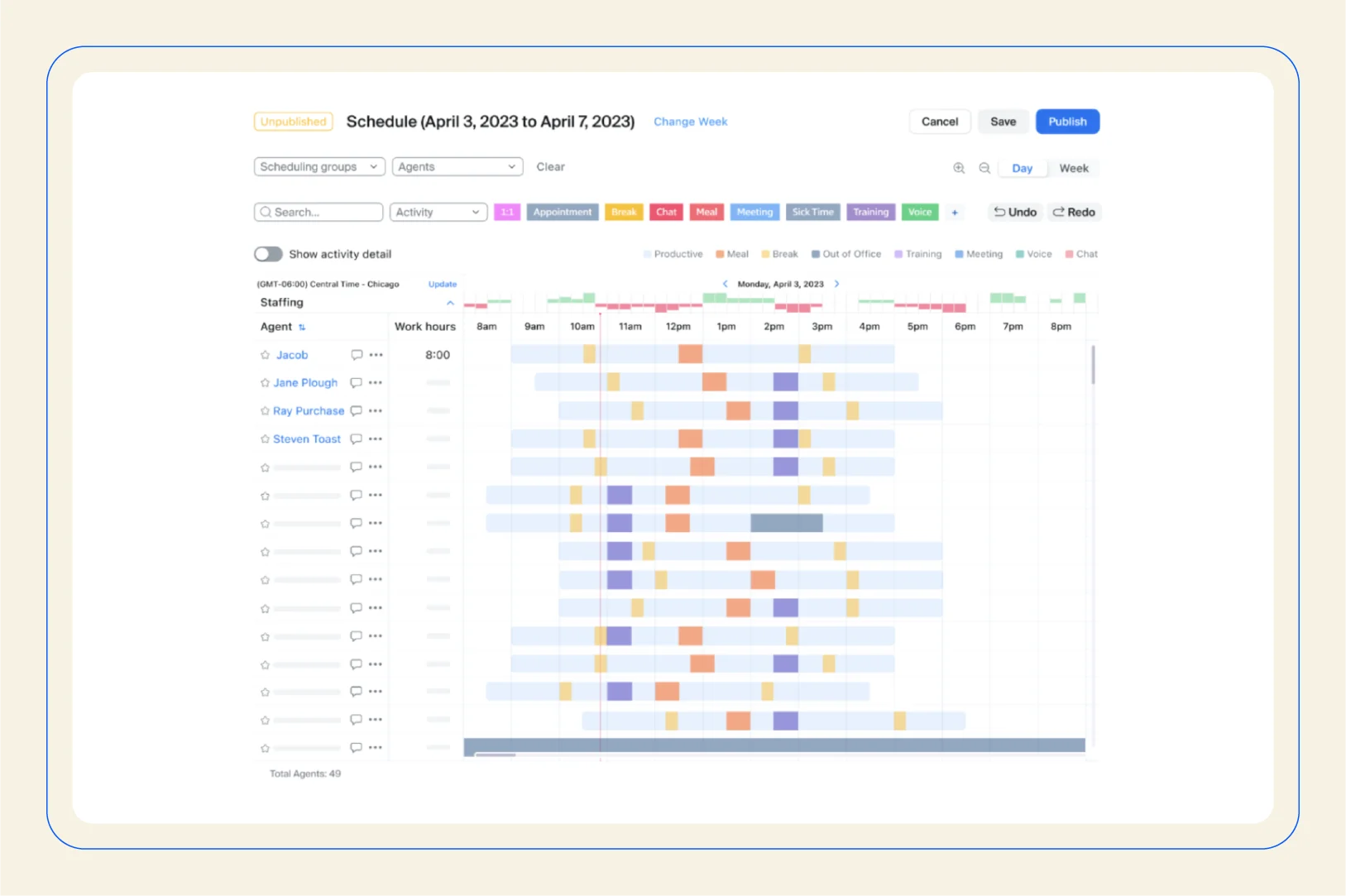
    Screenshot of Zoom workforce management call center scheduling
  • Enhance agent effectiveness: Optimize your roster by matching agent skills to customer needs and flexing breaks, lunches, and start times based on call patterns to improve first call resolution rates.
  • Be adaptable: Leverage real-time capacity monitoring to quickly adjust schedules when unexpected changes occur, such as weather disruptions or sudden call volume spikes.

2. Help keep agent morale high and prevent burnout

Supporting your agents’ well-being directly impacts both retention and customer satisfaction. According to ICMI’s State of the Contact Center report, 30% of contact centers saw increased turnover rates in 2023. 

With customer care being your company’s front door, boosting connection and reducing turnover by even the smallest amount can make a difference. But how do you keep morale high during your busiest time of year?

  • Provide schedule predictability or autonomy: Give agents visibility into their schedules well in advance or involve them in the planning process, allowing them to share availability and preferences while maintaining adequate coverage.
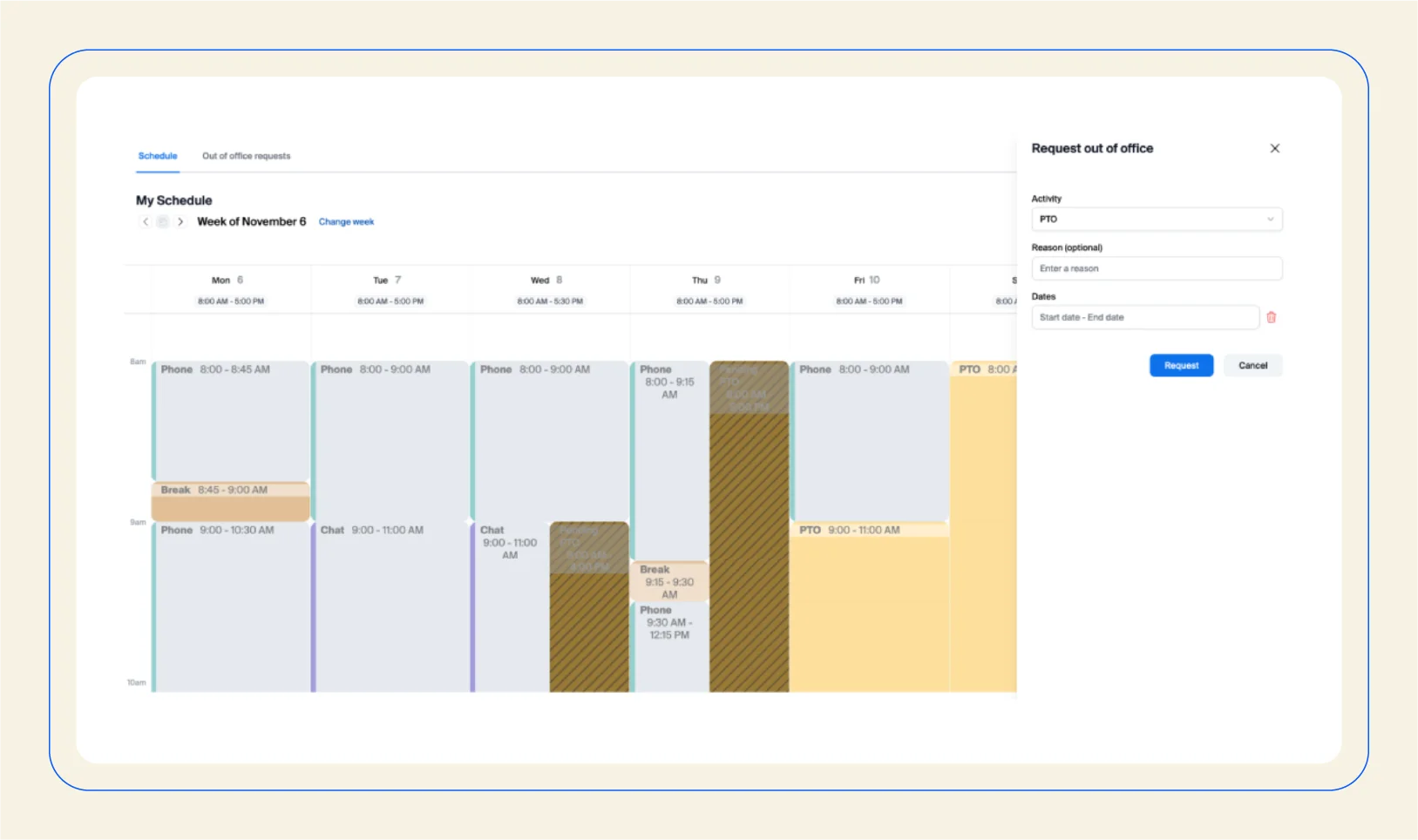
    Screenshot of Zoom workforce management call center schedules
  • Keep agents engaged: Equip agents with AI-powered tools, like Zoom CX’s AI Expert Assist, and knowledge bases that can help them resolve issues efficiently, reducing frustration and fostering a sense of accomplishment with each successful interaction.
  • Show appreciation for great work: Recognize outstanding performance with verbal acknowledgment, written praise, or tangible rewards such as bonuses, gift cards, or additional PTO to reinforce positive behaviors.

3. Let AI take the grunt work

Contact center technology is undergoing an AI transformation, an evolution we call the next-generation contact center. But what can AI do to help with a contact center’s workforce needs during busy seasons?

Generative AI is significantly simplifying the lives of contact center agents and supervisors. Capabilities like chat and call summarization give individual agents more context to quickly and effectively handle transferred and returning calls, reducing call durations and customer frustration. 

And then there are virtual agents. Virtual agents have been around for a while, but recent developments in AI are making them more helpful. 

Zeus Kerravala, founder and principal analyst at ZK Research, agreed when speaking at Zoomtopia 2025, saying, “AI has historically been about simply automating tasks, but it’s going to change and actually act like a collaborative digital colleague for frontline workers.”

Virtual agents can handle routine questions, collect key details, complete simple tasks, and route complex cases to the right agent with a clean handoff, which reduces queue pressure during peak times.

4. Amplify contact center WFM with one integrated platform

While workforce management solutions are necessary and helpful, there’s another way you can minimize siloed communication. As Metrigy found, by integrating your contact center capabilities with a unified communications (UC) platform, your team can benefit from:

  • Easier access to bring experts into customer interactions
  • Streamlined conversations between frontline and back-office employees over the same app
  • Agents and supervisors are both being involved in providing customer help and product development
  • Cost savings through bundled licenses
  • Use of video or screen sharing during customer calls

Research shows that the impact is significant. Based on research from 2023, Metrigy found that integrating unified and contact center solutions resulted in a 26.5% improvement in customer ratings, an 18% reduction in operational costs, a 22.6% increase in revenue, and a 23.1% boost in employee efficiency.

If you’re facing an overwhelming peak season, exploring a combined UC and contact center solution could help you prepare for the next ramp-up period.

5. Incorporate employee (and customer) feedback

Feedback is one of the most critical steps toward a successful, engaged call center. Gaining feedback from your agents and customers provides valuable insights into your overall operation and consumer needs. Such insights are one of the keys to data-driven decision-making that propels your call center forward. Through feedback, you can learn:

  • Areas where agents may need additional training
  • How to create a more balanced schedule that reduces burnout
  • Skills agents feel they need to develop further
  • The best ways to boost employee morale and engagement
  • What customers value most in their service interactions

To collect feedback, consider using surveys and dedicated feedback-collection tools. You can also gather feedback from your agents by asking them directly during performance reviews or 1:1 meetings. Fostering an environment where agents and customers feel their feedback is valued is exceptionally vital to the process.

6. Offer WFM features on mobile devices for agents

As remote and hybrid work continues to grow, customer service leaders must give agents access to their schedules on mobile devices and on their UCaaS platforms.


Benefits of call center workforce management

A well-implemented call center workforce management approach can yield far-reaching benefits for your organization. From agents to customers, you can create a better experience while improving operational efficiency.

5 Benefits of workforce management call center solutions

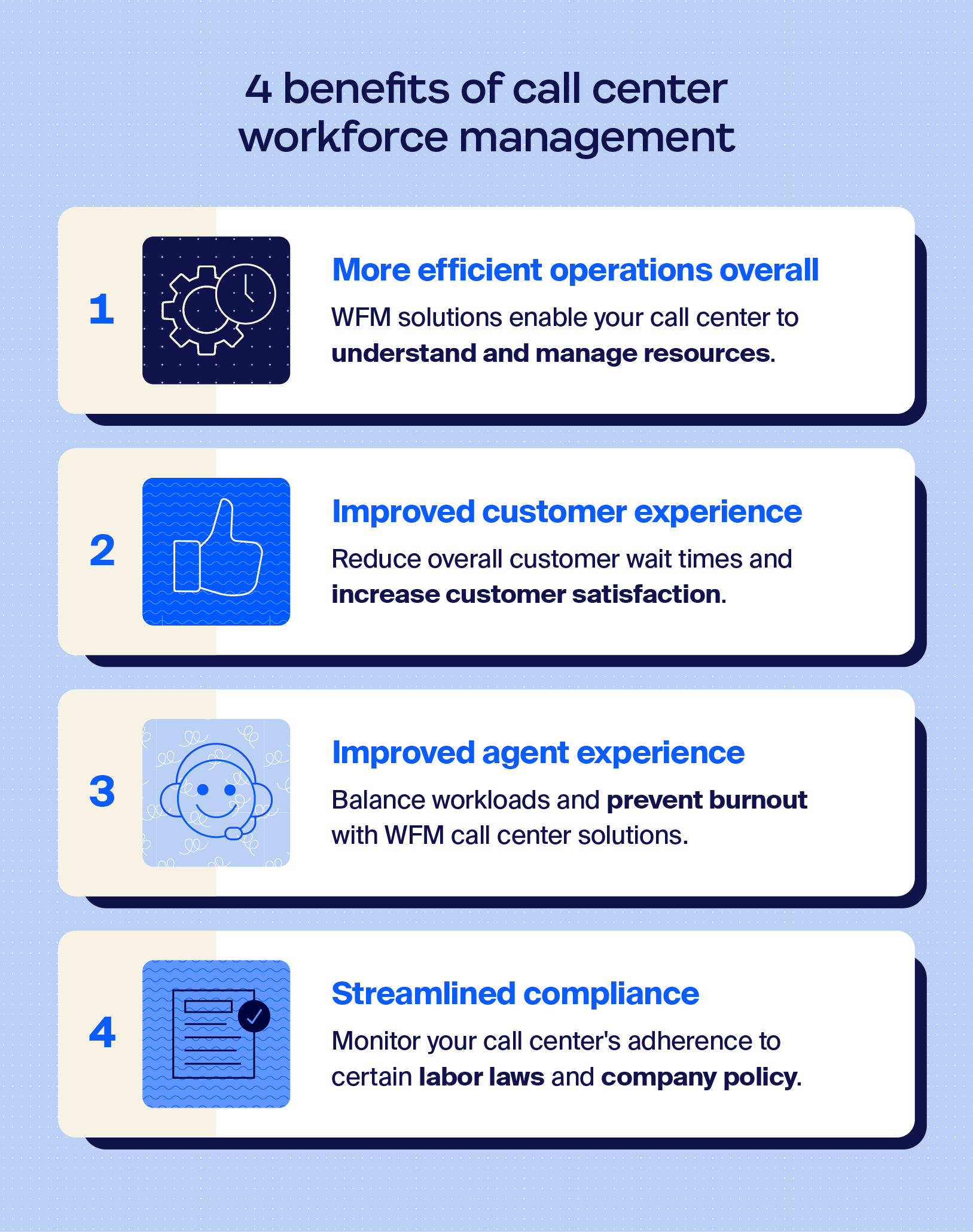
  1. More efficient operations overall: WFM solutions use data-driven forecasts and automated scheduling to optimize resource allocation, preventing costly over- or understaffing. This can lead to better planning and significant cost savings across your contact center operations.
  2. Improved customer experience: Proper staffing levels reduce wait times while skills-based routing connects customers with the right agents for their needs. The result is faster resolutions, more consistent service quality, and higher customer satisfaction scores.
  3. Improved agent experience: Balanced workloads and fair scheduling prevent burnout while allowing time for training and professional development. When agents feel supported and have the tools they need to succeed, engagement and job satisfaction naturally increase.
  4. Streamlined compliance: WFM platforms can automatically monitor working hours, breaks, and overtime to support organizations in meeting labor laws and company policies, helping to promote a fair, consistent work environment for all agents.

Effective contact center workforce management means happy agents and customers

Finding the delicate balance of answering a high volume of calls and queries while preventing team burnout takes work. Armed with the right technology and AI-enhanced tools and practices, you can eliminate the stress for all involved. 

Discover Zoom’s intuitive and easy-to-use Workforce Engagement Management solution, Zoom CX, and its suite of next-generation tools.

Workforce management for call centers FAQ

Here are answers to some of the most common questions leaders have when implementing or optimizing their WFM strategy.

How do you calculate forecasted call volume for staffing needs?

Forecasting call volume starts with analyzing historical data to identify patterns in call arrival rates, average handle times, and seasonal trends. Modern WFM solutions use AI and machine learning to process this data alongside factors like day of week, time of day, holidays, and marketing campaigns. 

The system then calculates required staffing by applying formulas such as the Erlang C model, which accounts for service-level targets and desired occupancy rates while forecasting up to 4 weeks ahead.

What’s the best way to improve adherence in call centers?

Improving adherence requires clear communication, the right tools, and a supportive work culture. Make sure agents understand their schedules in advance and use WFM software that provides real-time adherence monitoring so supervisors can address issues immediately. 

Create realistic schedules with adequate break times, and approach adherence issues with coaching rather than punishment to understand root causes. Finally, recognize and reward agents with strong adherence records to reinforce positive behaviors.

What are valuable workforce management KPIs for call centers?

Valuable WFM KPIs fall into four primary categories:

  • Scheduling accuracy: Forecast accuracy, schedule adherence, and occupancy rate
  • Efficiency metrics: Average handle time, service level, and shrinkage
  • Agent experience: Turnover rate, absenteeism, and satisfaction scores
  • Customer impact: First call resolution, CSAT, and average wait time

The key is selecting five to seven KPIs that align with your specific business goals and tracking them consistently rather than trying to measure everything at once.

Our customers love us

Okta
Nasdaq
Rakuten
Logitech
Western Union
Autodesk
Dropbox
Okta
Nasdaq
Rakuten
Logitech
Western Union
Autodesk
Dropbox

Zoom - One Platform to Connect