



Meet Zoom AI Companion, your new AI assistant!
Boost productivity and team collaboration with Zoom AI Companion, available at no additional cost with eligible paid Zoom plans.
Discover how Zoom is building the AI‑first platform to close the gap between what gets discussed and what actually gets done
Published on April 09, 2026




Xuedong Huang is the Chief Technology Officer (CTO). Prior to Zoom, he was at Microsoft where he served as Azure AI CTO and Technical Fellow. His career is illustrious in the AI space: he began Microsoft’s speech technology group in 1993, led Microsoft’s AI teams to achieve several of the industry’s first human parity milestones in speech recognition, machine translation, natural language understanding, and computer vision, is an IEEE and ACM Fellow and an elected member of the National Academy of Engineering and the American Academy of Arts and Sciences.
Xuedong received his Ph.D. in EE from the University of Edinburgh in 1989 (sponsored by the British ORS and Edinburgh University Scholarship), his MS in CS from Tsinghua University in 1984, and BS in CS from Hunan University in 1982.
Imagine a sales team that finishes a customer call and watches as Zoom AI automatically updates their Salesforce record, drafts personalized follow-ups based on the conversation, and pulls relevant product information from past meetings—all before they’ve closed their laptops. This is the conversation-to-completion workflow we’re building at Zoom.
Every day, billions of conversations happen across meetings, chats, and calls. Ideas spark, decisions get made — but too often, that intent never turns into action. Follow-ups slip through the cracks, systems stay out of sync, and context scatters across tools. The result isn’t just lost time — it’s slower execution, missed opportunities, and blurred accountability.
At Zoom, we believe the next era of work isn’t just about better communication — it’s about completion. That’s why we’re building an AI‑first work platform designed to move teams from conversation to completion.
We’re calling 2026 the Year of Completion — a shift from communication to execution, powered by AI that understands reasoning, context, and intent.
AI innovation moves fast, but quality is what sustains leadership. At Zoom, quality is more than accuracy — it’s efficiency, reliability, and responsibility.
Our ASR Scribe API, launched recently to provide developers the ability to integrate Zoom’s best-in-class AI into their own tech stack, now ranks among the top global benchmarks for speech recognition, and our research models have achieved leading results on reasoning and comprehension tests such as Tau‑2 and Humanity’s Last Exam. These achievements validate our federated AI approach, combining Zoom’s proprietary models with those from partners like OpenAI and Anthropic to deliver the best model for every task.
Today, we launched our Model Context Protocol (MCP) integration with Anthropic’s Claude, bringing Zoom meeting intelligence and platform capabilities into Claude Cowork and Claude Code. This integration demonstrates Zoom's leadership in open ecosystems—meeting developers and users where they work.
This federated architecture is what sets Zoom apart from other platforms that lock users into a certain model. Instead of forcing customers into a single AI model, we dynamically select the best model for each task—whether that’s Zoom's proprietary technology or partner models from OpenAI and Anthropic. The result: a federated system that delivers both flexibility for customers and efficiency for Zoom, with internal benchmarks showing up to 20× cost savings in production workloads, such as meeting summarization—all while maintaining high standards of trust and performance.
Modern work is fragmented. Teams collaborate in one place, document in another, and execute somewhere else. Zoom’s system of action bridges that gap by connecting the places where work starts with the systems where it gets done.
At its core, this shift is about closing a simple but critical loop: capturing what was said, understanding what it means, deciding what needs to happen next, and taking action automatically. Zoom is building this loop directly into the workflow.
Here’s our vision:
This end‑to‑end flow will transform conversations into completed outcomes. For example, a sales call leads to a pricing decision. Zoom captures the discussion, identifies next steps, updates the CRM, triggers a proposal draft, alerts finance for approval, and schedules the follow-up, all without manual coordination. What typically requires multiple tools and handoffs becomes a single, continuous workflow.
At the heart of this transformation will be our federated intelligence layer, which connects memory, intelligence, and execution:
Together, these layers form the foundation of our federated agent platform — a unified infrastructure that provides shared services like memory, safety, and evaluation across all AI agents. This ensures consistent quality and compliance, and interoperability with leading AI partners.
Since launching in December, AI Companion 3.0 is already transforming how people meet, write, and collaborate. We’ve been helping users complete tasks through agentic workflows, and we’re building on that with custom agents that reason thoroughly, resulting in AI that doesn’t just assist — it completes tasks you’d otherwise have to do yourself.
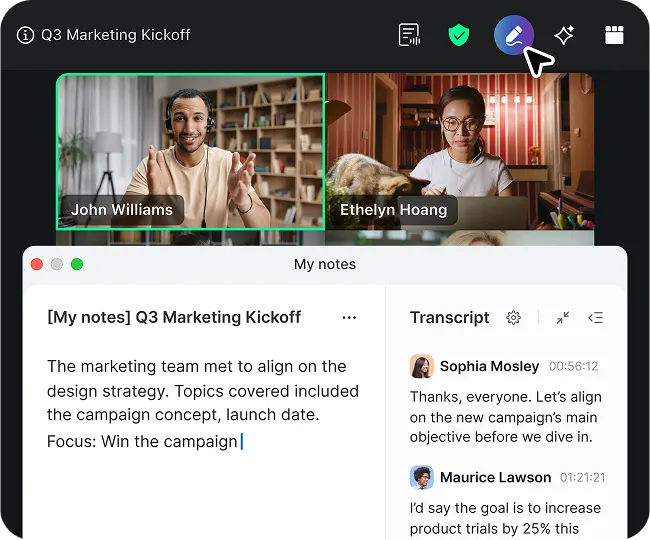
Imagine finishing a meeting and having Zoom AI Companion automatically draft follow‑ups, update your CRM, retrieve relevant information from past conversations based on your personal workflow preferences, and prepare a daily briefing summarizing priorities across all your conversations. That’s the power of conversation‑to‑completion workflows.
We are also introducing AI‑first canvases — AI Docs, AI Sheets, and AI Slides — that bring generative collaboration directly into the flow of work, so teams can create and co‑edit content without switching tools.
AI should amplify human potential, not replace it. Zoom’s AI Companion keeps people in control — handling routine steps so teams can focus on creativity, judgment, and quality.
By embedding AI directly into the flow of collaboration, we’re helping organizations spend less time managing follow‑ups and more time achieving results. Whether it’s a sales team closing deals faster, a healthcare provider improving documentation, or a global enterprise aligning across time zones — AI Companion is designed to help people finish what they start.
The next phase of work will be defined by a shift from systems that document activity to systems that drive outcomes. Organizations that continue to rely on manual follow-through will move more slowly, lose context, and struggle to scale execution. Those organizations that embed completion into their workflows will operate faster, with greater alignment and accountability.
At Zoom, we’re building the platform to power that shift — turning everyday conversations into completed work.
Because work doesn’t fall apart in meetings, it falls apart after them. And with AI built into the heart of collaboration, we’re closing that gap — helping every team move from conversation to completion.
Let’s make 2026 the Year of Completion.