Meet Zoom AI Companion, your new AI assistant!
Boost productivity and team collaboration with Zoom AI Companion, available at no additional cost with eligible paid Zoom plans.
 10 min read
Updated on December 09, 2024
Published on March 01, 2026



Matthew Saxon leads People Experience at Zoom, ensuring that the core value of Care is reflected in the company’s approach to benefits, compensation, diversity, equity, and inclusion, recruitment, culture, and employee experiences. He brings with him over two decades of experience in the HR field, serving most recently as Vice President of People Operations at Meta, where he helped develop the strategic people roadmap and led the delivery of programs and services supporting significant increases in headcount and company growth. He was also Senior Vice President of Compensation, HR Operations, and Shared Services for Humana Inc., and held several leadership positions at Motorola, Inc., including Vice President of Total Rewards and Vice President of Human Resources for Asia Pacific and Middle East.
Hybrid work has officially graduated from a temporary experiment to the way modern business gets done. But simply having a policy isn’t enough to keep your culture alive or your teams aligned. The conversation has shifted from “where do we work?” to “how do we stay connected and productive?”
As a platform powering millions of hybrid connections every single day, we have a unique front-row seat to the strategies that are actually preserving — and boosting — engagement.
The trends below come from our own white paper, “Navigating the Future of Work,” which surveyed more than 600 IT and C-suite leaders and nearly 1,900 knowledge workers across the globe, in combination with other Zoom studies and fresh data from leading research organizations. Whether you're a veteran of the hybrid work environment or just beginning your organization's flexible work journey, here are 12 must-know hybrid work trends shaping the current state and future of flexible work.
Employees tend to prefer remote work and many demand flexible arrangements that combine the benefits of in-office and remote work at minimum. The hybrid model provides a middle ground for organizations who prefer the in-office environment and employees who’d rather work from home, and it has become a smash hit. The preference for hybrid work is evident in the growing number of organizations adopting hybrid policies and the positive feedback from employees who have experienced this model firsthand.
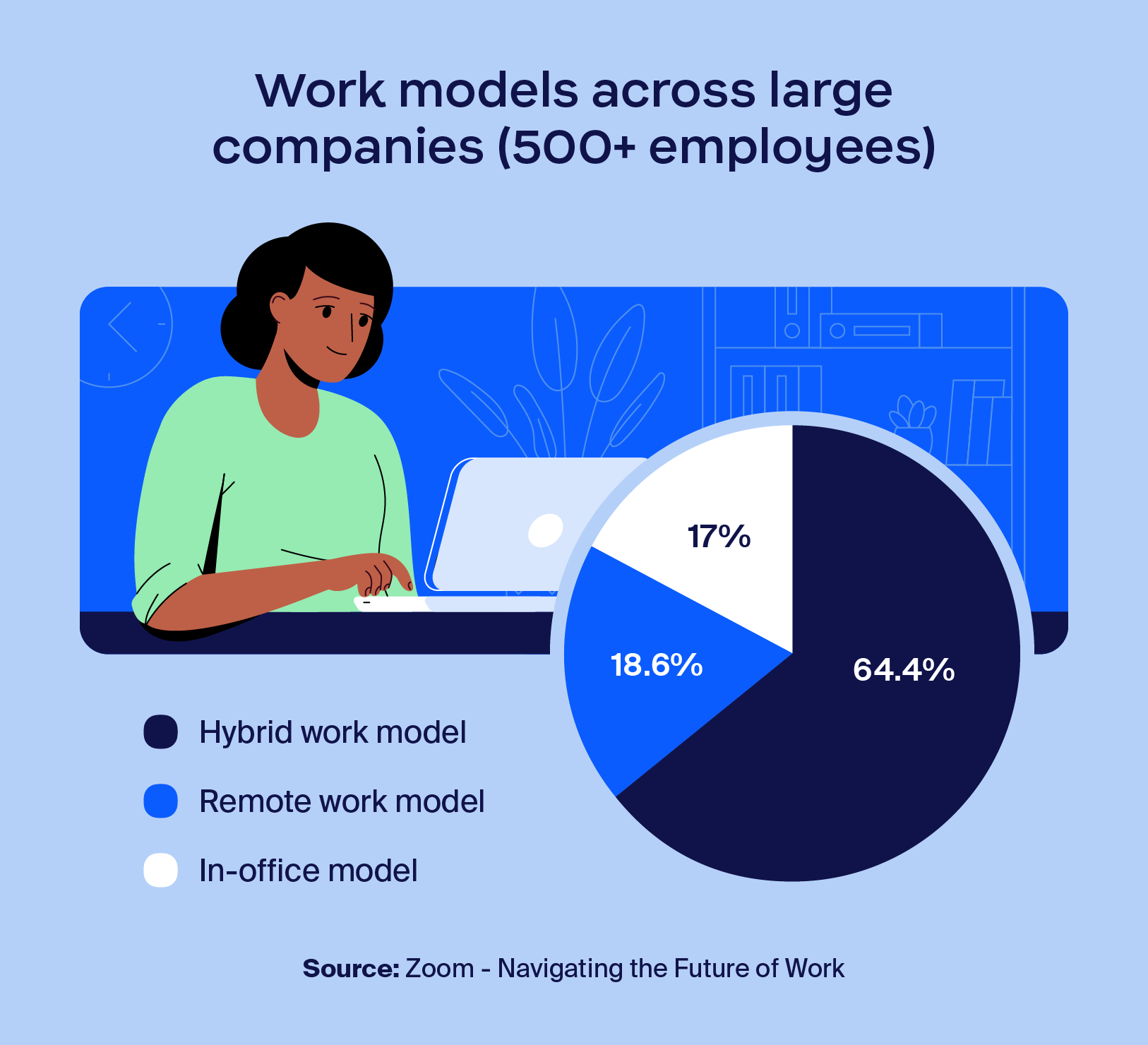
We see this reality reflected in our own data. According to our Navigating the Future of Work white paper, hybrid work is officially the dominant operating model, with 64.4% of organizations currently operating on a hybrid schedule, significantly outpacing fully in-office (17%) and fully remote (18.6%) setups.
This surge in popularity highlights the appeal of flexible work, which often provides employees with greater autonomy, improved work-life balance, and access to collaborative opportunities.
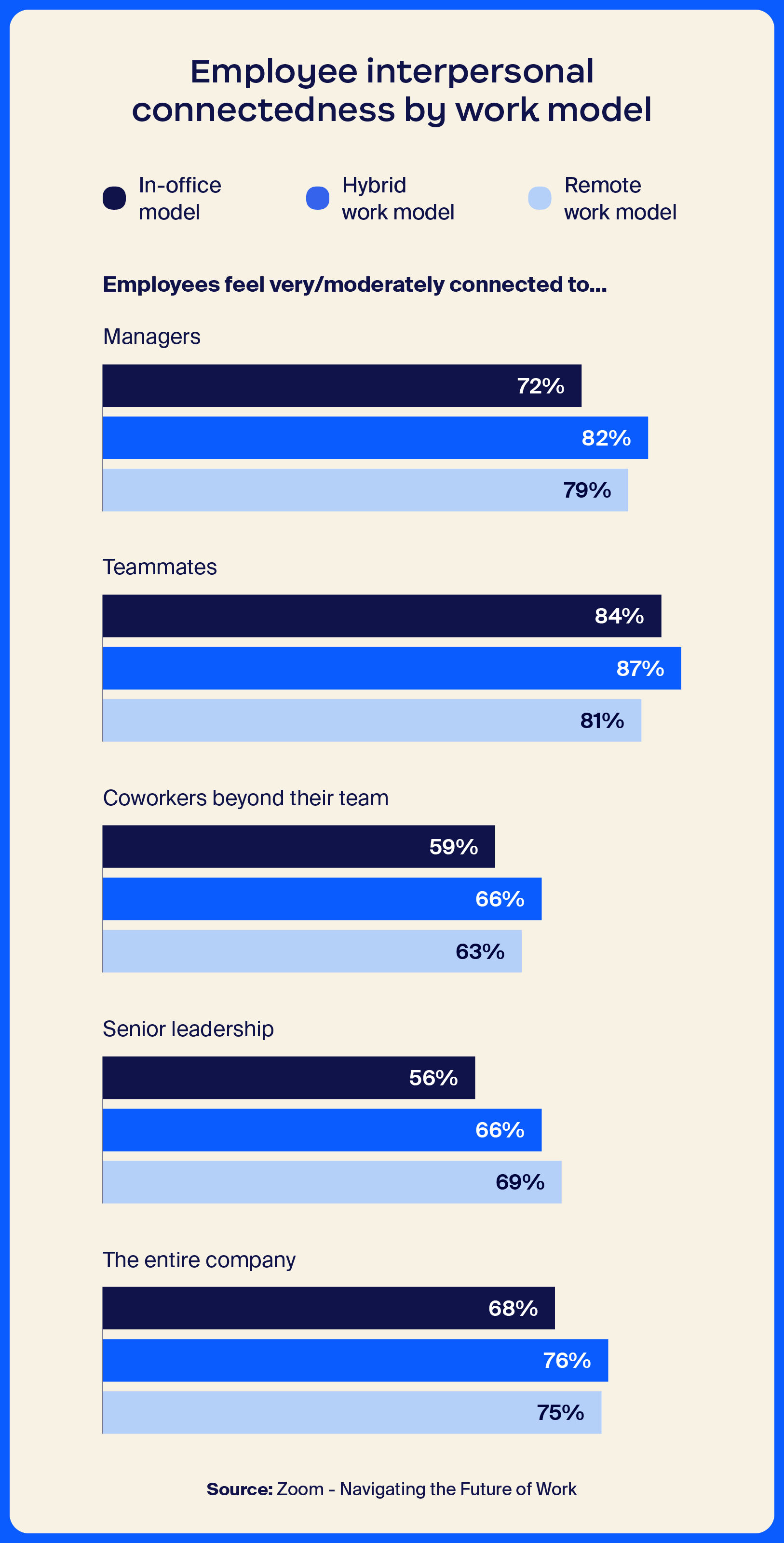
Contrary to popular belief, a well-designed and properly equipped hybrid work model can foster stronger human connections than a traditional in-office setup. Our "Navigating the Future of Work" study revealed that hybrid workers reported higher levels of connection with their managers, team members, and senior leadership compared to their in-office counterparts.
The study also found:
Hybrid work can effectively provide a healthy balance that fosters good working relationships. By leveraging technology and intentional planning, organizations can create a sense of community and belonging among employees, even when they’re not physically together on a daily basis.
Contrary to the return-to-office debates, the data confirms that hybrid work is no longer just a compromise — it’s becoming the sweet spot for employee well-being:
Sustaining this engagement requires the right tools. According to our recent survey of 1,000 business and IT leaders, The Productivity Payoff of Next Generation Collaboration, teams using next-generation collaboration features to reduce meeting friction report reduced stress, smoother workflows, and up to three hours of reclaimed productivity per week — giving them more time to focus on the work that matters.
The size of the organization plays a significant role in determining the ideal work model. While smaller companies may find it easier to maintain a cohesive team culture with a predominantly in-office or fully remote approach, larger organizations often benefit from the flexibility and efficiency of a hybrid model.
The larger an organization is, the more likely it is to have a remote model. The hybrid work approach is quickly becoming the norm for enterprise-level organizations (500+ employees) — in fact, our "Navigating the Future of Work" study revealed 64.4% of them are already operating a hybrid workplace model.
Midsize and large companies are more likely to gravitate toward hybrid work for several reasons, mainly because managing a larger workforce can be challenging. Hybrid work allows for greater flexibility in accommodating diverse employee needs and preferences. Additionally, hybrid models can improve employee satisfaction and retention by offering a balanced approach that combines the benefits of in-office collaboration with the flexibility of remote work.
As organizations, employers, and employees gain more experience with hybrid work, it makes sense that they would experiment with ways to optimize this approach and address emerging challenges. This ongoing evolution is likely to shape the future of hybrid work significantly.
One key consideration is the increasing flexibility and personalization of hybrid arrangements. As employees become more accustomed to remote work, they may seek greater autonomy in determining their work schedules and locations. Hybrid work models are popular with employees today, but 58% expect their preferences to evolve, our "Navigating the Future of Work" study shows.
The hybrid workplace is not a static concept. It requires ongoing adaptation and experimentation, especially as technology and employee preferences evolve. By embracing flexibility and new technology and prioritizing employee feedback, organizations can create hybrid work environments that are both productive and fulfilling for their employees.
Employee preferences are the primary catalyst for the rise of hybrid work models. A key factor driving the dominance of hybrid work is employees’ desire to work from anywhere rather than being tied to a specific geographic location — especially since advancements in technology enable them to do so. For example, in our "Navigating the Future of Work" survey, we found that 36% of employees would consider the idea of working remotely from anywhere if they were to change jobs.
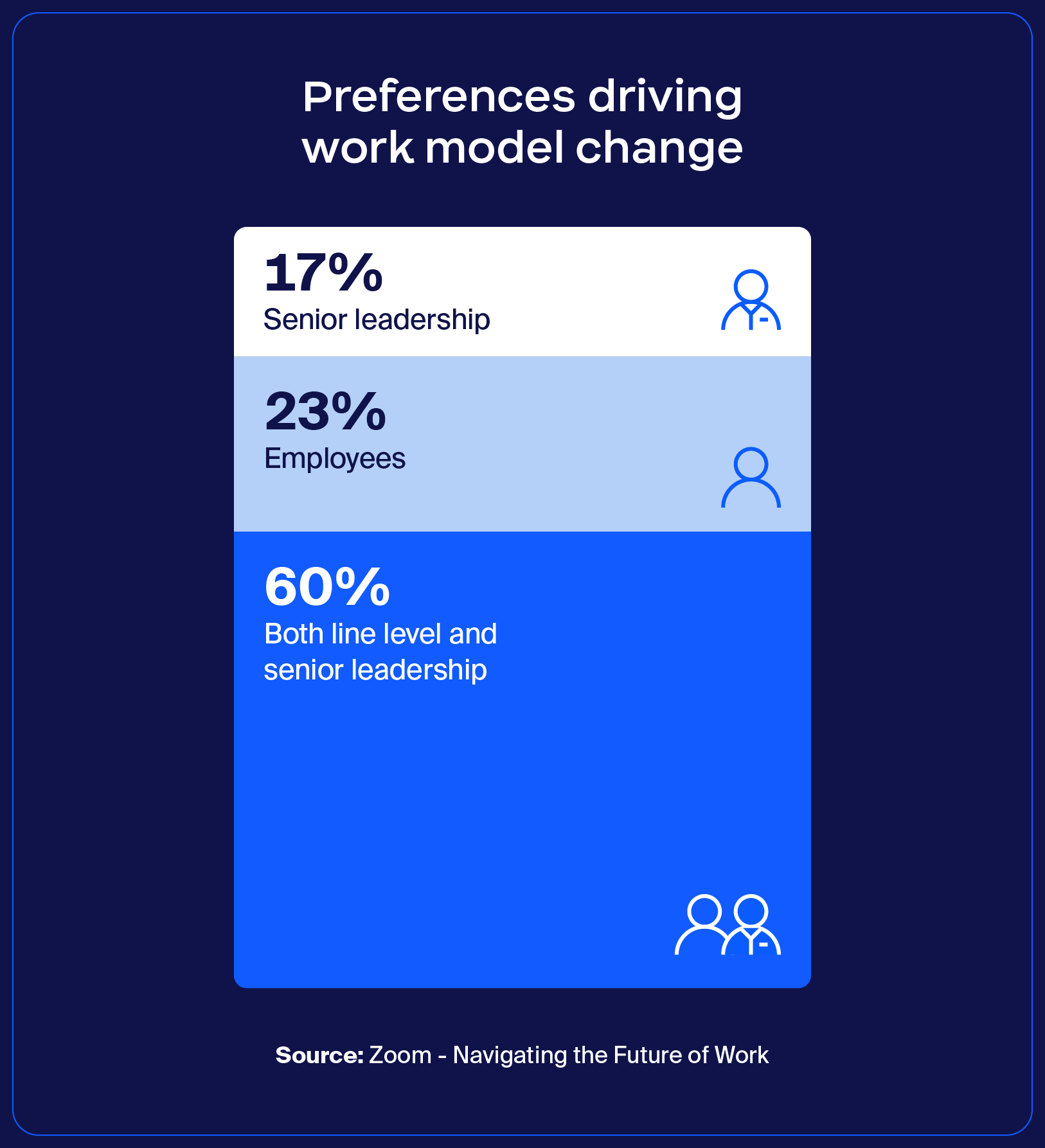
The adoption of hybrid work is often driven by a combination of employee demands and strategic decisions by leadership. Our survey revealed similar insights, though employees had more of an impact than leadership. Twenty-three percent of business leaders say employee preferences are shaping the company’s flexibility, while 17% attribute senior leadership’s preferences.
While senior leadership generally has a smaller influence on these decisions, they have valuable reasons for shifting to hybrid work. For example, many organizations have implemented hybrid models as a means of retaining talent and attracting top candidates. Business leaders say that flexible working hours (67%) and remote work options (58%) are the most effective strategies for employee retention.
Organizations that have embraced hybrid or remote work arrangements often report increased productivity among employees. Reduced commute times and improved work-life balance contribute to employee satisfaction and motivation, ultimately resulting in higher productivity.
In "Navigating the Future of Work," we found that 84% of business leaders say that increased productivity has influenced their decision to change the workplace model. Additionally, 62% of leaders cite the ability to recruit talent more broadly as a key factor driving their adoption of flexible work arrangements.
The impact on hiring speed is measurable: Our "The Productivity Payoff of Next Generation Collaboration" study revealed that HR teams leveraging next-generation collaboration tools for hybrid work report a 61% reduction in overall hiring timelines and a 55% reduction in recruiting costs, proving that the right tech pays for itself.
In short, employees are more likely to pursue flexible work models and generally perform better when working in these models. Plus, flexible work models allow businesses to tap into a much bigger talent pool from different time zones.
The rise of flexible work has blurred the lines between traditional employment and the gig economy, creating a massive surge in independent work.
The gig workforce has reached a historic high, according to research by ADP:
This correlation isn’t surprising. The same motivators driving the hybrid work trend — autonomy, control over one's schedule, and the pursuit of meaningful work — are the exact benefits that freelancing provides.
Emerging technologies such as artificial intelligence (AI), collaboration tools, and virtual meeting platforms are transforming the way teams collaborate and communicate, regardless of their physical location.
Solutions like Zoom Workspaces and Zoom Rooms can create immersive and engaging experiences for both in-office and remote employees. Additionally, AI-powered features, like smart name tags that utilize facial recognition, can enhance the hybrid experience by making it easier for participants to identify and connect with one another.
Eliminating these hurdles is critical because “meeting friction” is more pervasive than many leaders realize. Our research in "Navigating the Future of Work" found that 94% of employees encounter friction across the meeting lifecycle — from scheduling headaches to lost action items. This isn’t just annoying; it costs the average employee 1.6 hours of lost productivity every single week just in the preparation phase.
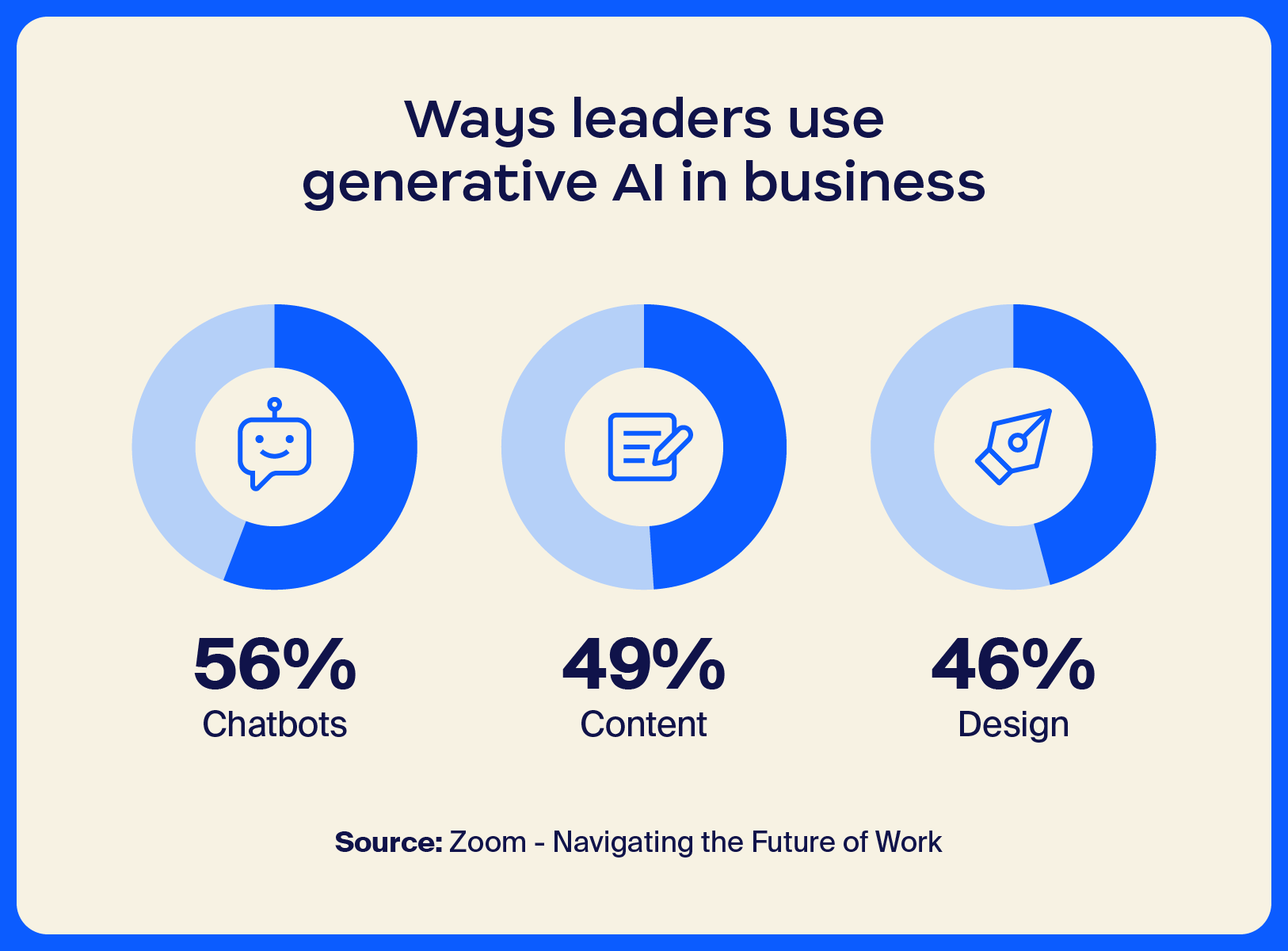
Tech advancements like these are allowing teams to better collaborate and focus on more critical areas of their work. According to our research in "Navigating the Future of Work", 94% of business leaders already use AI in day-to-day operations, with 56% saying they commonly use it for chatbots, 49% for content generation, and 46% for design assistance.
To fully leverage technology's potential in flexible work, organizations must focus on improving their technology infrastructure and integrating generative AI into their digital workplace. Without the right digital workplace platforms and AI innovations, organizations risk falling behind.
By automating routine tasks, providing intelligent assistance, and generating creative content, AI can help streamline workflows and free up employees to focus on more strategic and complex work.
Data from our "Navigating the Future of Work" study shows that 84% of leaders believe that generative AI has improved productivity within their organizations. At the same time, 50% of companies that haven’t adopted AI say their major roadblock in doing so is concern over information security, and 45% expressed concerns about reliability.
However, as AI technology matures and security measures improve, more organizations will likely adopt AI to boost productivity and enhance the hybrid work experience.
As organizations transition to more flexible work models, they must invest in the necessary tools and infrastructure to support their employees and maintain a seamless experience.
Many professionals feel that their organizations need to improve or acquire the necessary technology to support remote and hybrid work effectively. Our "Navigating the Future of Work" survey found that 75% of professionals agree that the technology their companies currently use needs improvement and upgrades, while 72% feel that their company needs to invest in new technologies in order to support flexible work models.
This suggests a significant gap between the technology available to employees and the tools they require to be productive and successful in a hybrid work environment.
However, buying the tools is only half the battle; teams need to actually use them. Our research in "The Productivity Payoff of Next Generation Collaboration" revealed a massive utilization gap, where employees currently use fewer than a third of the available capabilities to prepare for and during meetings. This means that for many companies, a vast reservoir of potential productivity is already sitting in their tech stack, waiting to be unlocked.
To address this challenge, organizations must prioritize investments in technology that can help facilitate collaboration, communication, and productivity. This includes tools such as video conferencing platforms, project management software, and AI-powered assistants.
Workplace preferences can vary significantly across different regions. While North America tends to favor in-office arrangements, EMEA (Europe, Middle East, and Africa) often opts for hybrid models, and APAC (Asia-Pacific) leans toward remote work. Our "Navigating the Future of Work" study found that 75% of leaders in EMEA lead hybrid organizations, compared to 60% in North America and 59% in APAC.
Even with the prevalence of the hybrid model, 27% of North American-based companies operate an in-office model, compared to 7% in EMEA and 16% in APAC.
These findings suggest that cultural factors, economic conditions, and technological infrastructure can influence regional preferences for workplace models. While hybrid work is gaining popularity globally, its level of adoption varies by region.
Our innovative platform provides a comprehensive suite of tools, including video conferencing, audio conferencing, chat, and file sharing, all in one platform. These tools enable collaboration, communication, and connection among teams, regardless of location.
Zoom Workspaces and Zoom Rooms offer dedicated spaces for teams to collaborate and connect, whether in the office or working remotely. Our AI-powered features, such as smart nametags and automated transcription, can enhance the hybrid work experience by making it more efficient and inclusive.
Leverage Zoom’s powerful collaboration platform to help give your team the tools they need to be effective and productive in a flexible work model.
As the hybrid work model continues to evolve, it’s important to keep up. Below, we provide answers to some of the most frequently asked questions about flexible work.
As organizations navigate the current landscape, the focus has shifted from adapting to hybrid work to optimizing it. We are seeing a clear shift toward smarter technology, intentional flexibility, and a core emphasis on employee well-being. Hybrid work is now fully integrated into the fabric of modern business, offering a sustainable and effective way to grow.
Hybrid work is more than a trend; it’s a structured work model and a long-term shift in the way we work. While its popularity may fluctuate over time, the underlying benefits of flexibility, improved work-life balance, and increased productivity make it a sustainable model for the future.
Some key challenges include maintaining team cohesion, providing equitable opportunities for all employees, and managing technology effectively. Addressing these challenges requires careful planning, effective communication, and a commitment to creating a supportive and inclusive work environment.
The key to a successful hybrid work model lies in creating a balance between flexibility and structure. Organizations must establish clear expectations, provide the necessary tools and technology, and foster a culture of trust and collaboration.