
Je handleiding om aan de slag te gaan met ZoomMate
Alles wat je nodig hebt om te beginnen met het gebruik van ZoomMate: notities, zoeken, workflows en AI-tools, allemaal binnen Zoom Workplace.
Met VoIP kun je bellen via het internet in plaats van via een vaste lijn. Ontdek hoe het werkt, de voor- en nadelen, de belangrijkste functies en hoe je overstapt.
 8 minuten lezen
Gepubliceerd op 16 juli 2024



| Waar staat VoIP voor? VoIP is een afkorting van Voice over Internet Protocol (VoIP). Je hoort misschien ook wel de term Voice over IP of IP-telefonie, maar alle drie de termen betekenen hetzelfde: bellen via internet in plaats van via traditionele telefoonlijnen. |
The shift away from old-school phone lines has opened the door to faster, smarter ways to stay in touch. Voice over Internet Protocol (VoIP) routes calls over the internet, giving you clearer audio, flexible setup options, and features that traditional systems struggle to match.
De adoptie van VoIP blijft versnellen; de nieuwste statistieken tonen aan dat de Amerikaanse VoIP-markt naar verwachting in 2034 bijna 152 miljard dollar zal bereiken, terwijl de wereldwijde markt naar verwachting 415,2 miljard dollar zal bedragen.
In this article, you’ll get a quick, practical look at what VoIP is, how it works, and the advantages and tradeoffs to keep in mind. We'll also cover the features that help teams communicate more efficiently.
VoIP is a technology that lets you make phone calls using the internet instead of traditional phone lines.
Unlike regular phones, which rely on physical wires, VoIP converts your voice into digital data and sends it over the internet to the person you’re calling. It works similarly to sending an email but transmits your voice instead of text.
In een VoIP-opstelling beheert en onderhoudt een organisatie doorgaans haar eigen VoIP-systeem, zoals Zoom Phone, inclusief de nodige hardware, software en infrastructuur. Deze aanpak kan kosten verlagen en tegelijkertijd teams meer flexibiliteit geven in hun communicatie.
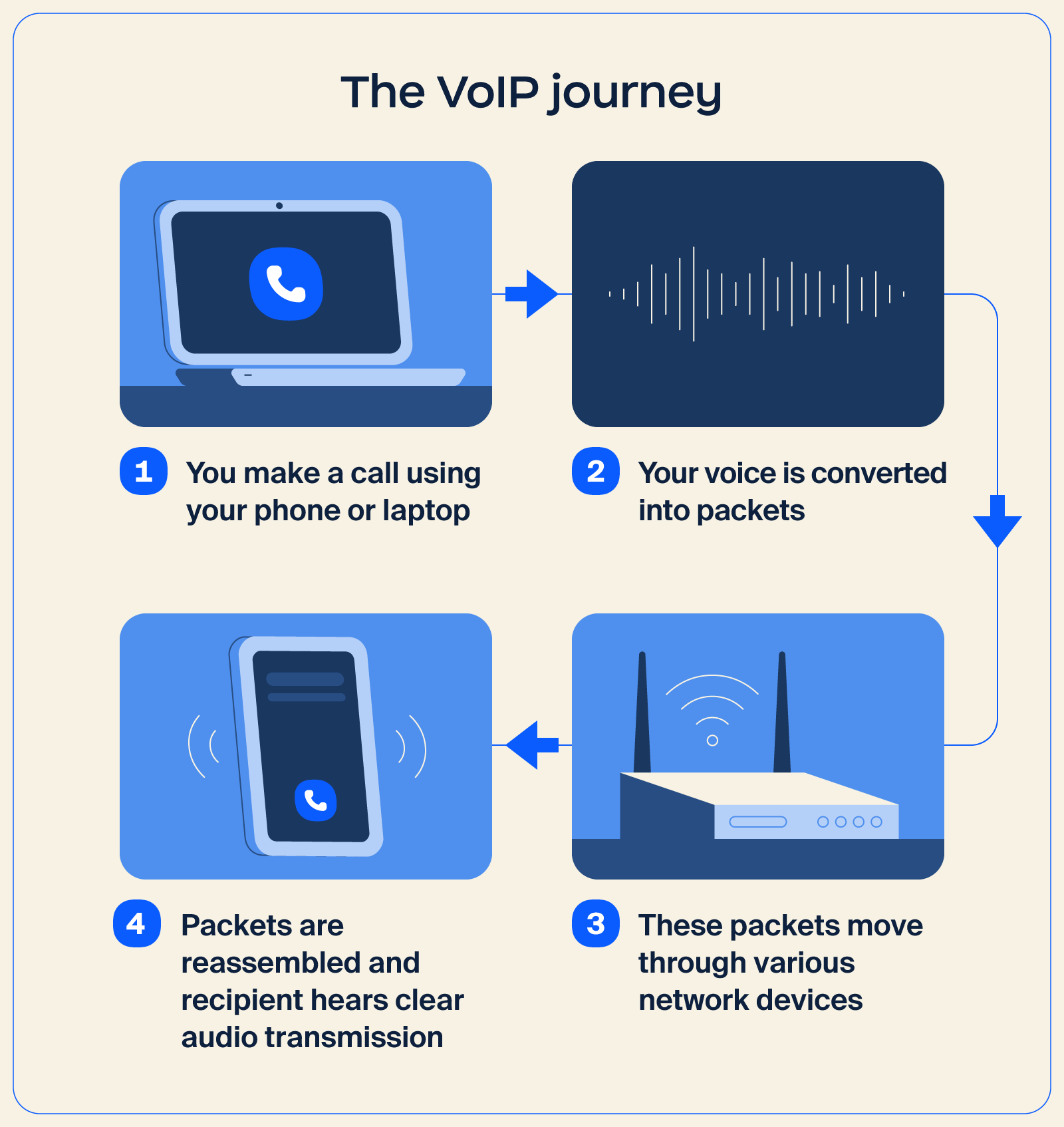
The voice calls you make over Wi-Fi or mobile data are a simple example of VoIP in action. While many apps use this approach for personal communication, the same concept extends for professional use through an IP phone system.
Solutions like Zoom Phone use VoIP technology to provide reliable calling, business numbers, call routing, and other features that help your business manage call workflows more efficiently.
Here’s how VoIP works behind the scenes:
VoIP can transform your business communication by replacing fixed phone lines with an internet-based system that’s easier to scale, manage, and adapt. This is especially useful for teams that want a flexible setup or use a Bring Your Own Carrier (BYOC) approach, since everything runs on a cloud-based foundation.
There are also a few tradeoffs to consider, particularly surrounding connection quality. Here’s a closer look at both sides:
| Pros | Cons |
|
|
If your team wants modern calling features, simpler management, and room to grow, VoIP offers a strong foundation. Teams see the strongest results when VoIP is paired with a stable internet connection and a provider that fits their workflow.
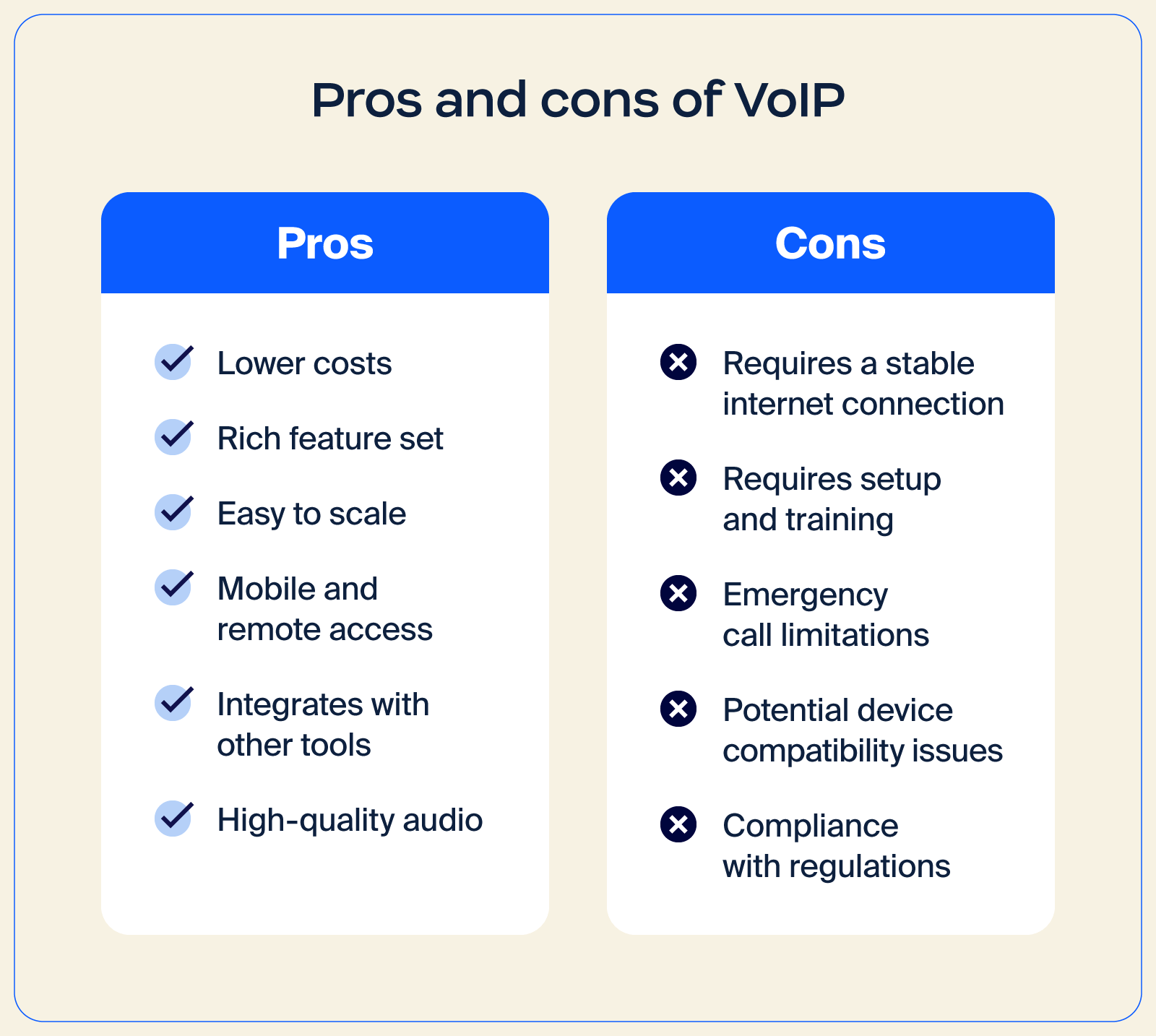
Hoewel VoIP vele voordelen heeft, kent het ook een paar nadelen en beperkingen. We bespreken een paar nadelen waarmee je te maken kunt krijgen:
Ben je op zoek naar een VoIP-telefoonsysteem dat voldoet aan al je eisen op het gebied van communicatie? Hier een paar functies die je bedrijfscommunicatie gemakkelijker kunnen maken:
Stel je voor dat je alle communicatiemiddelen op één plek hebt. Met geïntegreerde communicatie krijg je een naadloze integratie van vergaderingen, telefonie en Zoom Chat. Het is alsof je beschikt over een superkrachtig commandocentrum voor de samenwerking van je team.
Een automatische receptionist (soms ook wel automatische telefooncentrale genoemd) begroet bellers en verbindt ze automatisch 24/7 door naar de juiste persoon of afdeling, zonder dat er een baliemedewerker nodig is. Met Zoom Phone kun je ook een AI-receptionist toevoegen (beschikbaar als add-on) die oproepen buiten kantooruren beantwoordt, afspraken boekt en veelgestelde vragen afhandelt zonder tussenkomst van een live medewerker.
Blijf verbonden terwijl je onderweg bent dankzij compatibiliteit met desktop- en mobiele apparaten. Of je nu aan je bureau zit of onderweg bent, je VoIP-telefoonsysteem is vanaf elk compatibel apparaat toegankelijk, zodat je nooit meer belangrijke oproepen mist.
Bescherm je gevoelige communicatie met encryptie en robuuste beveiligingsmaatregelen. Het is als een veilige kluis voor je oproepen, die je gesprekken privé en vertrouwelijk houdt.
VoIP levert audio in hoge definitie die, mits er een stabiele internetverbinding is, vaak beter klinkt dan een standaard telefoongesprek via een vaste lijn. Moderne codecs en adaptieve kwaliteitstools helpen de impact van kleine netwerkschommelingen tot een minimum te beperken.
Moderne VoIP-platforms gaan veel verder dan basisbellen. Zoom Phone bevat bijvoorbeeld een gespreksoverzicht, voicemailtaken en de mogelijkheid om voicemails te prioriteren, zodat je gefocust kunt blijven en sneller kunt reageren. Zo kun je je richten op de bedrijfsvoering in plaats van op het doornemen van gespreksnotities.
Met de uitgebreide belfuncties van Zoom Phone kun je genieten van een flexibel, mobiel cloudtelefoonsysteem met integraties, HD-spraakkwaliteit, gespreksopname en toegang via een mobiele app.
VoIP and traditional landlines both handle business calling, but they work in very different ways. VoIP runs over the internet, making it easier to scale and manage, and is typically packed with features that help teams in today’s workplace communicate more efficiently.
Landlines rely on physical phone lines, which limit flexibility and make it harder to support modern workflows. Additional differences include:
| Category | VoIP | Landlines |
| Startup cost | Usually lower, especially for teams already using cloud tools App download is free; optional adapter cost: $20-$50 |
Can be higher due to hardware ($50-$100) and on-site phone installation ($40-$100) |
| Monthly fees | Often more predictable and budget-friendly Per user estimate: $15-$40 + taxes/fees |
Can increase with long-distance and maintenance charges Per line estimate: $20-$60 + taxes/fees |
| Call quality | High quality with a stable connection | Consistent, backed by physical infrastructure |
| International calls | More affordable — lower per-minute rates, often in cents | Higher rates — $1+ |
| Features | Rich capabilities, including call routing, voicemail transcription, and video options | Limited features |
| Unified communications | Can support meetings, phone, and chat in one place | Not designed for integrated communication |
| Security | Enterprise-grade security and protection are normally built in | Dependent on carrier systems |
| Other considerations | Easily scalable and adaptable to changing needs | Less flexible and harder to expand |
All in all, VoIP stands out for businesses that want a flexible IP phone system with modern workplace features. Landlines still offer steady reliability, but they lack the flexibility, speed, and range of capabilities that VoIP platforms offer for everyday communication.
Overstappen op VoIP is eenvoudig als je het proces duidelijk in fasen opdeelt. Je plant je behoeften, controleert je verbinding, kiest een provider, verzamelt apparatuur en rondt de installatie af met de onboarding.
Als je ooit haperingen hebt gezien bij een snelheidstest, weet je dat het internet een rol speelt in de kwaliteit van het gesprek, dus het vroeg voorbereiden van je netwerk helpt je het maximale uit je IP-spraakopstelling te halen.
Begin met het in kaart brengen van de communicatiepatronen binnen je team. Kijk naar het belvolume, de verwachtingen ten aanzien van thuiswerken, de tools die je al gebruikt en eventuele beveiligingsregels die van toepassing zijn. Zo zijn organisaties in de gezondheidszorg die onder de HIPAA-regelgeving vallen wellicht op zoek naar een VoIP-provider die functies biedt zoals versleutelde gesprekken en gecontroleerde toegang tot gespreksgegevens.
Stel vervolgens een duidelijk budget op. Budgetschattingen om rekening mee te houden:
Gebruik deze schattingen om de investering te vergelijken met potentiële winsten. Veel organisaties zien meetbare kosten- en infrastructuurverbeteringen na de overstap naar VoIP. Zo verminderde Flex 50%-70% van de circuits en infrastructuur wereldwijd en verlaagde de totale eigendomskosten door over te stappen op Zoom Phone.
Als je huidige configuratie tekortschiet, overweeg dan een kleine upgrade. Een nieuwere router, sterkere wifi of een andere internetprovider helpen het aantal onderbroken gesprekken te verminderen en haperingen tijdens gesprekken tot een minimum te beperken.
Een goede VoIP-aanbieder moet aansluiten op de huidige werkwijze van je bedrijf en tegelijkertijd ruimte bieden voor groei. Let bij het vergelijken van de opties op het volgende:
Controleer ook of de mobiele app wordt ondersteund, of er mogelijkheden zijn voor internationaal bellen en of er regionale beperkingen zijn. Met Zoom Phone krijg je een flexibel cloudgebaseerd telefoonsysteem dat is ontworpen voor mobiliteit, samen met handige integraties, AI-first productiviteitstools en HD-spraakkwaliteit. Extra VoIP-telefoonfuncties, zoals gespreksopname, transcriptie van voicemail en mobiele toegang, kunnen de dagelijkse communicatie eenvoudiger maken.
Zodra je je aanbieder hebt gekozen, verzamel je alles wat je nodig hebt voor een soepele onboarding, waaronder:
Je aanbieder begeleidt je bij de onboarding, die doorgaans een korte rondleiding door de functies en een gebruikerstraining omvat. Als je je huidige nummer behoudt, regelen zij de nummerportering. Zo niet, dan kun je een nieuw nummer delen via je website, e-mailhandtekeningen en klantkanalen.
Zodra alles is verbonden, kan je team met het nieuwe VoIP-systeem bellen en gebeld worden, en met minimale onderbrekingen overstappen op dagelijks gebruik.
VoIP staat voor Voice over Internet Protocol. Het is een technologie waarmee je kunt bellen en gebeld kunt worden via een breedbandinternetverbinding in plaats van via een traditionele vaste lijn of analoge telefoonlijn. Het wordt ook wel IP-telefonie of internettelefonie genoemd.
VoIP kan heel betaalbaar zijn. Veel abonnementen kosten ongeveer $ 10-$ 40 per gebruiker per maand. Kosten kunnen oplopen als je apparatuur of extra functies toevoegt. De installatie is doorgaans gratis tot minimaal, waardoor VoIP vooraf vaak aanzienlijk voordeliger is dan traditionele telefoonsystemen.
Ja, met veel mobiele telefoons kun je VoIP gebruiken via apps zoals Zoom Workplace. Wanneer ze verbonden zijn met wifi, routeren deze apps oproepen via internet in plaats van via het mobiele netwerk, wat de kosten kan verlagen en extra belfuncties kan ontgrendelen.
Ja. De meeste VoIP-providers ondersteunen nummerportering, dus je kunt je bestaande zakelijke telefoonnummer overzetten naar je nieuwe systeem.
VoIP kan sterkere bescherming bieden dan traditionele vaste lijnen wanneer providers actuele beveiligingspraktijken toepassen, waaronder encryptie, rolgebaseerde toegangscontroles en nalevingstools. De beveiligingservaring hangt sterk af van de provider die je kiest.
Standaard VoIP beschrijft de technologie zelf. Een gehost VoIP-systeem (ook wel een cloudtelefoonsysteem genoemd) houdt in dat de provider de infrastructuur voor je beheert; jij maakt alleen gebruik van de dienst. Veel van de huidige zakelijke VoIP-oplossingen, waaronder Zoom Phone, worden gehost.