Collaboration Insights & Trends

36+ essential workplace communication statistics for a productive 2026

11 min read

Updated on March 13, 2026

Published on March 13, 2026

A group of team members sitting around a table in the office.

Poor communication quietly drains more money from companies than most teams realize. It slows down projects, creates duplicate work, and leaves employees guessing about priorities.

The data makes the problem hard to ignore: over one-third of leaders spend an hour or more each day resolving collaboration issues, costing organizations up to $16,491 per manager annually in inefficient productivity, according to Zoom’s 2024 Global Collaboration in the Workplace report.

In this roundup of workplace communication statistics, we’ll walk through the real cost of misalignment, the most common breakdowns teams face, and why smarter communication tools are becoming essential heading into 2026.

Key workplace communication statistics

How teams communicate affects everything from engagement and productivity to burnout and retention. According to our Collaboration in the Workplace report, while some workers report stronger connections in hybrid setups, others struggle with unclear next steps, meeting overload, and collaboration challenges, especially among remote teams. 

These stats highlight the real impact of workplace communication and why getting it right is crucial for both employees and organizations.
  1. 52% of workers say team connectedness has improved since going hybrid and remote. (Zoom)
  2. 84% say strong workplace relationships can be built in a fully in-person environment, and 85% say the same is true in a hybrid setup. (Zoom)
  3. 54% of employees say they often leave meetings without knowing the next steps or who’s responsible for what. (Atlassian)
  4. Employee engagement in the U.S. dropped to 31% in 2024 — its lowest level in a decade — matching 2014 levels. (Gallup)
  5. Workers spend an average of 20 hours a week using digital communication tools. (Forbes Advisor)
  6. 76% of employees say they feel drained on days with many meetings. (Atlassian)
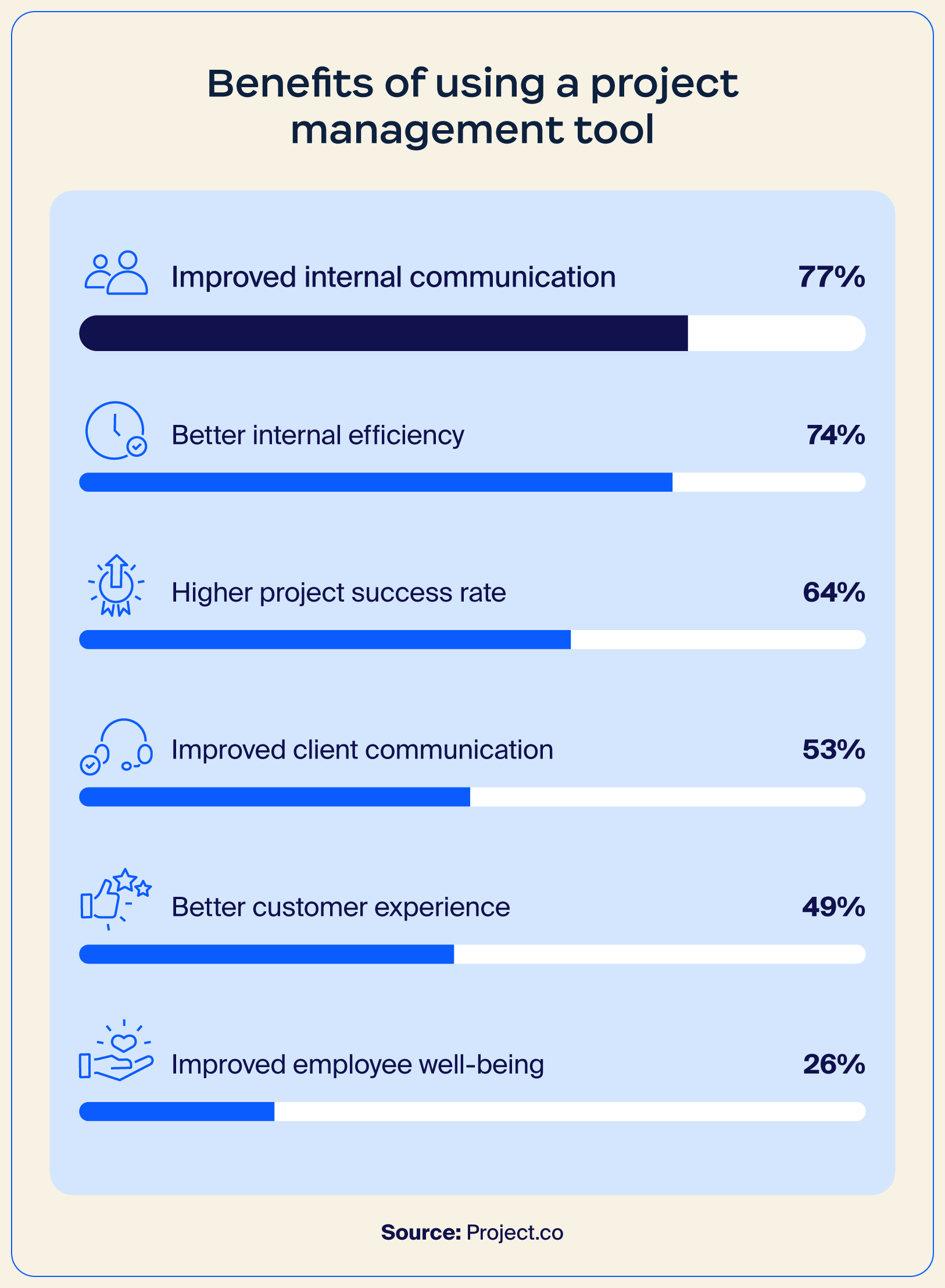
  7. In 2023, employees who primarily use a project management tool to communicate with clients and co-workers are 57% less likely to experience burnout, stress, or fatigue. (Project.co)

Illustration with the benefits of using a project management tool

The cost of poor workplace communication

Effective communication in the workplace drives productivity, trust, and business outcomes. When it breaks down, the effects ripple across teams, projects, and even customer satisfaction. 

In this section, we’ll look at workplace communication statistics that reveal just how much impact communication can have on organizations today.
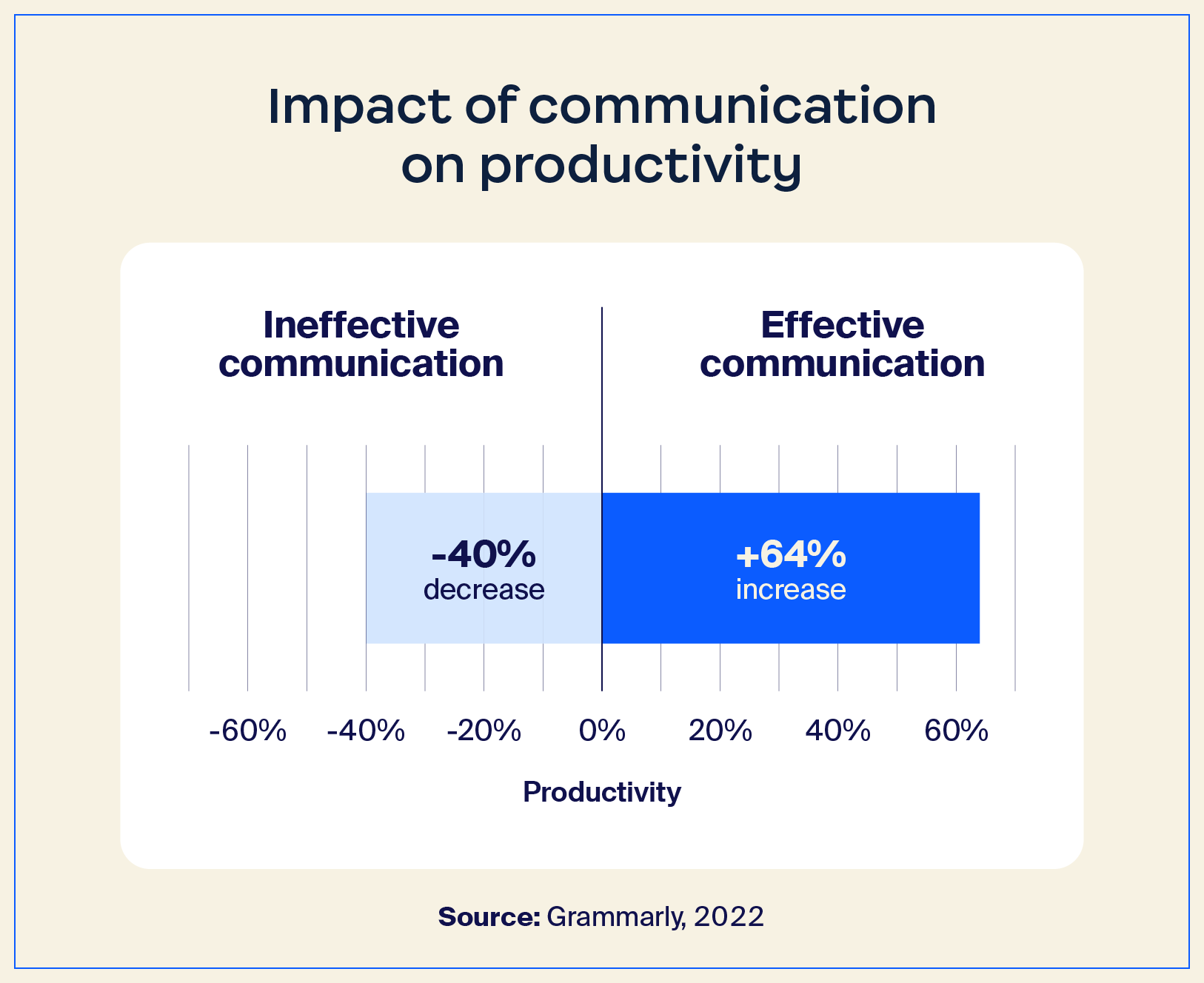
  1. Ineffective communication is estimated to cost U.S. businesses up to $12,506 per employee, per year. (Grammarly)
  2. On average, employees report spending only 66% of their workday on core job responsibilities — the rest is eaten up by distractions, avoidable meetings, and communication-related overhead. (Axios HQ)
  3. Poor communication reduces productivity for 49% of workers, and nearly half say it negatively affects their job satisfaction. (Forbes Advisor)
  4. 61% of employees who are unlikely to stay at their job cite poor internal communication as a key reason for wanting to leave. (Staffbase)
  5. 1 in 4 leaders see decreased customer satisfaction as a result of poor communication at
work. (Grammarly)
  6. For more than 40% of workers, poor communication erodes trust in both leadership and their team. The impact is even stronger for remote employees — 54% say it hurts trust in leadership, and 52% say it hurts trust within their team. (Forbes Advisor)
  7. On the other hand, poor communication can create real setbacks: 45% say it increases costs, and 37% say it leads to extended project timelines. 37% of leaders say it leads to extended project timelines, and 32% note it increases costs. (Grammarly)

Comparison of effective vs ineffective communication on productivity

Internal communication channel preferences

Understanding employees’ preferences and how leaders communicate can make a huge difference in engagement, clarity, and overall productivity. 

These statistics highlight the importance of communication in the workplace, showing which tools and formats teams rely on most and where organizations can focus to keep everyone informed and aligned.

  1. Among leaders, instant messaging takes the top spot at 50%, followed by project management tools at 44% and in-person meetings at 38%. (Global Collaboration in the Workplace)
  2. Employees lean even harder into digital channels — 64% prefer instant messaging, and 63% rely on email — with 54% still valuing in-person meetings as part of the mix. (Global Collaboration in the Workplace)
  3. 75% of employees use enterprise chat tools to communicate with other employees. (Gallagher)
  4. 67% of employees say they prefer email or newsletters for receiving critical internal updates. (Axios HQ).
  5. 39% prefer in-person meetings, and 24% prefer virtual department or staff meetings for critical updates. (Axios HQ).
  6. 18% of employees say they prefer chat / instant messaging tools for critical internal communications. (Axios HQ).
  7. 85% of internal communicators say email is their most effective channel. (Workshop)
  8. The same report notes increasing adoption of video and in-person events as communication tactics, signaling a shift toward richer, more interactive formats. (Workshop)
  9. Besides email (58%) and intranet (67%), workplace collaboration tools and direct supervisor communication are also among the most effective communication channels, at 45% each. (Modus + Staffbase)

Common communication pain point statistics

Even within well-run organizations, communication can break down easily. From juggling too many apps to struggling to find time on colleagues’ calendars, employees and leaders face daily barriers that slow workplace collaboration and eat into productivity. These common pain points carry real costs, from wasted hours to lost business. 

Let’s examine some key statistics that highlight where communication often fails and why addressing these challenges matters.
  1. Employees using more than 10 apps report communication issues at a higher rate (54%) than those using fewer than five apps (34%). (Global Collaboration in the Workplace)
  2. 83% of leaders and 77% of employees say finding time on others’ calendars is a major barrier to effective collaboration. (Global Collaboration in the Workplace)
  3. 82% of leaders and 81% of employees struggle with colleagues not responding quickly enough. (Global Collaboration in the Workplace)
  4. 82% of leaders and 72% of employees say they don’t have enough time between meetings or chats to actually get work done. (Global Collaboration in the Workplace
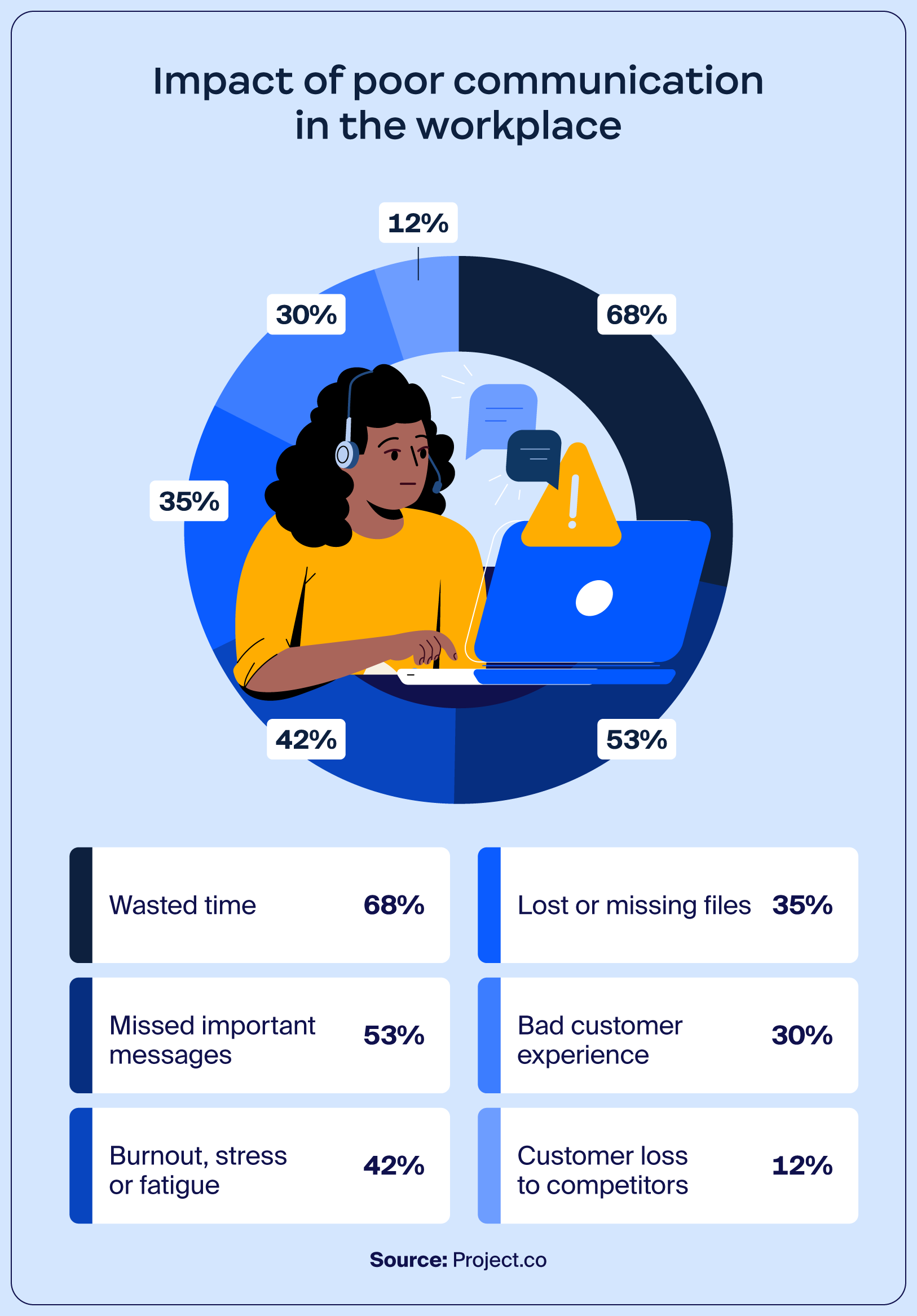
  5. Project-level communication failures are common: 68% of people say they’ve wasted time due to communication issues, and 53% report missing messages because of poor communication. (Project.co)
  6. 3 in 4 business leaders say their company underestimates the cost of poor communication. (Grammarly)
  7. 1 in 5 business leaders have lost business due to communication issues, with 86% estimating the lost value at $10,000 or more and 22% estimating $50,000 or more. (Grammarly)

Impact of poor communication in the workplace

Data-backed ways to improve your workplace communication

Technology is transforming how teams communicate, and the numbers show it can make a real difference. Leaders report that AI and digital collaboration tools not only save time but also help teams work together more effectively, streamline workflows, and keep projects on track.

The data below highlights exactly how communication tools are making an impact and where there’s still room for improvement.

  1. 75% of leaders whose teams use AI say their teams collaborate better. (Global Collaboration in the Workplace, 2023)
  2. 85% of leaders say they complete tasks faster by using AI tools. (Global Collaboration in the Workplace, 2024)
  3. Teams that integrate AI into workflows spend 18% more time on process and content communication, which helps with clarity and task alignment. (H. Ju and S. Aral)

Communicate seamlessly with your team in Zoom

As these workplace communication statistics show, strong communication drives productivity, engagement, and positive business outcomes. Zoom helps teams bridge the gaps that often slow collaboration, combining video meetings, chat, and project collaboration tools into a single, integrated experience with Zoom Workplace.

Whether your team is remote, hybrid, or in-person, our all-in-one platform helps keep conversations, files, and tasks connected.


Our customers love us

Okta
Nasdaq
Rakuten
Logitech
Western Union
Autodesk
Dropbox
Okta
Nasdaq
Rakuten
Logitech
Western Union
Autodesk
Dropbox

Zoom - One Platform to Connect