Meet Zoom AI Companion, your new AI assistant!
Boost productivity and team collaboration with Zoom AI Companion, available at no additional cost with eligible paid Zoom plans.
 12 min read
Updated on December 11, 2025
Published on December 11, 2025



Flexible hours, AI-first workflow tools, and “coffee badging” — how people do their jobs today looks very different from just five years ago. Employee engagement statistics prove it.
Survey after survey shows a workforce increasingly disengaged from their employers, burnout on the rise, priorities shifting, and AI reshaping how people do their jobs. This is prompting business and HR leadership teams to rethink how they hire, train, manage, and retain the talent they need to improve company productivity and performance.
Read on for the latest employee experience trends and statistics to help you understand what’s changing in the world of work and how to respond effectively.
What's truly shaping your employees' daily lives? From the widespread adoption of flexible work to the growing anxieties surrounding AI's impact and the staggering cost of disengagement, these standout research statistics offer a vital snapshot of the contemporary workplace:
1. Hybrid work is now the norm: 63% of leaders and 53% of employees split their time between home and the office, while just 4% of leaders are fully remote. (Morning Consult Survey commissioned by Zoom)
2. Three-quarters of leaders of companies whose teams use AI say collaboration has noticeably improved. (Zoom)
3. Eighty-six percent of employees fear the potential of human job losses because of AI and their company’s data becoming less secure. The same proportion also worries about how accurate AI is. (Zoom)
4. A third of flexible employees want to work three days from the office, and one-fifth want to work two days, with 15% wanting full-time remote work. (Owl Labs)
5. Two in five employees would start looking for a more flexible job if their employer stopped offering flexible work. (Owl Labs)
6. Half of all workers are either actively looking for a new job or keeping an eye out for one. (Gallup)
7. Two in five employees say they felt “a lot of stress” just yesterday. (Gallup)
8. Only 6% of Gen Z employees say their primary career goal is getting into a leadership position. (Deloitte)
9. Gallup estimates that disengaged employees cost the global economy $9.6 trillion in productivity, equivalent to around 9% of world GDP. (Gallup)
10. Replacing a single employee earning $50K costs about $16,500 or more assuming wage growth in 2025 — around one-third of their annual salary. (Work Institute)
Forget "quiet quitting"—the data reveals a full-blown engagement crisis. From endless meetings to strained manager-team dynamics, these statistics lay bare the alarming reasons behind widespread disengagement and offer a clear path forward: investing in the leaders who can turn the tide:
11. It’s hard for 83% of leaders to find time on colleagues’ calendars, which can weaken engagement between managers and their teams. (Zoom)
12. Slow response times from colleagues are a barrier for 82% of leaders, which can make it hard to keep momentum going. (Zoom)
13. For 82% of leaders, there’s not enough breathing room between meetings to focus properly, limiting productivity. (Zoom)
14. Meetings that don’t solve problems or end with a clear outcome take up an hour or more per day for 37% of participants. (Zoom)
15. Bad or ineffective collaboration leads to a lack of engagement or inattentiveness for 28% of leaders and 34% of employees. (Morning Consult Survey commissioned by Zoom)
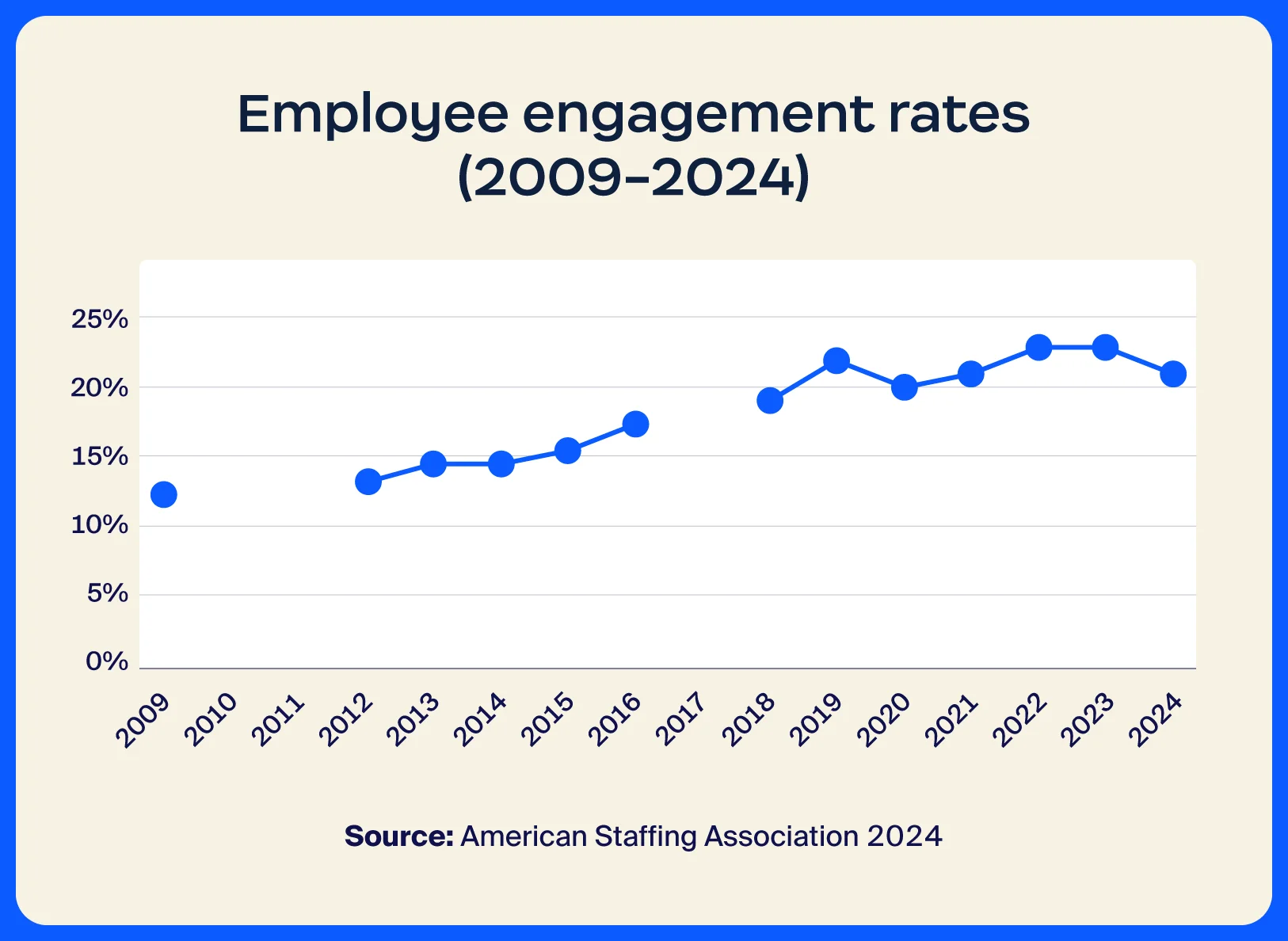
16. Only 21% of employees worldwide feel engaged at work, while 62% say they’re not engaged and 17% say they’re actively disengaged. (Gallup)
17. Rates of engagement vary widely around the world: 31% of workers are engaged in the U.S. and Canada, but just 13% in Europe and 14% in the Middle East and North Africa. (Gallup)
18. Only 44% of managers have received management training. Managers who have received training are half as likely to be actively disengaged compared to those who haven’t. (Gallup)
19. Just 28% of managers say they are thriving. This figure jumps to 34% when they receive training from their employer. (Gallup)
20. Manager engagement fell from 30% to 27% between 2023 and 2024, the steepest drop among any group of workers. (Gallup)
21. A mere 28% of Gen Z employees would recommend their employer as a good organization to work for friends and family, a number that jumps to 34% for millennials. (Deloitte)
22. Half of engaged employees say they’re thriving in life, compared to just one-third of those who aren’t engaged. (Gallup)
23. Just 51% of senior HR executives still use “favorable ratings” for employee survey reporting, a method some believe is adding to increasing staff disconnect. (Work Institute)
24. Only 11% of leaders strongly agree that their organization acts decisively on legal or compliance issues. (Work Institute)
25. Reports of fraud or unethical behavior rose to 7% in 2024, a 52% increase since 2020. (Work Institute)
26. Disengagement cost the global economy $438 billion in lost employee productivity last year. (Gallup)
27. Burnout, lack of recognition, large workloads, and poor growth opportunities are four of the main reasons that 43% of workers say they’re disengaged from work. (Owl Labs)
How you work matters—and the data proves it. From the quiet struggles of remote teams to the daily grind of the commute, working arrangements profoundly shape employee stress and concentration.
These stats highlight the increasing divide between how leaders and their teams view productivity and work-life effectiveness:
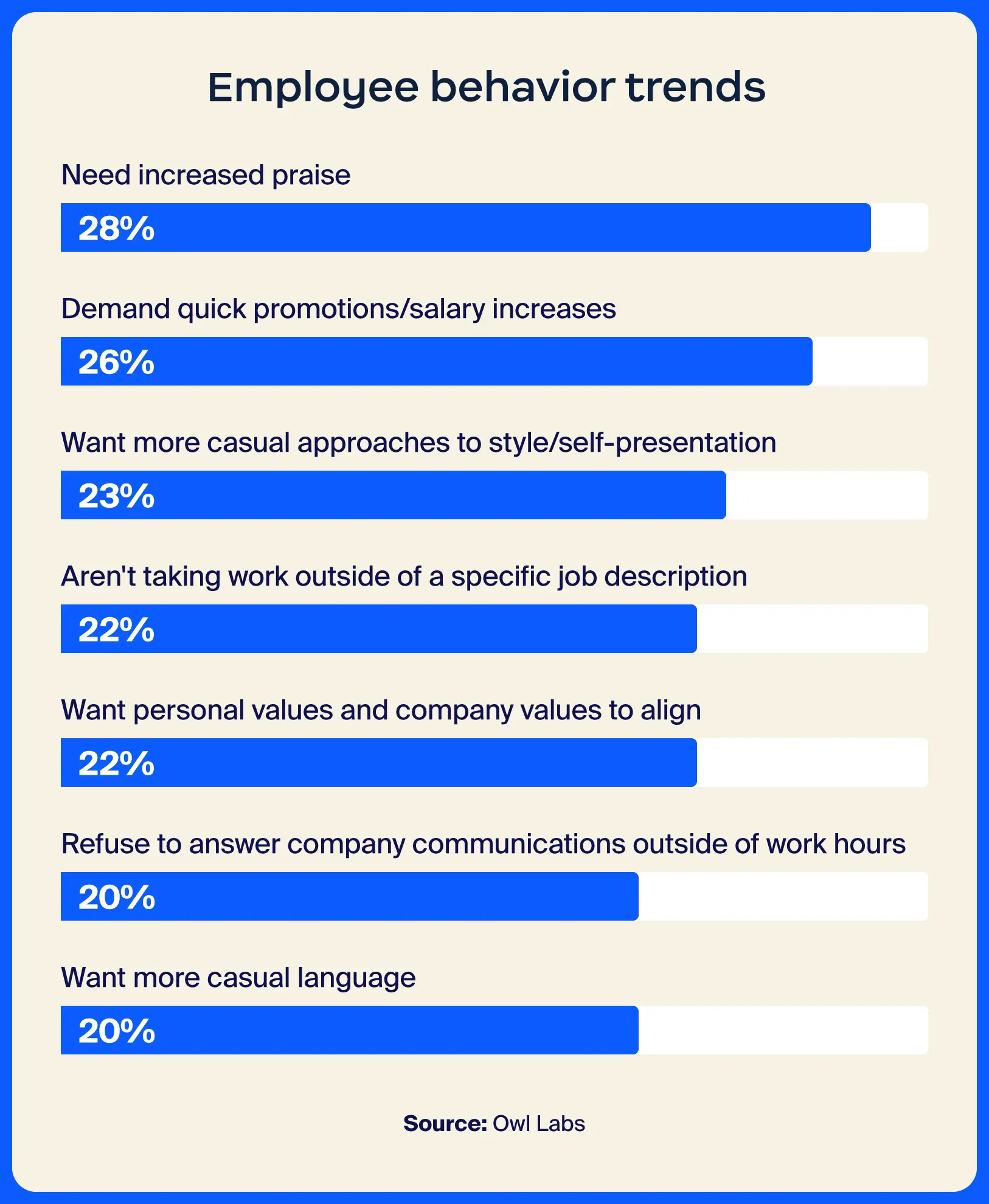
28. Over 2 in 5 flexible workers (44%) admit to “coffee badging,” or turning up briefly just to be seen before leaving, so it’s clear that not all office time is being used productively. (Owl Labs)
29. Exclusively remote workers experience daily sadness the most (30%), followed by on-site staff who could work remotely (23%), on-site staff who can’t work remotely (22%), and flexible workers (21%). (Gallup)
| Using online collaboration tools and exchanging end-of-day check-out messages can help bridge the gap between team leaders and their staff. |
30. Exclusively remote workers experience daily loneliness the most (27%), followed by flexible workers (23%), on-site staff who could work remotely (21%), and on-site staff who can’t work remotely (20%). (Gallup)
31. Long commutes are a drain for many, with 85% of employees traveling up to 45 minutes each way. The same survey found 74% say they’d be more productive without a commute, and 28% would be more willing to go into the office if the journey were shorter. (Owl Labs)
32. Managers and employees don’t always see eye to eye on productivity — 90% of employees say they’re just as or more productive working flexibly, but only 62% of managers agree. (Owl Labs)
These statistics show how companies are adopting tech to stay ahead in recruitment, but need to do better at retaining their current staff:
33. Artificial intelligence (AI) is having a clear impact on work efficiency, with 56% of HR leaders saying it’s improved efficiency in their organization, and 46% that it’s contributed to more innovation. (Mercer)
34. More than a third (39%) of respondents plan to use technology to create smoother hiring interactions. (Korn Ferry)
35. Top use cases for hiring employees will be using AI to search and vet candidates (27%), deploying people analytics technology (26%), and automating candidate relationships (21%). (Korn Ferry)
36. Between 35 and 40 million people will voluntarily quit their jobs this year. (Work Institute)
37. In 2024, the cost of that churn reached close to $1 trillion, approximately twice the cost in 2015. (Work Institute)
38. The majority (76.3%) of staff turnover in 2024 was preventable, caused by factors like career misalignment, work-life balance issues, and issues with management. (Work Institute)
39. Other preventable reasons include health and family (12.4%), work-life balance (11.9%), management behavior (9.7%), dissatisfaction with pay (8.2%), the nature of the job (8%), and the physical environment (7%). (Work Institute)
40. Lack of career development opportunities led 18.9% of people to quit their jobs. (Work Institute)
41. Given low employee engagement figures, 32% of employers aim to upskill their current staff, with 30% creating career paths for long-term growth of their businesses. (Korn Ferry)
42. Early exits are frequent, with 40% of people quitting in their first year of employment at an organization. (Work Institute)
43. Job hunting is most common among remote and flexible workers (57% each), followed by 47% of on-site staff without remote options and 45% of those who could work remotely but don’t. (Gallup)
The lines between work and life are blurring, and employees are feeling the squeeze. While companies grapple with measuring employee experience in this new flexible world, the data reveals a critical truth—work-life balance isn't just a perk, it's a make-or-break factor for talent.
See where companies are hitting the mark and where they're missing it:
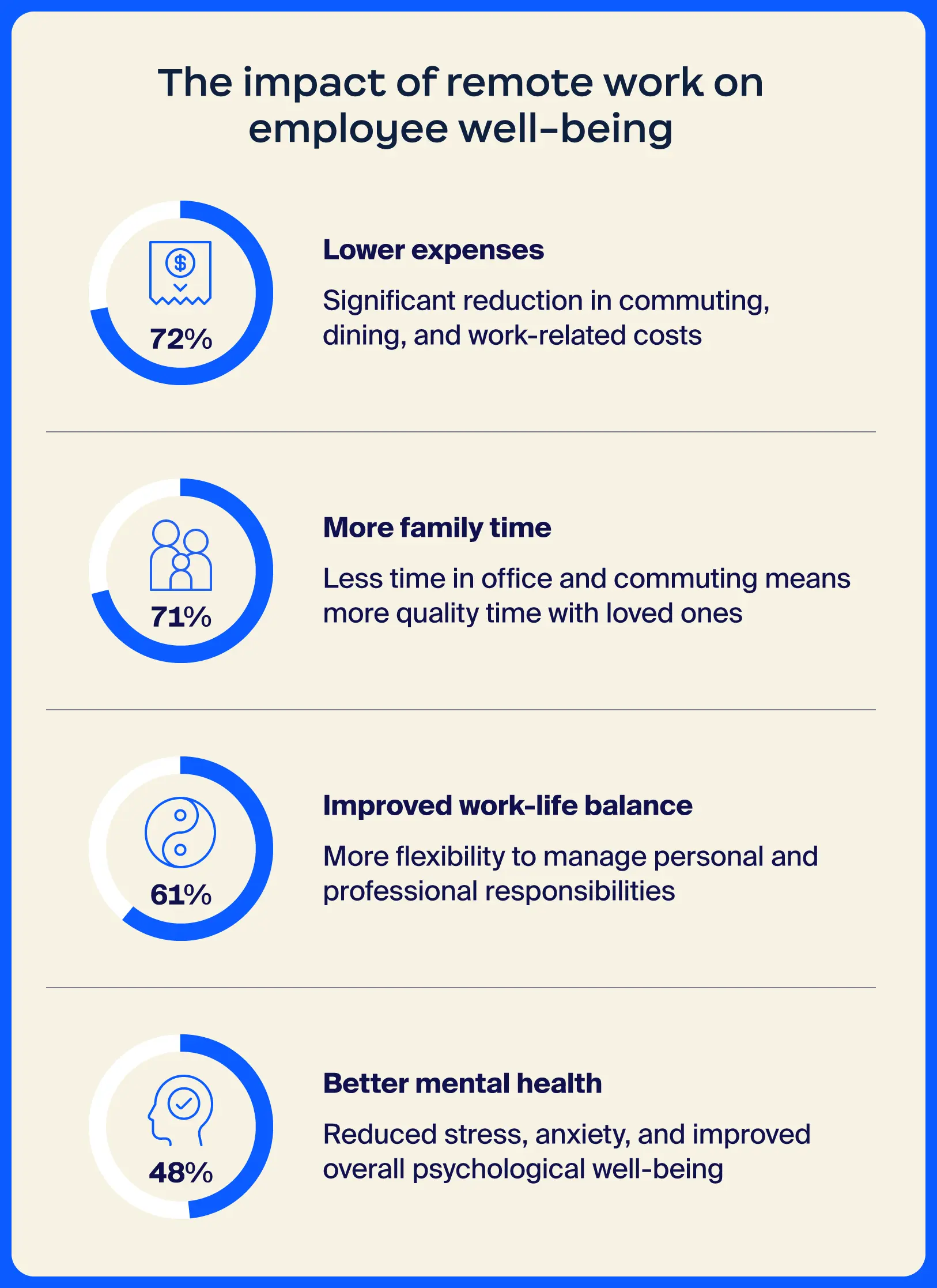
44. Remote workers say that their setups deliver an improved work-life balance (61%), better mental health (48%), more time with their family (71%), and lower expenses (72%). (Zoom)
45. When hiring flexible talent in the future, 48% of employers believe that managing work-life balance expectations will pose a major challenge. (Korn Ferry)
46. Employee life evaluations (how well a person feels they’re doing) dropped to 33% in a two-year period, with female managers and older managers experiencing the sharpest declines. (Gallup)
47. Among Gen Z employees, 51% of those satisfied in their roles are also happy with their work-life balance, compared to just 31% of those who are dissatisfied. For millennials, these figures increase slightly, to 58% and 32%, respectively. (Deloitte)
48. Many younger workers believe that clearer boundaries prompt a better work-life balance — 44% of Gen Z employees believe managers set clear limits, while only 28% believe they do. Among millennials, these figures are 42% and 24%, respectively. (Deloitte).
49. Gen Z (77%) and millennial (79%) employees believe generative AI has helped them free up their time and improve their work-life balance. (Deloitte)
50. Work-life balance also influences career decisions, with 28% of Gen Z and 26% of millennial employees having changed their career path or industry in pursuit of it. (Deloitte)
51. Gen Z employee promoters — those who would recommend their organization as a good place to work — are more likely to feel financially secure than non-promoters (69% vs. 49%, respectively). Among millennials, 73% of promoters feel financially secure compared to 51% of non-promoters. (Deloitte)
52. Those same Gen Z promoters are also happier with their work-life balance than non-promoters (90% vs. 78%), mental well-being (73% vs. 52%), pay and rewards (88% vs. 72%), and the learning and development opportunities their employers offer (90% vs. 77%). Millennial promoter figures are roughly in line. (Deloitte)
53. The main causes of stress and anxiety for millennials, which impact employee engagement and many other aspects of life, are their long-term financial future (45%), family well-being (45%), day-to-day finances (42%), and physical/mental health (35%/33%). For both Gen Z and millennial employees, their job is one of the least common sources of stress, though still a factor for around a third. (Deloitte)
54. The global stress level for men and women is equal at 40%. Stress levels are higher for exclusively remote (45%) and flexible staff (46%) compared to on-site staff who can work from home (39%) and who can’t (38%). (Gallup)
55. Women hold just 29% of C-suite roles in corporate America, and only 7% of those are held by women of color. (McKinsey)
56. There are signs of progress on boards: In 2024, 42% of new S&P 500 directors were women, and 26% were from ethnic minorities. In 2014, those figures were 30% and 12%, respectively. (Spencer Stuart)
57. Nearly half of LGBTQ employees (47%) have faced discrimination or harassment at work, and 21% believed they had been fired at some point in their lives because of their sexual orientation or gender identity. (Williams Institute)
58. Only 22.7% of Americans with a disability are employed, compared with 65.5% of those without. (BLS)
59. Even with a bachelor’s degree, the divide remains: Just 32% of graduates with a disability are employed, compared to 65.5% of the general population. (BLS)
60. Workers with disabilities are nearly twice as likely to be in part-time jobs as workers without disabilities (31% vs. 17%) and more likely to be self-employed. (9.2% vs. 6%) (BLS)
61. Over a five-year period, firms focused on including employees with disabilities made 1.6x more revenue, 2x economic profit, and 2.6x net income. (Disability:IN).
Technology has shaped the modern working environment over the last 25 years. Small and medium-sized businesses (SMBs) now have access to tools once exclusive to enterprise firms, creating opportunities to improve the total employee experience. A key part of this evolution is the rise of apps with AI companion features that provide on-demand assistance for employees.
Think your tech stack is just fine? These stats might make you think again. From collaboration conundrums to AI anxieties, these eye-opening stats reveal just how much tech shapes employee experience—and why it demands our attention:
62. “App overload” affects collaboration: 44% of leaders using more than 10 apps report poor team alignment, compared to 34% using five to 10 apps and 29% using fewer than five. (Zoom)
63. Despite general positivity, many worry about AI adoption. Four in five leaders are concerned that it needs too much training, 79% that it’s too impersonal, and 78% that employees will learn to depend on it. (Zoom)
64. Switching between apps is a major time drain for employees, with 42% stating it takes at least 15 minutes to refocus after task-switching. (Zoom)
65. Firms with better technology would lure 18% of employees from different companies. (Owl Labs)
66. Good technology matters to 87% of employees, behind salary (94%), a supportive manager (92%), benefits (91%), and pay equity. (Owl Labs)
67. Better meeting room tech makes a difference to 18% of staff who say it might draw them back to the office. (Owl Labs)
68. Lack of IT and technical support is a concern for 45% of employees. (Owl Labs)
69. A majority of younger workers are already using generative AI: 57% of Gen Z and 56% of millennials report using it at work. (Deloitte)
Employees are the people who generate your revenue and keep your clients coming back. To provide a positive employee experience, track metrics like sentiment and staff churn rates to identify what’s working and what’s not, and make the changes needed to create the conditions required for peak performance.
Investing in the right collaboration tools to help employees, wherever they’re located, is a great way to help them feel like an important part of the overall team.
To find out how technology can increase the level of support you can provide to your frontline teams, check out Zoom’s Workforce Engagement Management suite or contact a Zoom expert today.