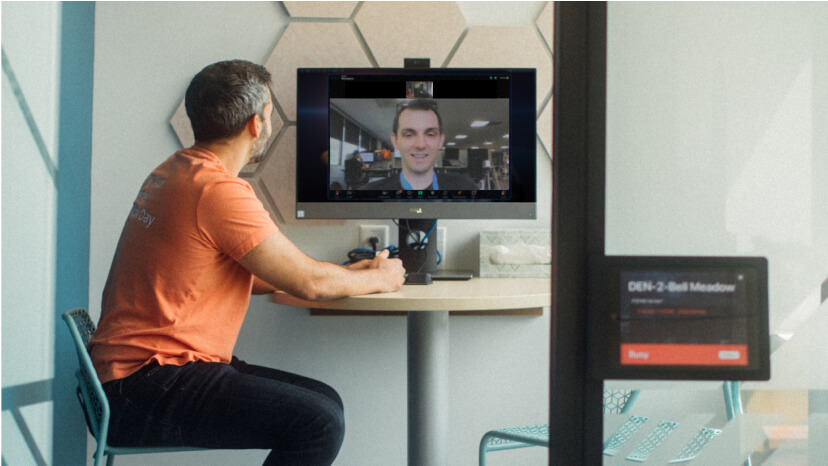
Meet Zoom AI Companion, your new AI assistant!
Boost productivity and team collaboration with Zoom AI Companion, available at no additional cost with eligible paid Zoom plans.
AI tools are saving employees hours each week—but most organizations have no idea where that time goes. The new AI Companion ROI Dashboard shows account owners and admins exactly where those gains are happening and helps organizations turn them into tangible results.
Updated on March 30, 2026
Published on March 30, 2026




Robin Bunevich is a Product Marketing Manager at Zoom. She oversees product marketing and strategy for Zoom AI. After three years of leading marketing for Zoom’s Event Solution products, and launching one of the fastest growing products at Zoom, Zoom Events, she is now focused on helping organizations seamlessly adopt AI into their workflows. Prior to Zoom, she ran marketing for live events at The New York Times, and was instrumental in helping the organization transition to a fully virtual events program in March of 2020. At Zoom, Robin uses her 15 plus years of marketing and advertising experience to drive awareness and adoption for Zoom’s AI solutions.
AI has transformed work faster than anyone expected—but most organizations still struggle to point to the value. A recent study from Deloitte and Zoom found that 94% of employees run into friction across the meeting lifecycle—preparing agendas, following up on action items, and everything in between, getting back an average of three hours per employee each week when organizations use next-gen AI features.* And from a recent Zoom-commissioned survey, we have found that people get that time back from faster follow-ups (about 1.6 hours), more engaged meeting time (up to 15% more focus), and skipping meetings that don't need you there (another 1.1 hours).†
The real problem isn't just too many meetings—it's everything that happens before and after. Preparing materials, taking notes, capturing action items, searching for what was discussed, and following up with stakeholders. These tasks eat up hours each week, breaking your focus and slowing everything down.
You can get those hours back with smarter prep work, faster follow‑up, and skipping meetings that don't need you there. HR teams can shorten hiring cycles, sales teams can meet more customers, and IT teams can reduce support burdens—all while employees report smoother workflows and less stress.*
The new AI Companion ROI Dashboard provides metrics calculated from your organization's actual meeting volume, AI Companion usage patterns, and research-validated benchmarks. The research foundation relies on measuring three core productivity gains, each validated through data from 688 knowledge workers and third-party analysis. These metrics help quantify the specific ways AI Companion can change how people work:
These research metrics—measured through survey data, internal meeting telemetry, and third-party validation—provide the foundation for the dashboard's default value calculations. The methodology uses conservative assumptions, counting only measurable, task-specific activities and excluding participants without summary access. This keeps the findings realistic, reproducible, and defensible when you need to show real impact.
The ROI Dashboard uses actual usage data from your organization combined with those validated time-saving benchmarks to provide estimated productivity metrics. Here's what each number represents:
Each metric is calculated based on your organization's actual meeting volume and AI Companion usage patterns. You can adjust the default benchmark values to custom values to better match your specific workflows and meeting patterns.
The dashboard turns abstract productivity gains into concrete numbers you can share. You can:
It's a simple way to connect AI adoption with tangible outcomes—helping leaders see not just how much time AI saves, but how that time fuels better work.
The dashboard takes out the guesswork. Instead of estimating ROI based solely on industry averages, you can calculate it using your organization's real meeting data.
Collaboration platforms have become essential infrastructure, but their value depends on how you use them and whether you can measure the outcomes.* The AI Companion ROI Dashboard is designed to close that gap, turning everyday AI interactions into a clear productivity story you can share. It's not just about proving ROI—it's about understanding where AI creates the most value so you can do more of it across your organization.
When you can measure your ROI with confidence, you can invest in it with confidence. The AI Companion ROI Dashboard gives you both.
*Source: The Productivity Payoff of Next Generation Collaboration, Zoom & Deloitte
†Source: Zoom-commissioned quantitative online survey conducted between November 2025 and February 2026, surveying a total of 688 knowledge workers on generative AI usage for meeting note-taking.