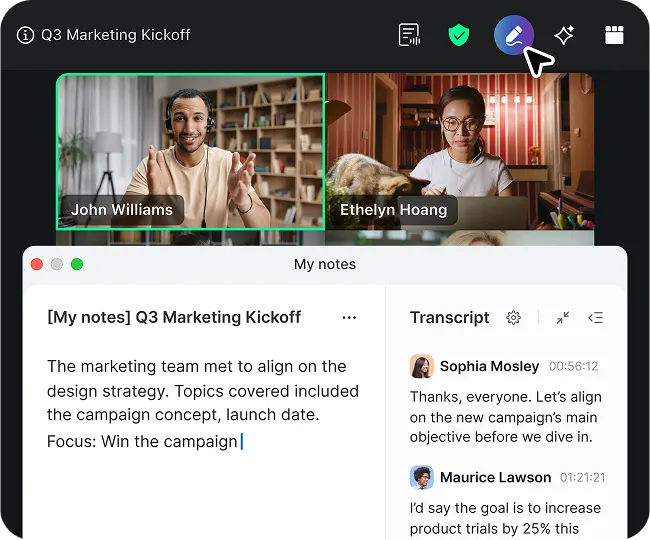
Automatically captures, summarizes, and extracts action items from any virtual or in-person meeting.
Learn more
Webinars & Events
Zoom Webinars
What's ahead for virtual events: Three priorities that will define success
Your webinar content has more life left in it than you think. Read on to find out how to turn it into a revenue-driving asset that continues to reap the rewards post-event.
We've all been there. You spend weeks planning a webinar, the live session goes off without a hitch, you hit "end meeting," and then... crickets. Maybe you send a follow-up email with the recording link. Perhaps you upload it to your website and hope people find it. But if you're honest with yourself, you know there's untapped potential sitting in those 45 minutes of virtual event content you just created.
Recently, we brought together Matt Heinz, President of Heinz Marketing, and Rajul Shah, General Manager of Zoom Webinars and Events, to talk about what's changing in the virtual events landscape and what event marketers should actually be doing about it. The conversation was lively, the chat was buzzing, and the insights were practical. Here are three clear priorities that separate event programs that can drive real business impact from those that simply check a box.
Stop celebrating registration numbers. Start speaking in business impact.
When we asked our audience what metric they use to measure event success, attendance came out on top. It's not surprising, but it's telling. The reality is that the most successful marketers have moved well beyond how many people are showing up. They're focused on event marketing metrics that tie more to business outcomes.
"There's a move further into the funnel, a move from just looking at the volume at the top (who registered and who attended) to what kind of real revenue impact it has," Matt explained.
Rajul reinforced this point from his conversations with event marketers who have earned a seat at the revenue table: "They've stopped celebrating pure registration numbers and started speaking the language of pipeline and revenue. Not just general pipeline, but really targeted pipeline."
This isn't about abandoning top-of-funnel metrics entirely. Registration and attendance still matter, but they matter as leading indicators, not destination metrics. The shift is about asking better questions: Are we getting the right people? Which target accounts are showing up? Who from those accounts attended?
One of Matt's clients has a standing 10x ROI goal for every event they run. If they spend $100 on an event, they expect to generate $1,000 in pipeline. That's a meaningful standard for measuring webinar ROI, and it can be achievable when you measure beyond the event itself.
The takeaway here isn't that brand awareness or thought leadership events don't have value. They absolutely do. But whatever your objective is, document it before the event happens. When someone comes knocking on your door asking about success, you'll be ready with the right answer because you defined success on your terms from the start.
Treat your event like a movie premiere, not a one-night performance
Here's an analogy Rajul shared that stopped us in our tracks: "It's like spending millions of dollars on shooting, filming, and promoting a movie, and then only showing it once in the theaters, without any promotion after the movie premieres."
Too many organizations treat webinars as point-in-time events. You promote heavily, you deliver the live session, and then you move on to the next thing. But the most successful virtual event marketing programs recognize that the live event is just one chapter in a much longer story.
Before the event, build anticipation. Rajul mentioned seeing customers create teaser videos and trailer content to get people excited, "bread crumbing it all the way to the actual event." Think about how commercials build anticipation for the Super Bowl. That same principle applies to your webinar.
During the event, maximize engagement. Use polls, enable chat, invite questions, and create moments where attendees feel heard and seen. That access and interactivity is valuable, and it's a reason to show up live.
After the event is where most programs drop the ball and where the biggest opportunity for webinar content repurposing exists. "The vast majority of the pipeline they create comes in the follow-up," Matt noted.
So what does good follow-up look like? It's not just sending the recording link to everyone who registered. It's about segmentation and customization. Did someone attend live and ask questions? That's a different webinar follow-up strategy than someone who registered but didn't show.
Zoom's AI content repurposing tools help extend the life of your webinar content. This makes it easier to transform a 45-minute recording into bite-sized content for LinkedIn, email nurtures, or internal promotion. "You send out a 2-minute highlight reel that goes automatically to LinkedIn, or to whatever else," Rajul explained. "And that gets people excited about then maybe going and watching that full on-demand recording." Case in point, would you have guessed that the first draft of this blog was generated in 30 seconds based on the content from our webinar with Matt and Rajul?
The consumer world has already shifted to on-demand viewing, and the business world is following that pattern. Don't let your content gather dust when it could be working for you across multiple channels and touchpoints. Use AI to streamline your event marketing workflow, while keeping a human in the loop for quality control and strategic decision-making.
Strategy first, process second, technology third
If there's one thing that creates friction in virtual event strategy, it's technology sprawl. Rajul recounted a recent conversation with a customer who had separate tools for registration, email, hosting, and more. His question was simple: "How much time do you spend just making these tools talk to each other?"
The answer, predictably, was: too much.
Matt's framework here is invaluable: "Strategy first, process second, technology third is kind of my mantra." Start with your objective. What are you trying to achieve? Then develop the processes that will activate that strategy. Only then should you figure out which tools you need and how they should work together.
"If we go right to the tools, we don't really know what to tell the tools to do," Matt explained. And he's right. Too many event programs are built around what the technology can do rather than what the business needs to accomplish.
This doesn't mean technology isn't important. Event technology integration matters enormously, especially when it comes to connecting event data with your marketing automation platform and CRM. But the goal isn't to have the fanciest tech stack. The goal is to have a streamlined workflow that saves time, improves data quality, and makes follow-up actually happen.
Rajul emphasized that most friction isn't in running the live event. That part is relatively easy. "It's really all about the setup, the rehearsals, the planning, the follow-up. How do you do all of that?" Getting those pieces right requires thinking through the entire attendee journey.
The bottom line
The evolution happening in virtual events isn't about flashier production or fancier features. It's about treating events as strategic growth engines rather than tactical activities. It's about measuring webinar success with the right metrics, extending value beyond the live moment, and building workflows that actually work.
As Matt put it: "Pick a couple that you're gonna really commit to implement and get in place sooner versus later, and build a process and workflow for how that happens."
Start there. Pick one thing from this list. Maybe it's defining better success metrics, maybe it's creating a content repurposing plan, maybe it's mapping your current workflow to find inefficiencies. Document it, implement it, and make it repeatable.
Because the difference between event programs that drive revenue and those that just fill calendars comes down to these fundamentals: knowing what success looks like, maximizing the value of every piece of content you create, and building systems that support your strategy rather than slow it down.
The webinars you're running deserve better than being one-and-done experiences. Your audience deserves better. And frankly, so does your pipeline.
To find out more about what Zoom Events can do to help you achieve your marketing goals in 2026, request a demo today. Our team would love to give you a tour of our solution.